
To comprehend the £11.9 billion valuation of the UK art market in 2023, we must return to a derelict London warehouse in July 1988, where a group of students staged a strategic coup against the aesthetic establishment. Many observers find the initial visceral shock of the young british artists has since calcified into a dense, often impenetrable layer of history, making it difficult to separate genuine innovation from mere spectacle. This article provides an analytical interrogation of the movement's genesis, its entrepreneurial spirit, and its enduring influence on the British contemporary art market.
The gallery examines the transition from the seminal Freeze exhibition to the current landscape, ensuring readers can identify these historical threads in modern practice with curated confidence. By unfolding the dialogue between 1990s provocation and current materiality, Aleph Contemporary bridges the gap between the artist's studio and the collector's discerning gaze. This exploration reveals how these creators moved beyond the liminal spaces of the late twentieth century to redefine the very nature of artistic discourse in the United Kingdom.
Key Takeaways
- Trace the historical genesis of the movement from the seminal 1988 'Freeze' exhibition to its emergence as a cornerstone of the London art scene.
- Interrogate the aesthetic of provocation and the unconventional materiality that allowed the young british artists to redefine the boundaries of conceptual art.
- Decipher the "Saatchi Effect" to understand how strategic patronage and high-profile exhibitions revolutionised the commercial landscape of the British art market.
- Gain insights into the enduring influence of this lineage on modern collecting, focusing on how the movement’s spirit informs current trends in figurative and abstract works.
- Discover how Aleph Contemporary facilitates a sophisticated dialogue between this established historical legacy and the emerging voices currently challenging contemporary norms.
The Genesis of the Young British Artists: From Goldsmiths to Freeze
The emergence of the Young British Artists (YBAs) in the late 1980s London scene signalled a tectonic shift in the global art discourse. This wasn't a manifesto-led movement in the traditional sense; rather, it functioned as a loose collective of practitioners who shared a penchant for shock tactics, entrepreneurial savvy, and a total rejection of the then-stagnant gallery system. Aleph Contemporary views this era as a critical interrogation of materiality and the artist's role in a post-industrial society. By the time the 1990s arrived, these creators had dismantled the barriers between high art and tabloid culture, rebranding British visual identity for a global audience.
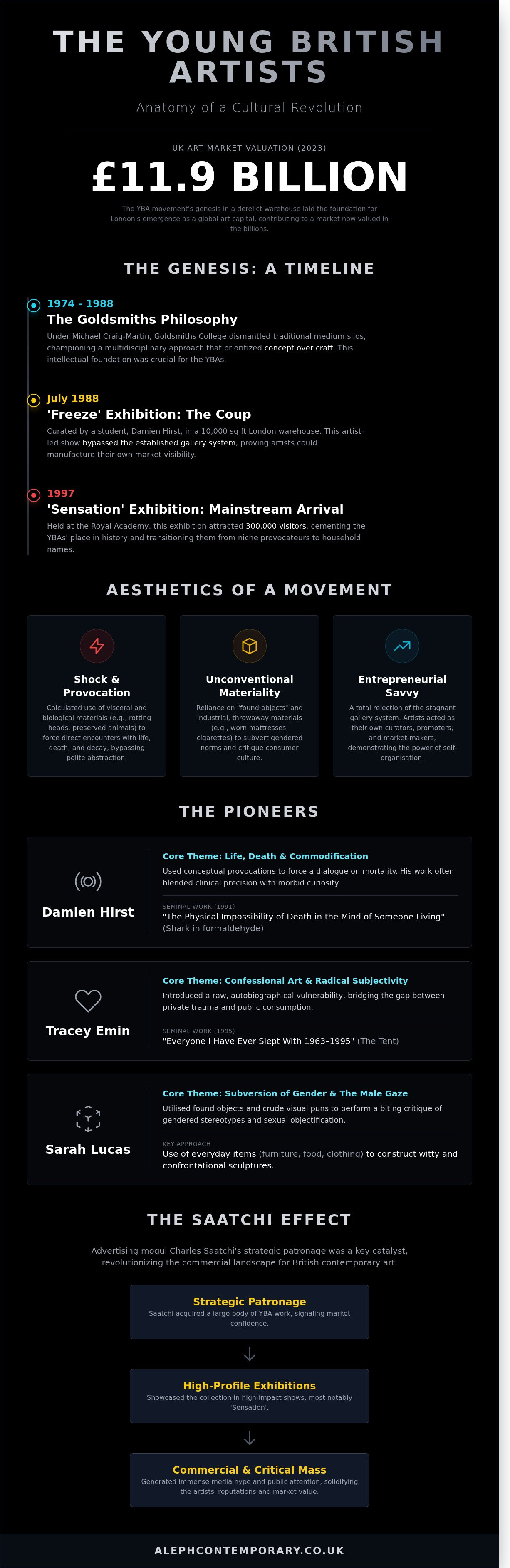
Central to this revolution was the 1988 'Freeze' exhibition, an event that bypassed the traditional gallery-led discovery model entirely. Staged in a 10,000-square-foot Port of London Authority warehouse at Surrey Docks, the show was curated by a second-year student, Damien Hirst. It bypassed the established West End dealers who had long dictated which voices were heard. The movement's rise coincided with the 'Cool Britannia' era, a period of renewed cultural confidence in the UK. This cultural backdrop helped elevate these artists from niche provocateurs to household names, with the 1997 'Sensation' exhibition at the Royal Academy attracting 300,000 visitors and cementing their place in history.
The Goldsmiths Philosophy: Breaking the Medium Silos
The intellectual foundation of the young british artists was forged at Goldsmiths College under the tutelage of Michael Craig-Martin. His pedagogical approach, which he championed throughout his tenure from 1974 to 1988, encouraged a multidisciplinary dialogue that prioritised the concept over the craft. Students weren't siloed into traditional painting or sculpture departments; instead, they were pushed to explore the liminal spaces between media. This shift allowed for a radical interrogation of objects, where a vacuum cleaner or a formaldehyde tank could carry the same weight as a bronze cast. The 'Freeze' exhibition functioned as the definitive pivot point for independent curation in 1988, proving that artists could manufacture their own market visibility without institutional permission.
Key Figures: Hirst, Emin, and the First Wave
The first wave of the young british artists was defined by a visceral engagement with the human condition and the limits of the physical world. Their work didn't just sit in a room; it demanded a reaction, often through a blend of morbid curiosity and clinical precision. The following figures were instrumental in defining this aesthetic:
- Damien Hirst: His early installations, such as the 1991 shark preserved in formaldehyde, used conceptual provocations to force a dialogue regarding life, death, and the commodification of the soul.
- Tracey Emin: She introduced a radical subjectivity to the movement, using confessional art like her 1995 piece Everyone I Have Ever Slept With 1963-1995 to bridge the gap between private trauma and public consumption.
- Sarah Lucas: Lucas utilised found objects and industrial materials to perform a biting subversion of gendered materiality, often using everyday items to critique the male gaze.
Aleph Contemporary recognises that these artists didn't just create objects; they created a new language for contemporary practice. They understood that the gesture of the artist is as much about the context of the display as it is about the work itself. Their legacy remains a testament to the power of self-organisation and the enduring relevance of art that refuses to be polite.
Aesthetics of Provocation: Shock Tactics and Found Objects
The young british artists redefined the gallery space as a site of visceral interrogation. By utilising biological materials, such as the rotting cow’s head in Damien Hirst’s 1990 installation A Thousand Years, these practitioners forced a direct encounter with the liminal space between life and death. This wasn't merely a quest for notoriety. It was a calculated use of shock to bypass the institutional gatekeepers who had long curated the British art scene through a lens of polite, detached abstraction. The movement’s reliance on industrial or throwaway materials, like Sarah Lucas’s use of worn mattresses or Tracey Emin’s inclusion of personal detritus, served as a biting critique of late-twentieth-century consumerism. By elevating the mundane or the grotesque to the status of high art, they challenged the very definition of aesthetic value. The YBAs' impact on the art world remains visible in how contemporary spaces now balance conceptual depth with raw, physical presence.
Materiality and the Found Object
The lineage from Marcel Duchamp’s readymades to the young british artists is direct yet amplified by a new sense of scale and consequence. Hirst’s 1991 work, The Physical Impossibility of Death in the Mind of Someone Living, featured a 4.3-metre tiger shark preserved in formaldehyde. The sheer volume of the vitrine created a gestural quality that transcended mere sculpture; it became an immersive environment. This sensory impact, often involving the clinical smell of chemicals or the coldness of steel, demands a physical response from the viewer. It's an exploration of materiality that refuses to remain static or purely decorative. Aleph Contemporary continues to champion works that engage with this specific dialogue between the physical object and its metaphysical implications. Collectors looking for works with such enduring cultural significance can explore the gallery's latest acquisitions online.
The Language of British Post-Modernism
Irony and dark humour became the primary linguistic tools for this generation. They rejected the ivory tower academicism that defined the 1970s, opting instead for a visual language that felt accessible yet intellectually corrosive. Critics often argued that shock value indicated a lack of craftsmanship, but this perspective misses the point. The craft lay in the orchestration of the concept and the precision of the presentation. In the 1997 Sensation exhibition at the Royal Academy, the meticulous arrangement of found objects demonstrated a rigorous attention to detail. These artists didn't lack skill; they simply redirected it toward the interrogation of the object itself. The gallery observes that this discourse shifted the focus from the hand of the artist to the mind of the viewer. This created a tension between high-concept philosophy and low-brow visual cues that remains central to the British contemporary art market today.
The Saatchi Effect and the Commercial Revolution
Charles Saatchi did more than merely collect; he manufactured a market through sheer force of capital and advertising acumen. His background as a co-founder of Saatchi & Saatchi allowed him to apply aggressive branding techniques to the conceptual output of the Young British Artists (YBAs). By purchasing entire graduation shows and warehouse exhibitions, Saatchi provided the liquidity that the stagnant 1980s London art scene lacked. He acted as both patron and market-maker, creating a feedback loop where media controversy directly inflated the valuation of his holdings. This wasn't just patronage; it was a sophisticated interrogation of how value is constructed in the public consciousness.
The 1997 'Sensation' exhibition at the Royal Academy of Arts marked the movement's commercial zenith. It drew over 300,000 visitors, a staggering figure for a contemporary art show at the time. The exhibition's success was built on a deliberate friction between high culture and tabloid provocation. Works like Marcus Harvey’s 'Myra' and Damien Hirst’s shark became household talking points, shifting the discourse from the gallery floor to the front pages of national newspapers. This media obsession birthed the 'Britart' phenomenon, where the artist’s persona became as tradeable as the work itself. London’s status changed almost overnight. The city transitioned from a provincial outpost of the New York-centric art world into a vibrant global centre, eventually leading to the opening of Tate Modern in May 2000.
The rise of the artist-as-celebrity redefined the professional trajectory for creative practitioners in the UK. Young british artists like Tracey Emin and Sarah Lucas didn't shy away from the limelight; they occupied it. This visibility ensured that contemporary art was no longer a niche pursuit for the elite but a central pillar of British 'Cool Britannia' culture. The commercial revolution was total, replacing the quiet reverence of the past with a loud, unapologetic marketplace.
The Entrepreneurial Artist Model
The YBAs rejected the passive role of the waiting artist. Starting with the 1988 'Freeze' exhibition, they curated their own shows in derelict industrial spaces, bypassing traditional gallery hierarchies. This 'can-do' attitude was paired with a keen sense of branding that treated the artwork as a luxury commodity. The YBAs turned the art market itself into a medium of expression by treating price tags and auction records as integral components of the work's conceptual weight.
Becoming the New Establishment
Transitioning from warehouse outsiders to the heart of the institution happened with remarkable speed. The Turner Prize played a vital role, with wins for Damien Hirst in 1995 and Gillian Wearing in 1997 cementing their status. Today, these artists are Royal Academicians and 'Blue Chip' staples. Their market performance remains robust; Hirst’s 2008 'Beautiful Inside My Head Forever' auction at Sotheby’s raised a record-breaking £111 million, proving the movement's enduring commercial legacy.
- 1988: Damien Hirst curates 'Freeze' in a London Docklands warehouse.
- 1992: The first 'Young British Artists' exhibition is held at the Saatchi Gallery.
- 1997: 'Sensation' opens at the Royal Academy, attracting 300,000 visitors.
- 2008: Hirst bypasses galleries to sell directly at auction, netting £111 million.
Collecting in the Wake of the YBAs: Legacy and Lineage
The shadow cast by the 1988 Freeze exhibition remains long; its influence has matured from adolescent rebellion into a sophisticated framework for contemporary acquisition. Collectors today don't merely seek the shock value that defined the young british artists during the 1990s. They look for the intellectual residue of that era: a specific brand of audacity coupled with a rigorous interrogation of what constitutes an art object. This "YBA DNA" manifests in a preference for works that bridge the gap between conceptual coldness and visceral, tactile reality. Recent market data from 2023 indicates that while blue-chip names like Tracey Emin continue to break records, with her 2022 sale of "Like a Cloud of Blood" reaching £2.3 million, the real movement is occurring in the primary market. Here, a new generation adopts the DIY ethos of their predecessors while refining the aesthetic output for a more contemplative audience.
The current UK collecting landscape prioritises artists who maintain a dialogue with the past without being tethered to it. Aleph Contemporary identifies this lineage in creators who treat the canvas as a site of physical struggle. The legacy of the 1990s isn't found in pickled sharks but in the permission granted to artists to be unapologetically British, messy, and brilliant. This shift has transformed the gallery space into a laboratory for cultural enquiry where the value of a piece is measured by its ability to provoke a sustained intellectual response rather than a momentary gasp.
The Evolution of British Figurative Art
The raw honesty of the 1990s revolutionised how we perceive the human form. It stripped away the polite veneers of traditional portraiture to reveal something more urgent and fractured. This heritage is visible in our current figurative art collections, where the body is often presented as a vessel for psychological exploration rather than a mere subject of anatomical study. Painting has seen a significant resurgence as a vital medium for contemporary discourse. In 2023, figurative works accounted for a substantial 42% of contemporary art sales in London galleries, reflecting a desire for art that feels grounded in the human condition. These modern practitioners use the "honest" brushwork championed by the YBAs to navigate themes of identity and presence in an increasingly digital world.
Abstract Explorations and Post-YBA Materiality
Materiality remains a central interrogation for the modern British painter. The dialogue between 90s conceptualism and today's abstract art is defined by a shared obsession with the physical properties of the medium. It's no longer enough for a work to be "about" something; it must "be" something. Collectors seeking quality and originality should look for works where the process is visible and the materials themselves contribute to the narrative. Whether it's the use of industrial pigments or the layering of unconventional resins, the tactile surface of the work becomes a liminal space where the artist’s intent meets the viewer’s perception. This focus on the "objecthood" of the painting ensures that the work maintains its power across decades, offering a depth that transcends fleeting trends.
To explore works that continue this prestigious lineage of British innovation, view the latest acquisitions at Aleph Contemporary.
Aleph Contemporary: Continuing the British Art Dialogue
Aleph Contemporary functions as a vital conduit between the provocative legacy of the young british artists and the emerging practitioners of the 2020s. While the YBAs disrupted the 1990s art market with visceral materiality and shock tactics, the gallery focuses on a more contemplative interrogation of the liminal. This approach ensures a rigorous continuity in the British art discourse. The gallery champions artists who refuse to separate technical skill from philosophical inquiry. It's a commitment to work that possesses both immediate visual impact and a slow-release intellectual depth. The selection process prioritises artists who engage with the temporal and the tactile, ensuring each piece resonates with a sense of historical awareness and future potential.
The gallery operates as a bridge between the artist’s studio and the discerning collector. This relationship is built on a foundation of analytical precision and a shared appreciation for the poetic nuances within modern practice. By positioning itself as a sophisticated cultural interlocutor, Aleph Contemporary avoids the fleeting trends of the broader market; instead, it identifies works with enduring cultural significance. This perspective is essential for those looking to understand how the radical energy of the young british artists has been distilled into the nuanced, high-level conversations of the present day. The gallery invites a high-level dialogue about materiality and the human condition, fostering a connection that transcends mere acquisition.
Curating the Next Chapter of British Art
The gallery’s roster reflects a deliberate selection of artists who balance formal dexterity with conceptual weight. By offering a diverse range of mediums, including oil paintings and sculpture, Aleph Contemporary supports the evolution of traditional craft into contemporary contexts. These artists often explore the same tensions between the domestic and the monumental that defined the previous generation's output. They push the boundaries of their chosen materials to reflect 21st-century anxieties. This curation provides a platform for voices that challenge the status quo through nuanced artistic statements. The focus remains on artists who demonstrate a mastery of their medium while interrogating the very structures of visual language.
Investing in the Future of British Creativity
The creative centre of gravity has shifted in recent years. While London remains a commercial powerhouse, regions like the Cotswolds and Stroud have emerged as essential hubs for serious practice in 2024. Aleph Contemporary leverages this regional energy to identify talent before it reaches the saturation point of the capital's market. Collectors can participate in this movement at various entry points. The gallery offers everything from accessible prints starting under £500 to major investment-grade canvases. This tiered approach democratises the acquisition of high-calibre art without compromising on the gallery's stringent standards for originality and permanence. It's an invitation to own a piece of the current cultural dialogue and support the longevity of artistic ideas.
- Intellectual Depth: Every work is selected for its ability to sustain long-term inquiry.
- Technical Mastery: The gallery prioritises artists who demonstrate exceptional control over their chosen medium.
- Regional Insight: By focusing on hubs like Stroud and the Cotswolds, the gallery uncovers voices often overlooked by the London-centric mainstream.
- Diverse Acquisition: Options range from entry-level editions to significant primary market works.
The gallery's role is that of a visionary guide, helping collectors navigate the complexities of the modern art world with confidence. Whether you're a seasoned aesthete or a new collector, the focus remains on the transformative power of the object. We invite you to explore our curated selection of British contemporary artists and discover the works that are defining our present moment.
The Future of the British Avant-Garde
The legacy of the young british artists isn't just a historical record; it's a vital force that continues to dictate the trajectory of the global market. Since the 1988 Freeze exhibition initiated a shift toward self-curation, the movement has redefined the relationship between materiality and the viewer. This evolution reached its commercial peak with the 1997 Sensation show, which permanently altered the valuation and accessibility of contemporary practice. Today, the dialogue persists. A new cohort of creators interrogates these established boundaries with renewed intellectual vigour.
Aleph Contemporary serves as a sophisticated interlocutor in this ongoing narrative, operating from its base in the historic art hub of Stroud, Gloucestershire. The gallery maintains a meticulously curated selection of museum-quality works that honour the provocative spirit of the past while championing technical excellence. To support the growth of private and institutional collections, the gallery provides complimentary delivery within the UK on all acquisitions. This commitment ensures that the transition from the artist's studio to the collector's space is as seamless as it is significant.
Discover original works by the next generation of British contemporary artists at Aleph Contemporary and engage with the enduring power of the British avant-garde.
Frequently Asked Questions
Who were the core members of the Young British Artists?
Damien Hirst, Tracey Emin, Sarah Lucas, and Gary Hume represent the movement's foundational core. These practitioners emerged from Goldsmiths College, where the 1988 Freeze exhibition unified their disparate voices into a singular, disruptive force. Aleph Contemporary observes that these artists transitioned from student radicals to global icons. Their work remains a cornerstone of the secondary market, with Hirst’s 1991 shark installation serving as a definitive archetype of the era.
Why was the 1988 Freeze exhibition so significant for British art?
The Freeze exhibition of July 1988 served as the catalyst for a radical shift in the British art ecosystem. Curated by Damien Hirst in a derelict London Port Authority building, the show featured 16 students who bypassed traditional gallery gatekeepers. This act of self-institutionalisation challenged the established hierarchies of the late 1980s. It effectively decentralised the power of the London art scene, creating a new model for artist-led initiatives that persists today.
What are the defining characteristics of the YBA style?
The young british artists are defined by an unapologetic engagement with materiality and a penchant for the readymade object. Their aesthetic often explores the liminal space between life and death through industrial processes. One might look at the 1990s use of formaldehyde or domestic detritus as evidence of this tactile discourse. This movement prioritised conceptual clarity over traditional craftsmanship, utilising shocking imagery to interrogate the human condition and consumerist culture.
How did Charles Saatchi influence the success of the Young British Artists?
Charles Saatchi transformed the movement’s trajectory through his 1992 exhibition series and the landmark 1997 Sensation show at the Royal Academy. As a prolific collector, Saatchi provided the financial infrastructure and marketing acumen that propelled these artists into the global consciousness. His purchase of Hirst’s shark for £50,000 in 1991 set a precedent for the high-value transactions that now define the contemporary market. His patronage was instrumental in establishing their institutional permanence.
Is shock value the only goal of YBA art?
Shock isn't the final objective but rather a gateway to deeper interrogations of mortality and identity. While Hirst’s bisected animals or Emin’s My Bed (1998) garnered tabloid headlines, these works function as profound memento mori. They challenge the viewer to confront the visceral reality of the body and the transience of existence. The gallery views these provocations as essential components of a philosophical dialogue that transcends mere sensationalism or temporary media attention.
How has the YBA movement influenced the current British art market?
The legacy of the movement is visible in the £2.5 billion annual turnover of the UK art market as recorded in recent industry reports. These artists established London as a primary global hub, paving the way for the 2003 launch of Frieze London. Their success created a robust secondary market where works frequently exceed their original estimates at auction. This period of intense creativity redefined the commercial potential of British art for a generation.
Are the Young British Artists still relevant in 2026?
The young british artists maintain significant relevance in 2026 as their works have transitioned into the category of blue-chip investments. Recent auction data from 2025 shows sustained demand for 1990s-era pieces, with prices for major works often exceeding £1,000,000. Their influence persists through the pedagogical frameworks of British art schools and the continued dominance of their conceptual strategies. They aren't just historical figures; they're the architects of the contemporary aesthetic landscape.
Can I still buy works by artists associated with the YBA movement?
Collectors can acquire works by these artists through major auction houses like Sotheby’s and Christie’s or specialist secondary market galleries. While primary market access is now limited, prints and editions from the 1990s remain accessible for those entering the market at lower price points. A 1995 Hirst print might fetch £5,000, whereas a major installation can command several million pounds. Aleph Contemporary recommends rigorous provenance checks to ensure the long-term value of these acquisitions.

