
Could the most intellectually rigorous moment in an artist's practice be found not in the grandiosity of a canvas, but in the quiet, silvered friction of a lead point? For too long, the discerning collector has been told that pencil & graphite works are merely the scaffolding of a masterpiece; a transient, preparatory stage in a larger discourse. It's a common sentiment that treats the drawing as a fragment, yet this perspective ignores the profound materiality and permanence that modern graphite offers.
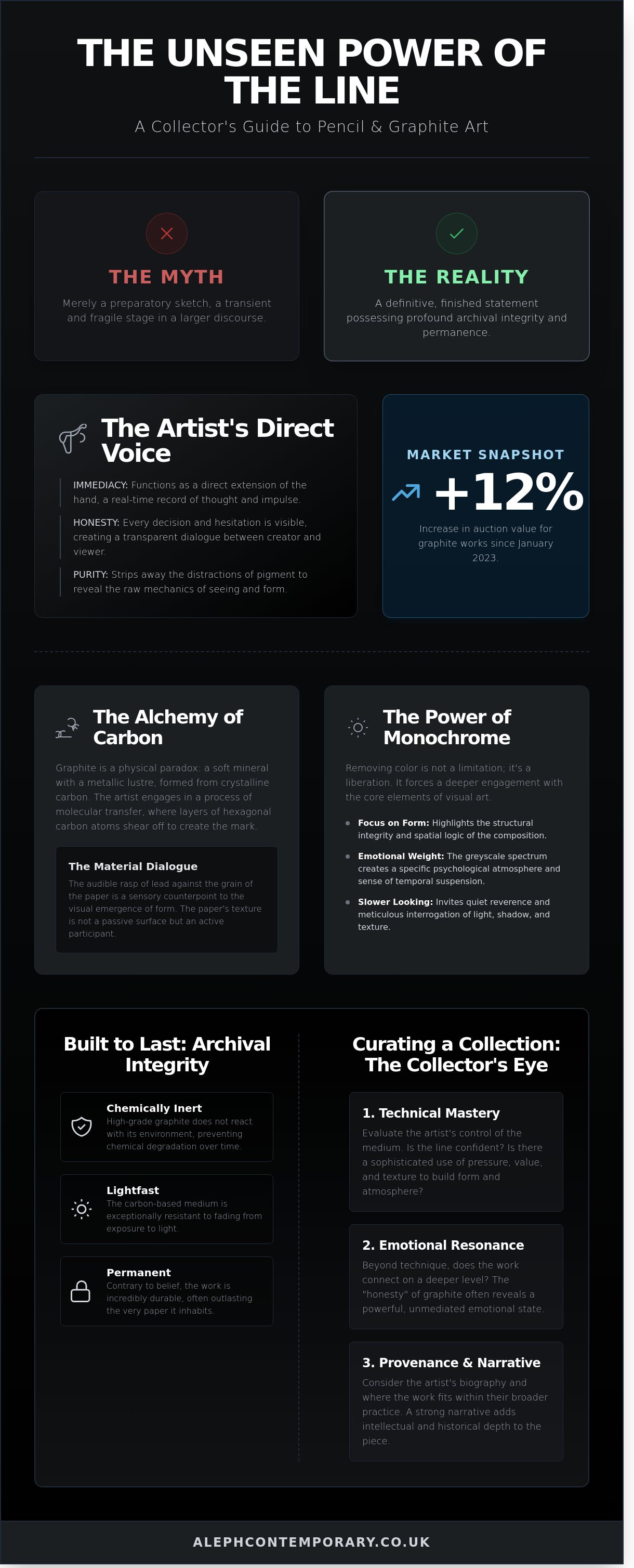
We agree that the perceived fragility of a sketch can feel daunting when compared to the heavy impasto of tradition. However, we'll explore how these works possess an archival integrity that rivals any other medium. In fact, high-grade graphite is chemically inert and lightfast, often outlasting the very paper it inhabits. In this interrogation of the line, you'll learn to evaluate the gestural intent of contemporary artists and understand why the market for these works has seen a 12% increase in auction value since January 2023. We'll move from the technical nuances of the mark to the sophisticated curation of a collection that celebrates the pencil as a definitive, finished statement.
Key Takeaways
- Appreciate the "honesty" of the graphite line as a definitive medium, transcending the preparatory sketch to reveal the artist’s unmediated thought and technical precision.
- Examine the alchemical materiality of pencil & graphite works, from the crystalline structure of carbon to the way specific paper textures influence the movement of the line.
- Gain professional insight into curating a contemporary collection by evaluating technical mastery, emotional resonance, and the provenance of the artist’s biographical narrative.
- Discover how Aleph Contemporary champions visionary artists who are currently redefining the poetic boundaries and intellectual discourse of this timeless medium.
The Primacy of the Mark: Defining Pencil & Graphite Works
The pencil remains the most visceral conduit between human consciousness and the tangible surface. It functions as a direct extension of the hand. While paint often requires a medium or a drying time, graphite responds instantly to the artist's pulse. This immediacy creates a record of thought in real-time. We find ourselves witnessing the very moment an idea takes form. It's a dialogue of pressure and friction that reveals the artist's internal state without the mediation of complex tools.
Historically, the distinction between a working sketch and a finished piece was rigid. The 16th-century masters viewed drawing primarily as disegno, a concept meaning both drawing and the intellectual design that forms the backbone of art. In this tradition, the pencil was a structural blueprint for later works in marble or oil. This perception changed significantly by the late 19th century as artists began to treat the paper as a final destination. In the 21st century, Graphite has transcended its utilitarian roots. It's now a medium capable of immense scale and profound complexity, standing alone as a definitive statement of intent.
What are Pencil & Graphite Works in Fine Art?
In the context of contemporary practice, these works represent a sophisticated exploration of value, line, and texture. The mark is everything. It's the artist's unique signature, as distinct as a fingerprint. Whether it's a soft, atmospheric smudge or a sharp, architectural line, the mark defines the spatial logic of the piece. Graphite works are the purest distillation of artistic vision. They strip away the distractions of pigment to reveal the raw mechanics of seeing. This clarity allows for a meticulous interrogation of the subject matter that colour can sometimes obscure.
The Enduring Appeal of the Monochrome
Removing colour isn't a limitation. It's a liberation. By discarding the emotional bias of the spectrum, the artist forces us into a deeper engagement with the interplay of light and shadow. We notice the subtle gradations of silver and charcoal. We see how a single stroke can suggest a three-dimensional volume. This tonal restraint creates a specific psychological weight, especially in contemporary portraiture. The greyscale spectrum allows for a focus on the structural integrity of the composition rather than its decorative surface.
In figurative art, the absence of colour highlights the vulnerability of the subject. It creates a sense of temporal suspension. The work feels both ancient and modern. To understand how these linear techniques build complex narratives, you can explore our figurative collection to see how line defines form. The greyscale palette demands a slower kind of looking. It invites a quiet reverence for the materiality of the paper and the precision of the artist's intent.
Modern collectors often find that pencil & graphite works offer a clarity that's hard to find elsewhere. There's no hiding behind a vibrant wash or a thick impasto. Every decision is visible. Every correction is a part of the history of the object. This transparency is what gives the medium its enduring power. It's an honest dialogue between the creator and the viewer, mediated only by a thin layer of carbon. The pencil doesn't lie. It records the artist's breath, their hesitation, and their ultimate triumph over the blank page. This makes the medium one of the most intellectually honest forms of expression available to the contemporary aesthete.
Materiality and Metaphysics: The Alchemy of Carbon
Graphite exists as a physical paradox. It's a crystalline form of carbon that yields a metallic lustre under direct light, yet it possesses a softness that allows it to surrender to the surface of a page. This transition from a raw mineral to a refined expression represents a fundamental shift in human mark-making. When an artist engages with pencil & graphite works, they're participating in a process of molecular transfer. The hexagonal lattice of the carbon atoms, arranged in layers, shears off under the slightest pressure. This creates a sensory dialogue; the audible rasp of the lead against the grain of a 300gsm cold-pressed paper provides a rhythmic counterpoint to the visual emergence of the form. In The Power in Your Pencil, the transition from raw earth to ethereal thought is documented as a defining characteristic of the medium's unique versatility.
The resistance of the paper's fibre determines the character of the line. A heavy "tooth" or texture acts as a microscopic abrasive, catching the carbon and creating a gritty, gestural mark. Conversely, smooth Bristol board allows for a fluid, almost frictionless movement. This relationship between the lead and the substrate is where the metaphysics of the medium reside. Graphite is a liminal substance; it's part ancient mineral and part fleeting thought. It doesn't sit on the surface like oil paint. Instead, it embeds itself within the fibres, creating a material presence that feels inseparable from the support itself.
Comparing Drawing Media: Graphite vs. Charcoal vs. Silverpoint
| Feature | Graphite | Charcoal | Silverpoint |
|---|---|---|---|
| Precision | High; surgical detail | Low; broad, gestural | Extreme; hair-thin |
| Tonal Range | Wide (9H to 9B) | Deep, matte blacks | Narrow; light greys |
| Erasability | High; versatile | Moderate; smudges | Permanent; indelible |
| Historical Context | Post-1564 (Borrowdale) | Prehistoric / Ancient | Renaissance peak |
Contemporary artists often favour graphite for its interrogative capacity. Unlike the deep, light-absorbing matte of charcoal, high-grade graphite reflects light, giving it a distinct "silver" sheen. This reflective quality allows the work to shift in appearance as the viewer moves through the gallery space. The drawing becomes a temporal experience. It's an active exchange rather than a static image. This specific lustre distinguishes pencil & graphite works from the more traditional, opaque mediums, offering a luminous depth that invites closer inspection.
The Artist's Process: From H to B
The hardness scale, patented by Nicolas-Jacques Conté in 1795, dictates the ratio of graphite to clay. A 9H pencil contains a high percentage of clay, allowing for surgical precision and a light, silvery touch. A 9B pencil is rich in carbon, producing velvet depths and a soft, crumbly texture. Artists don't merely draw; they organise space through tonal layering. By applying varying degrees of pressure, the practitioner forces the carbon into the paper's grain, creating a sense of weight and volume.
This structural approach is central to the curated selections at Aleph Contemporary, where the line is treated as a site of philosophical inquiry. The artist's gesture is recorded with absolute fidelity. Every hesitation, every burst of speed, and every deliberate layer of tone is visible. This transparency of process builds a material presence that feels both grounded and incredibly fragile, capturing the very essence of the artist's hand in real-time.
Beyond the Preparatory: Graphite as a Definitive Medium
For centuries, the prevailing hierarchy of the art world relegated pencil & graphite works to the status of mere rehearsals or skeletal blueprints for "greater" pursuits in oil or marble. This reductive view, which positions drawing as a secondary discipline, ignores the profound vulnerability and technical rigour inherent in the monochromatic line. A painter can mask a structural error with a strategic glaze or a heavy impasto; a draughtsman possesses no such luxury. There's a stark honesty in the medium. Every mark remains a definitive statement of intent, leaving the artist with nowhere to hide a weak line or a hesitant gesture. This transparency is precisely why contemporary collectors have begun to view the medium with renewed reverence.
The landscape of international gallery exhibitions has shifted to reflect this appreciation for graphite as a primary mode of discourse. We've seen a significant rise in large-scale works that command the same physical and intellectual space as traditional canvases. For instance, the 2017 exhibition "The American Dream: Pop to Present" at the British Museum showcased how the humble pencil could carry the weight of complex social narratives. Artists like Robert Longo have pushed this even further, producing monumental works that have achieved auction prices exceeding £1,500,000 at major London houses. These are not studies; they're finished interrogations of power, materiality, and the human condition. The scale of these pieces demands a physical engagement from the viewer, forcing an acknowledgement of the pencil's capacity for immense drama and tonal depth.
The Intellectual Weight of the Drawing
The pencil allows for a temporal recording of the artist's cognitive process that few other media can replicate. When we observe a drawing, we aren't just viewing a static image; we're witnessing a chronological map of decision-making. Each stroke represents a choice, an erasure, or a moment of hesitation, transforming the paper into a site of active inquiry. It's a finished interrogation rather than a simple study. To see this in practice, you can discover abstract works that utilise line to explore these complex themes of presence and absence. The drawing functions as a direct bridge between the artist’s interior logic and the external world, offering a sense of intimacy that is both raw and intellectually demanding.
Archival Quality and Longevity
Collectors often harbour a misplaced anxiety regarding the fragility of paper-based art. It's a common myth that needs debunking. Graphite is essentially crystalline carbon, which is one of the most chemically stable substances on the planet. Unlike oil paints, which can suffer from delamination or yellowing as they age, pencil & graphite works are remarkably resistant to atmospheric degradation. When an artist utilises 300gsm acid-free, 100% cotton rag paper, the work possesses an archival life that spans centuries. Modern conservation techniques, including the use of high-grade synthetic resin fixatives and UV-filtered glazing, ensure these pieces remain pristine. Data from the Victoria and Albert Museum’s conservation department confirms that carbon-based drawings are among the most resilient items in their collection, provided they're housed in stable environments.
Curating a Collection: How to Buy Pencil & Graphite Works
Acquiring pencil & graphite works requires a shift in the collector's internal rhythm. Unlike the immediate, chromatic impact of an oil painting, drawing demands a slower form of engagement; it's a quiet dialogue between the artist's hand and the surface of the paper. When you evaluate a piece for your collection, technical mastery should be your primary metric, yet this must be balanced with emotional resonance. Look for the artist's unique mark-making. Does the graphite sit on the surface, or has it been pressed into the fibres with a density that suggests a physical struggle? The most compelling works often inhabit a liminal space between the seen and the felt.
Provenance and the artist's biographical narrative provide the essential scaffolding for any serious acquisition. A drawing isn't merely a preliminary sketch; in a contemporary context, it's a finished interrogation of an idea. Investigate the artist’s history, looking for consistent themes or a rigorous dedication to the medium. This context transforms a simple arrangement of lines into a significant cultural artefact. Collectors should seek out artists who treat drawing as a primary discipline rather than a secondary thought. This commitment ensures the work maintains its intellectual and financial value over time.
Evaluating the Work: A Collector's Checklist
Begin by scrutinising the gestural quality of the piece. A line should feel alive, possessing a temporal energy that suggests the movement of the hand across the page. If the marks feel static or overly laboured, the work may lack the necessary vitality. Next, consider the compositional balance. Contemporary masters of graphite often use negative space as a structural element, allowing the untouched paper to breathe and hold equal weight to the marks themselves. Finally, examine the materiality. Observe how the artist has manipulated the graphite; whether through delicate silver-grey washes or heavy, obsidian-like burnishing that creates a metallic sheen. These physical attributes define the work’s presence in a room.
Framing and Displaying Works on Paper
The preservation of pencil & graphite works is paramount, as paper is inherently more sensitive to environmental shifts than canvas. You must use UV-protective glass, specifically museum-grade glazing that offers at least 99% UV protection, to prevent the paper from yellowing or the graphite from losing its subtle tonal range. Archival mounting is non-negotiable. Ensure the artist or framer uses acid-free, 100% cotton rag boards to avoid chemical degradation. For those beginning their journey, you can shop artworks under £1, 000 to find accessible entry points that don't compromise on artistic integrity.
Float mounting has become the preferred aesthetic choice for contemporary drawings. By suspending the paper away from the backing board, the viewer can appreciate the deckled edges and the natural undulations of the material. This method emphasises the work as a three-dimensional object rather than a flat image. When integrating these pieces into a broader collection, place them in a dialogue with heavier media. A delicate graphite drawing can provide a necessary pause between dense oils or vibrant mixed media works, creating a curated rhythm that encourages the 'slow looking' so vital to the appreciation of fine art. This contrast highlights the specificities of each medium, allowing the subtle power of the line to hold its own against the weight of colour.
Explore our curated selection of contemporary drawings and find a piece that resonates with your aesthetic vision. View the full collection at Aleph Contemporary today.
Discovering Contemporary Graphite at Aleph Contemporary
Aleph Contemporary remains steadfast in its dedication to artists who command the poetic nuance of the line. We view the gallery not merely as a commercial space but as a site of active intellectual inquiry where curated exhibitions interrogate the very essence of materiality. Our focus on pencil & graphite works stems from a belief that the simplest tools often yield the most profound psychological resonance. By championing creators who push the medium beyond its traditional preparatory role, we invite collectors to engage with the temporal and gestural depth of contemporary drawing. Our exhibitions are framed as interrogations of specific themes, positioning the gallery as a laboratory for the visual language of the international art world. We don't chase fleeting trends; we identify works with the potential for historical longevity and lasting cultural impact.
The Aleph Selection: A Dialogue of Styles
The artists within our roster navigate a constant tension between classical tradition and radical innovation. They use the silvered sheen of graphite to explore themes of memory, history, and the fragility of the human condition. For instance, the meticulous mark-making found in our current collection challenges the viewer to reconsider the liminal space between reality and abstraction. This discourse between the artist's hand and the paper's surface creates a lasting cultural document. These pencil & graphite works are not merely sketches; they are finished statements of intent that record the physical pressure and rhythmic movement of the creator. The dialogue between different artists in our collection creates a tapestry of technical mastery, where the graphite becomes a vehicle for philosophical exploration. Collectors often find that the monochromatic spectrum offers a clarity of vision that colour sometimes obscures. You can browse our full Pencil & Graphite collection to witness these varied approaches firsthand.
Acquiring Art with Confidence
Collecting works on paper represents a visionary step for the discerning collector. These pieces offer an intimate glimpse into the artist's primary thought process, often possessing a raw energy that larger oils might lack. Aleph functions as a sophisticated cultural interlocutor, ensuring that every acquisition is backed by curatorial rigour. Our online shop facilitates this process with ease, offering complimentary UK delivery on all orders to ensure your new work arrives securely. We understand that the modern collector values both depth of substance and the convenience of a seamless digital experience. By providing detailed provenance and high-resolution documentation, we remove the barriers to ownership. Whether you're a seasoned aesthete or a new enthusiast, our team provides the analytical precision required to guide your journey. We believe the silent exchange between the viewer and the object is a transformative experience. To stay informed about our latest exhibitions and private views, please register for our newsletter to be the first to view new graphite acquisitions. This connection allows you to build a collection that possesses enduring significance while supporting the longevity of artistic ideas.
Engaging with the Permanent Mark
The transition from a preparatory sketch to a standalone masterpiece represents a vital shift in how we perceive the materiality of carbon. These pencil & graphite works aren't merely beginnings; they're the culmination of a sophisticated artistic discourse that explores the liminal space between thought and form. By moving beyond the ephemeral nature of the initial mark, contemporary artists create a rhythmic complexity that invites deep, unhurried looking. It's a testament to the medium's enduring power that such a simple tool can yield such profound intellectual depth and metaphysical weight.
Aleph Contemporary provides a bridge for the discerning collector, offering access to works selected by our 3 internationally recognised art experts who prioritise artists with over 20 years of demonstrated cultural impact. We ensure the acquisition process is as seamless as the art is evocative, providing complimentary UK delivery on all original works to protect the integrity of your investment. It's an opportunity to anchor your collection with pieces that possess both technical precision and a timeless, poetic resonance. We invite you to begin your journey of discovery with us today.
Explore our curated selection of Pencil & Graphite Works
Frequently Asked Questions
Are pencil and graphite works the same thing?
In the contemporary art market, curators often use these terms interchangeably, though they technically refer to the same carbon-based materiality. While "pencil" suggests the wooden casing of the tool, "graphite" honours the pure mineral substance discovered in Cumbria circa 1564. Discerning collectors of pencil & graphite works recognise that the term graphite often denotes a more professional, archival intent in the artist's practice. It’s a distinction that elevates the medium from a mere sketch to a finished interrogation of form.
Do graphite drawings fade over time if exposed to light?
Graphite is inherently lightfast because it consists of stable crystalline carbon that doesn't suffer from the photochemical degradation seen in organic pigments. On the Blue Wool Scale, which measures lightfastness from 1 to 8, graphite consistently achieves the maximum rating of 8. It’s the paper substrate that remains vulnerable. If you display a work on non-archival paper in direct UV light, the background will yellow within 24 months, even if the silver-grey marks remain unchanged.
Why are some pencil works more expensive than paintings?
The valuation of a drawing rests on its historical resonance and the singular prestige of the artist’s hand. In 2022, a graphite study by a prominent British figurative artist achieved a hammer price exceeding £2,500,000 at a London auction, surpassing many oil canvases. This price reflects the rarity of a master's line and the intellectual intimacy of the medium. Collectors often pay a premium for the raw, unedited dialogue found in these pencil & graphite works because they represent the artist’s purest thought process.
How should I clean the glass on a framed graphite work?
You should only clean the glazing with a soft, lint-free microfibre cloth and a specialist pH-neutral glass cleaner. Never spray any liquid directly onto the frame; instead, apply a small amount of 70% isopropyl alcohol solution to the cloth first. This prevents moisture from seeping under the rebate and damaging the paper's delicate fibres. If the work is protected by acrylic instead of glass, use an anti-static cleaner to avoid attracting dust that could settle on the drawing's surface.
What is the best way to store unframed works on paper?
Unframed works require a controlled environment with a stable temperature between 18 and 22 degrees Celsius and relative humidity of 50%. You should house them flat within acid-free Solander boxes, ensuring each piece is interleaved with pH-neutral glassine paper to prevent graphite transfer. Never use PVC sleeves, as they release harmful gases that degrade paper over a 10 year period. Meticulous storage preserves the liminal qualities of the line and protects the structural integrity of the 100% cotton rag paper.
Can graphite be combined with other media like watercolour?
Artists frequently layer graphite with watercolour or gouache to create a sophisticated dialogue between linear precision and fluid pigment. This hybridity allows for a rich interrogation of texture, where the metallic sheen of the carbon resists the aqueous washes. Contemporary practitioners often employ this technique to bridge the gap between drawing and painting. It’s a practice that dates back to the 18th-century English school of tinted drawings, where the pencil provides the essential scaffolding for the colour's emotional resonance.
How do I know if a graphite work is an original or a print?
You can verify the authenticity of a work by examining the paper surface under a 10x magnifying loupe to check for the characteristic reflective sheen of the carbon. An original graphite mark creates a slight indentation in the paper fibres and possesses a varying tonal depth that digital printers can't replicate. If you see a consistent pattern of CMYK dots or a flat, matte surface, it’s likely a mechanical reproduction. Genuine works always show a tactile, gestural quality where the lead has physically engaged with the grain.
Is it better to frame pencil works with or without a mount?
Framing with a mount is the superior choice for preservation because it creates a necessary 5mm gap between the artwork and the glass. This space prevents the graphite from smudging against the glazing and protects the paper from condensation damage. You should ensure the mount is 100% museum-grade cotton barrow board to avoid acid burn. While "floating" a work without a mount is a popular aesthetic choice, it requires a hidden spacer to maintain that vital protective distance between the medium and the environment.

