
Imagine you're standing in our light-filled gallery in Stroud, watching the soft Cotswolds sun stream through floor-to-ceiling windows to catch the rich, gestural textures of a fresh oil painting. It's a quiet, transformative moment, yet for many new collectors, that initial spark of connection is often followed by a flicker of uncertainty. You might worry about whether a piece is truly high quality or if a contemporary abstract work will actually suit the atmosphere of your home. Understanding what to look for when buying a painting doesn't have to be a daunting process; it's simply about learning to see with both your heart and a curator's eye.
We've found that the most rewarding acquisitions come from a balance of emotional resonance and technical confidence. You deserve to feel certain that the art you love is also a sound piece of craftsmanship. In this guide, I'll help you discover how to evaluate original artwork through a blend of personal connection, materiality, and professional provenance. We'll explore the specific markers of quality that ensure a work is "easy to live with," giving you the tools to select a piece that offers a lasting, meaningful dialogue within your own collection.
Key Takeaways
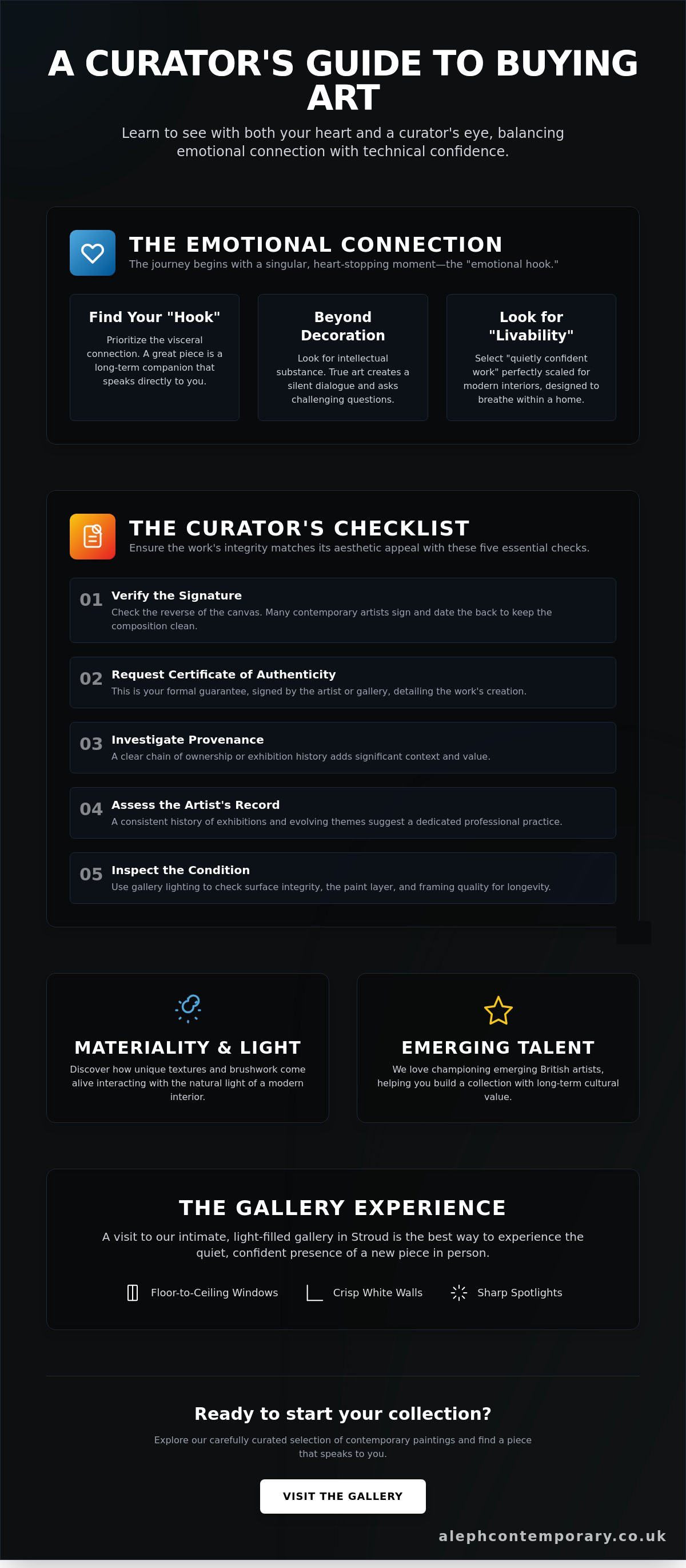
- Learn to prioritize the "emotional hook," selecting works that are "easy to live with" and create a lasting personal connection in your home.
- Master the curator’s technical checklist, including exactly what to look for when buying a painting to verify authenticity and secure professional provenance.
- Discover how the materiality of a work—its unique textures and brushwork—comes alive when interacting with the natural light of a modern interior.
- Find out why we love championing emerging British artists who possess a unique voice, helping you build a collection with long-term cultural value.
- Understand why a visit to our intimate, light-filled gallery in Stroud is the best way to experience the quiet, confident presence of a new piece in person.
The Emotional Connection: Finding a Painting You Can Live With
The journey of collecting art often begins with a singular, heart-stopping moment. It's that instant when a canvas speaks directly to you across a room, sparking a feeling that is difficult to put into words. At Aleph Contemporary, we call this the "emotional hook." While technical details and investment potential are vital, the very first thing to consider when determining what to look for when buying a painting is this visceral connection. A painting is more than just a physical object; it's a long-term companion that will share your daily life and quietest moments. We believe in championing "quietly confident work," pieces that don't shout for attention but instead reveal their layers and nuances over years of looking. It's a relationship that matures. A painting should be a presence that grows with you, shifting in meaning as you experience different seasons of life.
Moving Beyond Decoration
It's tempting to view a painting as a finishing touch for a room, perhaps something to complement a specific colour palette or a particular piece of furniture. However, true art offers something much deeper than mere decoration. There is a profound difference between a "pretty picture" and a work with intellectual substance. When you look at a painting, you should feel the start of a silent dialogue. This is how the most significant history of art collecting has always functioned; it's about the exchange between the viewer and the artist’s ideas. You want to find a piece that challenges you slightly, one that asks questions rather than just providing easy answers. When a work possesses this depth, it moves beyond the ephemeral nature of trends. It becomes a permanent part of your environment’s soul.
The Curator’s Perspective on Livability
Nicholas Wells curated our collection with a specific eye for "livability." This doesn't mean the art is safe or boring. Instead, it means the works are perfectly scaled for modern interiors, designed to breathe within a home rather than overwhelm it. When you are deciding what to look for when buying a painting, trust your initial instinct but look for that enduring quality. We love how abstract paintings can serve as a versatile starting point for new collectors. They offer a sense of space and movement that adapts beautifully to different rooms. In our light-filled gallery in Stroud, visitors often notice how the white walls and sharp spotlights help them visualize how a piece might look in their own environment. It’s about finding that balance between a powerful artistic statement and a work that feels at home in your personal sanctuary.
The Curator’s Technical Checklist: Authenticity and Provenance
While the heart leads the way, the mind requires a different kind of assurance. Understanding what to look for when buying a painting involves a few practical steps that ensure the work’s integrity matches its aesthetic appeal. We believe that professional transparency is the foundation of a robust relationship between a gallery and a collector. When you’re evaluating a potential acquisition, follow these five essential steps to ensure your piece is exactly what it claims to be.
- Verify the signature: Check the reverse of the canvas. Many contemporary artists sign and date the back to keep the visual composition clean and focused on the materiality of the paint.
- Request a Certificate of Authenticity: This document is your formal guarantee. It should be signed by either the artist or the gallery and include specific details about the work’s creation.
- Investigate the provenance: Look for a clear chain of ownership or a documented exhibition history. Even for a new work, knowing it was part of a carefully curated show in our Stroud space adds significant context.
- Assess the artist’s record: A consistent history of exhibitions and a clear evolution of themes suggest a dedicated professional practice.
- Inspect the condition: Use the sharp spotlights of a gallery to check the surface integrity. Look for any inconsistencies in the paint layer or signs of poor framing that could affect the work's longevity.
Why Provenance Matters for New Collectors
Provenance is essentially the biography of the painting. It provides the validity that every serious collector seeks, acting as a bridge between the artist’s studio and your home. At Aleph Contemporary, every piece is carefully vetted before it ever reaches our white walls. We love how this rigorous approach gives our visitors the peace of mind they need to collect with confidence. Buying from an established UK gallery means you aren't just buying an object; you're buying into a verified history that protects your investment for years to come.
Documentation and the Artist’s Hand
A professional Certificate of Authenticity should be more than just a piece of paper. It’s a vital part of the artist’s story, detailing the medium, dimensions, and the specific moment of its creation. Nicholas Wells curated our roster specifically to include artists whose work possesses enduring cultural significance. This focus on the "artist’s hand" ensures that the technical markers of quality are as strong as the conceptual ones. If you're curious about the specific history of a piece, we're always happy to share more about the creators in our oil painting collection.
To further preserve this artistic history, some creators choose to supplement their physical documentation with high-quality multimedia catalogs or video presentations on custom physical media; for professional-grade execution of such materials, Alternate Root offers specialized printing and duplication services that ensure every aspect of the artist’s presentation is handled with care.
Materiality and Light: Assessing the Painting as an Object
Once you’ve established an emotional bond and verified the technical details, it’s time to consider the painting as a physical object. In an increasingly digital world, it’s easy to forget that a canvas possesses a unique "materiality" that a screen simply cannot replicate. When considering what to look for when buying a painting, we always encourage visitors to look closely at the surface. You’ll see the weight of the brushstrokes, the way the artist has built up layers of pigment, and the subtle "gestural" marks that reveal the hand of the creator. This physical presence is what makes a piece feel alive in your home, offering a tactile quality that changes depending on where you stand in the room.
Light is the silent partner of every great artwork. In our light-filled gallery in Stroud, we’ve designed the space with floor-to-ceiling windows and sharp spotlights specifically to show how art reacts to its environment. We love how a painting can appear completely different at eight in the morning compared to four in the afternoon as the soft Cotswolds sun moves across the walls. A truly "quietly confident work" doesn't just sit on the wall; it enters into a dialogue with the light around it, revealing new shadows and depths as the day unfolds. This interaction is a key part of what to look for when buying a painting if you want a piece that remains engaging for years to come.
Oil vs. Acrylic: A Matter of Texture and Depth
The medium an artist chooses fundamentally changes how a work interacts with light. We often find that oil paint works have a rich, slow-drying nature that creates an incredible sense of depth and luminosity. The oil allows for a translucent quality where light seems to glow from within the layers. On the other hand, the acrylic works in our collection offer a different kind of modern vibrancy. Acrylics dry quickly, often resulting in sharp, crisp edges and bold, opaque colours that feel very immediate and contemporary. Both mediums have their own charm, but noticing how the texture of the paint catches the light will help you decide which "voice" suits your interior best.
Scaling Art for Modern Living
Finding a piece that is "perfectly scaled" for your home is essential for creating that intimate exhibition feel. If you aren't sure how a canvas will fit, we suggest the "newspaper template" method. Simply tape together sheets of newspaper to match the dimensions of the painting and place it on your wall. This helps you visualize the physical footprint of the work without the guesswork. Remember that art needs room to breathe; leaving space around a frame allows the work to maintain its presence without feeling crowded. Whether under the focused glow of spotlights or the wash of natural light, a well-scaled painting becomes a natural extension of your living space.
Building a Collection: Emerging Talent and Long-Term Value
Building a collection is a gradual unfolding of your own aesthetic identity. It moves beyond the acquisition of a single object and becomes a narrative told through the works you choose to live with. When considering what to look for when buying a painting with long-term value, we look for artists who demonstrate a unique voice and a dedicated, evolving practice. Nicholas Wells curated our roster to champion those whose work possesses enduring cultural significance, ensuring that even as a new collector, you're investing in ideas that will last. In 2026, we've noticed that collectors are becoming more discerning. According to a 2025 survey, 30% of art collectors reported being more selective with their purchases, a trend that highlights the importance of finding art with genuine substance rather than chasing fleeting market trends.
Our relocation to the light-filled gallery in Stroud has allowed us to create a more intimate environment for this discovery. Surrounded by white walls and bathed in the soft glow from our floor-to-ceiling windows, you can see how an artist's career is built through a consistent exploration of themes. We believe the role of a gallery is to act as a bridge, helping you understand what to look for when buying a painting by providing the context and history behind every brushstroke. This curator-led approach ensures that every piece in our collection is "easy to live with" while maintaining its intellectual weight.
The Joy of Discovery
We love how a little research can transform your appreciation of a piece. Understanding where an artist has exhibited and how their style has matured provides essential context for your collection. It’s about finding a "quietly confident work" that speaks to you personally. For a deeper look at the current landscape, our British Contemporary Artists guide offers a curatorial survey of the UK scene as it stands in 2026. This kind of knowledge helps you build a collection that feels both personal and professional.
Investing in Originality
An original painting offers a depth of materiality that prints simply cannot replicate. There is a specific energy in the way oil or mixed media sits on a canvas, catching the light in ways that a flat reproduction never could. Supporting living artists through a contemporary art gallery in Stroud is incredibly rewarding, and it doesn't always require a massive investment. You can find exceptional works in various price brackets, such as our selection ranging from £1, 000 to £2, 500. Starting with original works is the best way to ensure your collection has a soul.
If you're ready to start your journey, we invite you to browse our carefully curated selection of original works under £1, 000.
The Gallery Experience: Why the Right Environment Matters
The space in which you first encounter a painting often dictates the depth of your connection with it. We believe that art requires a certain kind of silence to be truly heard, and our gallery in Stroud was designed to provide exactly that. When you’re considering what to look for when buying a painting, the physical environment acts as a neutral stage, allowing the work’s materiality and emotional resonance to take center stage. Within our walls, the combination of clean white surfaces and sharp spotlights ensures that every texture and tonal shift is visible. This clarity is essential for new collectors who want to move beyond digital previews and experience the "quiet reverence" that only a physical encounter can provide.
A curator-led approach changes the nature of the acquisition. Instead of a transactional exchange, a visit to Aleph Contemporary becomes a high-level conversation about history, technique, and the human condition. We encourage our visitors to ask questions freely, whether they’re curious about an artist’s specific process or the finer points of what to look for when buying a painting for a particular room. This personal guidance helps bridge the gap between the artist's studio and your own home, ensuring that the piece you select is one you’ll continue to cherish as it matures on your walls.
From London Roots to Cotswolds Warmth
Our story took a significant turn in late 2023 when we relocated from our London roots to a beautifully light-filled space in the heart of Stroud. This move allowed us to blend a sophisticated "London eye" for world-class contemporary art with a distinct "Cotswolds warmth." Visitors often notice how the floor-to-ceiling windows create a dynamic relationship between the gallery and the outside world. The way natural light interacts with a contemporary canvas is impossible to replicate in a dark or crowded space. It’s this unique positioning as a Cotswolds art gallery that allows us to offer such an intimate and unpretentious environment for discovery.
Your Invitation to Stroud
We invite you to visit us in Stroud and linger in front of our current exhibition just as you would linger over a thoughtful scholarly essay. The atmosphere here is one of quiet intellectual inquiry, yet it remains deeply welcoming to those just beginning their collection. We’ve ensured that every work is perfectly scaled for modern living, making the transition from our gallery to your home feel natural and effortless. If you can't make the journey to the Cotswolds just yet, we offer a seamless way to buy original paintings online with complimentary UK delivery. Whether in person or online, we're here to help you find a quietly confident work that speaks to your soul.
Your Journey Into Art Collecting Starts Here
Finding a piece that resonates with your personal narrative is the most rewarding part of becoming a collector. We've explored how balancing an initial emotional spark with technical rigour ensures you select a work that is both significant and easy to live with. By understanding what to look for when buying a painting, from the artist's gestural brushwork to the security of a verified provenance, you're now equipped to build a collection with enduring cultural value. Every piece in our light-filled gallery in Stroud is Nicholas Wells curated to ensure it meets our exacting standards for quality and originality.
We invite you to explore our carefully curated collection of contemporary paintings online or visit us in person to see how the soft Cotswolds light interacts with our canvases. With complimentary UK delivery on all original works, starting your collection has never been more accessible or inviting. We look forward to helping you find a quietly confident work that will bring joy and intellectual curiosity to your home for years to come.
Frequently Asked Questions
What is the most important thing to look for when buying a painting?
The most vital element of what to look for when buying a painting is a genuine emotional connection that suggests the work will be easy to live with for years. While technical quality is essential, a painting should spark a personal dialogue every time you pass it. We love how our light-filled gallery in Stroud allows visitors to experience this quiet reverence in person, ensuring the piece feels right for their home.
Does a painting need to have a Certificate of Authenticity?
Every original artwork should ideally be accompanied by a Certificate of Authenticity signed by the artist or the gallery. This document serves as a formal guarantee of the work's origin and is a key part of its professional provenance. It's an essential record that protects the long-term value of your collection and provides peace of mind regarding the piece's history and validity.
How do I know if an artist’s work will increase in value?
While no one can predict the market with absolute certainty, looking for artists with a consistent exhibition record is a sound strategy. In 2026, many collectors are focusing on high-quality works by established artists for stability. However, supporting emerging British talent often offers the greatest joy of discovery. Nicholas Wells curated our roster specifically to highlight artists with enduring cultural significance and unique voices.
Is it better to buy oil or acrylic paintings for a home?
Neither medium is objectively better; the choice depends entirely on the atmosphere you wish to create. Oil paintings offer a rich, translucent depth that glows under natural light, while acrylic works provide a crisp, modern vibrancy. When you visit our space in Stroud, you'll notice how our floor-to-ceiling windows help you see how different mediums interact with the changing light of a typical day.
How can I tell if a painting is original or a print?
Materiality is the clearest indicator of an original work. Look closely for the texture of the brushwork and the physical presence of the paint on the canvas. An original piece will have a gestural quality where the artist's hand is visible, catching the light in a way that a flat print cannot. Under the sharp spotlights of a gallery, these three-dimensional details become quite obvious.
What should I ask a gallery curator before making a purchase?
You should feel free to ask about the artist's story, the specific materials used, and the work's exhibition history. Understanding the context behind a canvas helps you appreciate its intellectual depth. We find that visitors often notice details they might have missed once we explain the inspiration behind a piece. It's all part of the unhurried, scholarly dialogue we encourage at Aleph Contemporary.
Can I buy original paintings online safely?
Yes, you can buy original art online safely if you choose a reputable, curator-led gallery that offers transparency. We provide detailed descriptions and high-resolution images to help you understand what to look for when buying a painting from your own home. For added security, we offer complimentary UK delivery and a personal approach that ensures your new acquisition arrives in perfect condition.
How do I choose the right size painting for my wall?
We always recommend the "newspaper template" method to ensure a piece is perfectly scaled for your wall. Tape sheets of newspaper together to match the painting's dimensions and place them in your room to visualize the footprint. This helps you choose art that feels at home in your interior without overwhelming the space. Art needs room to breathe to maintain its quiet, confident presence.

