
The most profound moment in a gallery isn't always the silent encounter with a canvas, but the conversation that follows it. Many visitors feel a lingering hesitation, a sense that they aren't "expert enough" to speak up, yet the right questions to ask an art gallery owner are simply keys to unlocking the artist's world. Since our 2023 relocation from London to our light-filled contemporary art gallery Stroud, Nicholas Wells curated each exhibition to bridge this gap. Whether you're watching how natural light interacts with a textured oil painting through our floor-to-ceiling windows or exploring a carefully curated show in our Cotswolds art gallery, a thoughtful dialogue transforms a beautiful object into a meaningful story.
It's natural to worry about art world jargon or feel the pressure of a potential sale when you just want to understand a piece's materiality. We agree that the best collecting experiences are built on transparency; visitors often notice that the most rewarding acquisitions are those where the story is clear. This guide will show you how to approach these conversations with ease, ensuring you feel confident and informed. You'll discover how to inquire about an artist's process, gain clarity on the logistics of acquisition, and ultimately find works that are perfectly scaled and easy to live with in your own home.
Key Takeaways
- Learn how to initiate a low-pressure dialogue by focusing on your immediate reaction to a work, using phrases like "we love how" to connect with the curator.
- Discover which questions reveal the secrets behind an artist's process, moving beyond the subject matter to explore the specific use of oil paints or mixed media.
- Gain confidence in the logistics of collecting with a list of essential questions to ask an art gallery owner about pricing, shipping, and how a piece will live within your home.
- Understand the impact of environment by learning why natural light and floor-to-ceiling windows in our Stroud gallery are crucial for viewing abstract and figurative works.
The First Conversation: Breaking the Ice in a Contemporary Space
Walking into a gallery should feel like an invitation rather than an audition. At Aleph Contemporary, our light-filled space in Stroud is designed to encourage slow looking, where the sharp spotlights and white walls provide a neutral stage for the art to speak. When you first encounter a painting, your immediate sensory response is your most valuable asset. Instead of worrying about formal art history, let your initial reaction lead the way. Sharing what you see is a foundational step in understanding art galleries and how they function as bridges between the creator and the viewer.
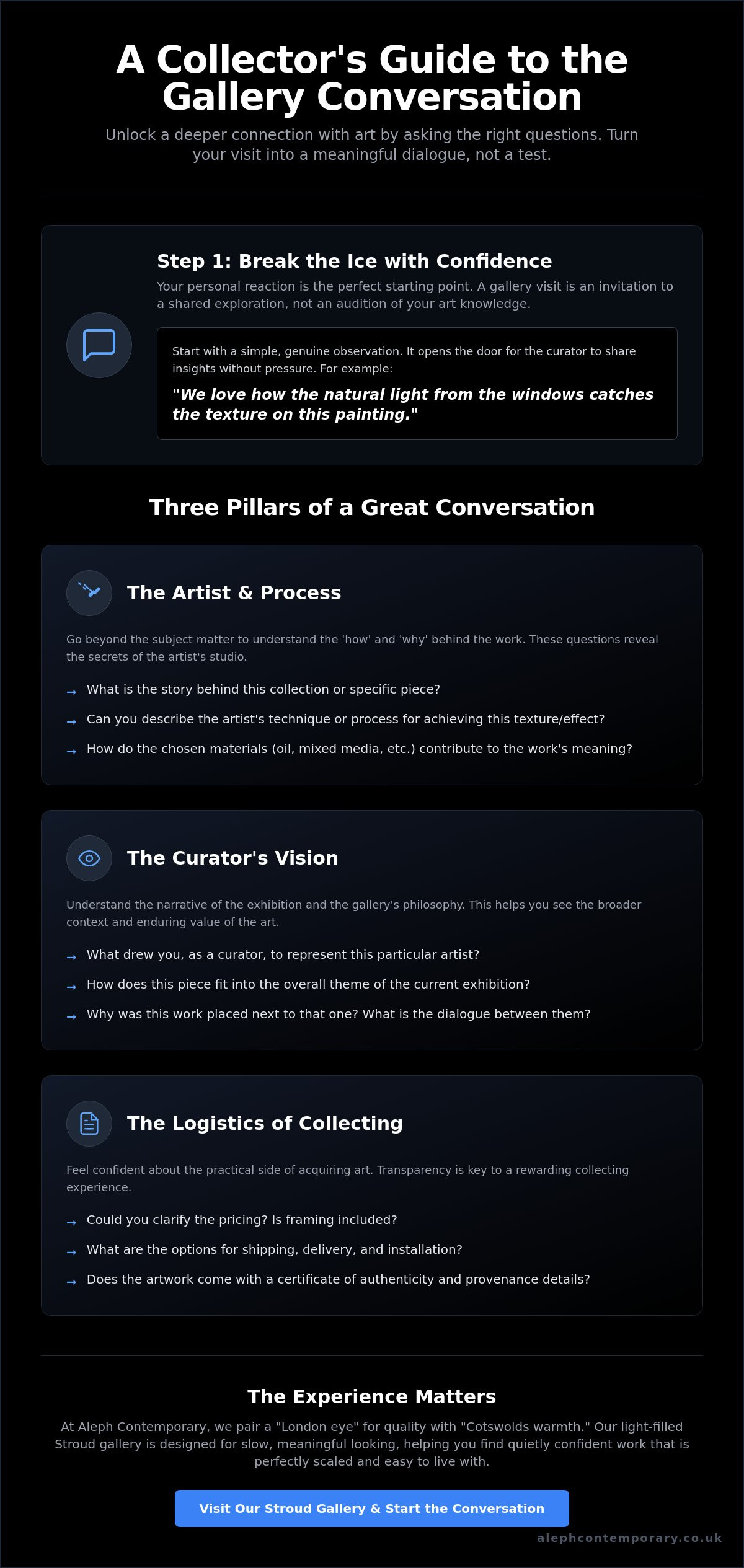
We often suggest starting with the phrase, "we love how." It's a gentle, low-pressure way to start a conversation with the curator. For instance, you might say, "we love how the natural light from these floor-to-ceiling windows catches the texture of this piece." This opens a door for us to share technical insights without the conversation feeling like a lecture. It turns the act of viewing into a shared exploration. These questions to ask an art gallery owner are not tests of your knowledge; they are tools to help you connect with the work on a deeper level.
In an intimate exhibition, every piece is placed with intention. Ask about the dialogue between the works. Why does this abstract art sit next to that figurative piece? Understanding the curation philosophy helps you see the broader narrative Nicholas Wells has curated for the season. It reveals the "quietly confident" nature of the collection and how different artists might be exploring similar themes through different lenses.
Simple Ice-Breakers for New Visitors
- "What drew you to represent this particular artist's work?"
- "Can you tell me a bit about the story behind this specific collection?"
- "How does this piece fit into the current exhibition's theme?"
Understanding the Curator's Perspective
Nicholas Wells brings a "London eye" for quality paired with "Cotswolds warmth" to our Stroud space. He seeks out works that possess an enduring cultural significance rather than chasing fleeting trends. When you ask about the curator’s perspective, you're really asking about the longevity of the art. Many of our visitors notice that the works we show are perfectly scaled for modern interiors. Don't be afraid to ask how a work might function in a domestic setting. We believe contemporary art should be easy to live with, and understanding the curator's vision helps you find a piece that resonates with your own environment.
Understanding Materiality and Process: Questions for the Curious Mind
The physical presence of a work of art often holds secrets that go far beyond its visual subject. When you're standing in our contemporary art gallery Stroud, we encourage you to look closely at the surface of the canvas. One of the most revealing questions to ask an art gallery owner is how the artist chose their specific mediums. Whether an artist works with the traditional richness of oil or the layered complexity of mixed media, these choices dictate how the piece lives in a space. Visitors often notice how the natural light from our floor-to-ceiling windows plays across a gestural brushstroke, revealing depths that might be missed in a flatter environment. This interaction between light and texture is a hallmark of the quietly confident work we represent.
Questions About Technique and Materials
Understanding the physical "how" is just as vital as the "why." You might ask what process the artist used to achieve a specific impasto or a subtle, translucent glaze. It's also helpful to consider how an artist's smaller drawings inform their larger compositions. These intimate works on paper often show the rawest form of their thinking and can be a wonderful entry point for new collectors. We're always happy to discuss the archival qualities of a piece, ensuring that the materiality of the work remains stable and vibrant for decades. If you're curious about the technicality of a piece, we invite you to explore our latest oil paintings to see these textures firsthand under our sharp spotlights.
The Narrative Behind the Canvas
Every painting is a specific point on an artist's creative timeline. Inquiring about an artist's background and the evolution of their style provides the context that makes a work truly easy to live with. While collectors focus on the final object, artists also have their own set of Questions Artists Should Ask Before Starting a Gallery Partnership to ensure their story is told with integrity. This mutual understanding between the creator and the curator is what Nicholas Wells curated into every show in our Cotswolds art gallery. Ask if the piece belongs to a limited series or a broader body of work to understand its place in the artist's personal history. This perspective helps you see the work not just as a decorative element, but as a significant chapter in a larger artistic discourse.
The Logistics of Love: Practical Questions for Collectors
Once a piece resonates emotionally, the conversation naturally shifts toward how it will inhabit your personal space. These practical questions to ask an art gallery owner are essential for ensuring that your chosen work is truly "easy to live with" over the long term. Nicholas Wells curated our Stroud collection with modern interiors in mind, selecting pieces that are perfectly scaled for contemporary homes. We often find that collectors appreciate a direct dialogue about the logistics of acquisition, from the history of a piece to its eventual placement on your walls. Understanding the provenance and long-term value of contemporary artwork doesn't have to be an intimidating process; it's simply about ensuring the piece has a clear and documented lineage.
Finding Art Within Your Budget
Transparency regarding investment is a cornerstone of our approach in the Cotswolds. We believe that exceptional art should be accessible to everyone, whether you are a seasoned collector or just beginning your journey. We love how visitors react when they discover our carefully curated selection of works under £1,000, which offers a wonderful entry point into the world of original painting. If you aren't visiting us in person, our guide on buying original paintings online provides clarity on the logistics of delivery and payment. Don't hesitate to ask if we have smaller, intimate works available that might suit a specific nook or a more modest room.
Placement and Preservation
The way natural light interacts with a canvas can transform its character throughout the day. In our Stroud gallery, the floor-to-ceiling windows allow you to see how a landscape or abstract work shifts in tone from morning to dusk. You should feel free to ask how the specific lighting in your own home, whether you use sharp spotlights or softer diffused light, might affect the colours and textures of a painting. Most of our works are sold unframed to allow for personal choice, but we are always happy to recommend bespoke framing services that complement the quietly confident nature of the art. These logistical details ensure that the piece you love today remains a joy to experience for years to come.
For the Creators: How Artists Should Approach the Conversation
The relationship between an artist and their gallery is a delicate, evolving partnership. It's more than just a commercial arrangement; it's a shared commitment to the longevity of artistic ideas. When creators visit our light-filled gallery in Stroud, they often see how the white walls and sharp spotlights create a specific stage for contemporary painting. While collectors have their own inquiries, there are specific questions to ask an art gallery owner from the perspective of a creator seeking a meaningful partnership. Nicholas Wells curated our current roster with a "London eye," looking for artists whose work possesses a quietly confident presence that can hold its own in both a gallery and a modern interior.
The Professional Inquiry
A respectful approach to submissions is the first step in building trust. We love how artists take the time to understand our specific aesthetic before reaching out. It's helpful to ask about the gallery’s preferred method for portfolio reviews rather than dropping in unannounced. This shows a professional appreciation for the curator's time and the "curator-led" nature of the space. You might also inquire how the gallery views the relationship between the artist’s studio and the exhibition floor. At Aleph, we see the gallery as a site of active intellectual inquiry, where the materiality of oil paint works or mixed media can be fully explored. Understanding if your work fits into the gallery's existing dialogue is crucial for long-term success.
Promotion and Partnership
A gallery's reach should extend far beyond its physical walls. Since our relocation to the Cotswolds in late 2023, we've focused on blending our local presence with a robust international online market. Artists should ask how the gallery uses its digital presence to support their growth. For instance, how do we introduce new abstract art to an established network of collectors? An intimate exhibition at Aleph is not just a three-week event; it's part of a continuous dialogue that includes digital catalogues and social storytelling. Visitors often notice that our floor-to-ceiling windows and natural light provide a unique viewing experience, but our online platforms ensure that work is seen globally. Understanding the typical duration and the follow-up support helps artists plan their studio output effectively. If you are a creator looking to understand the type of work we champion, we invite you to view our curated abstract collections to see if your practice aligns with our vision.
Experience the Light: Why the Setting in Stroud Matters
The architecture of a gallery isn't merely a container for art; it's a silent participant in the viewing experience. In our contemporary art gallery Stroud, the environment is intentionally designed to reveal the subtle shifts in a work's character. One of the most insightful questions to ask an art gallery owner during your visit is how a specific piece responds to the changing light of the day. Because our space features floor-to-ceiling windows, we see how the golden hour of a Cotswolds afternoon can draw out hidden warmth in a cool-toned abstract art piece, or how the crisp morning light emphasizes the precision of a figurative work. This temporal dialogue between the sun and the canvas is something you simply cannot experience through a digital screen.
The Physicality of the Stroud Gallery
Visitors often notice that our white walls and sharp spotlights create a focused, professional atmosphere, yet there's an undeniable "Cotswolds warmth" that makes the experience feel personal and unhurried. The way natural light interacts with the materiality of oil paint is a revelation. While a photograph might capture the composition, it often misses the gestural depth and the physical presence of the medium. Nicholas Wells curated the Stroud space to ensure that every work feels perfectly scaled for a home environment, allowing you to imagine how these pieces will live within your own modern interior. Don't be afraid to ask us to move a piece or adjust the lighting; we want you to be certain that the work is easy to live with before it leaves our walls.
- Observe how the floor-to-ceiling windows change your perception of depth and colour throughout the afternoon.
- Notice how the sharp spotlights highlight the specific textures and materiality of the artist's process.
- Experience the welcoming atmosphere that bridges the gap between a high-level art discourse and an intimate gallery visit.
Your Next Step
We invite you to step away from the digital world and join us in person to experience these works as they were meant to be seen. If you're unable to visit Stroud immediately, you can explore our carefully curated online shop, where we provide detailed descriptions to help you understand the physical impact of each piece. Whether you're looking for a definitive insight into a new artist or just starting to consider your first acquisition, the right questions to ask an art gallery owner will always lead to a more profound connection. Sign up for our newsletter to stay informed about our latest explorations and upcoming intimate exhibitions in our light-filled gallery.
Start Your Journey into Contemporary Collecting
Building a collection is a deeply personal voyage that begins with a single, thoughtful conversation. By understanding the right questions to ask an art gallery owner, you move beyond the role of a passive viewer and become an active participant in the story of a painting. Whether you're exploring the textural depth of an oil work or considering how a landscape will settle into your home, these dialogues ensure the art you choose is both meaningful and easy to live with. We love how the light-filled gallery in Stroud provides the perfect environment for these explorations, where natural light and Red Dot Design award-winning aesthetics meet Nicholas Wells' curated expertise.
We're here to offer bespoke collector support, helping you navigate everything from archival materiality to the final placement in your interior. With complimentary UK delivery and a focus on quietly confident work, we make the transition from gallery to home seamless. Explore our carefully curated collection of original British art and discover works that resonate with your own unique perspective. We look forward to welcoming you into the conversation at our Cotswolds space soon.
Frequently Asked Questions
Is it okay to ask about the price of a painting immediately?
Yes, it is absolutely fine to ask about the price of a painting at any time. We believe in transparency and want our collectors to feel comfortable from the moment they step into our light-filled gallery. Knowing the investment required helps you focus on works that are within your reach, making the process of finding art that is perfectly scaled for your home much smoother.
What does 'curator-led' actually mean for a collector?
A curator-led gallery means that every piece has been personally selected by Nicholas Wells for its enduring cultural significance and quality. Instead of following fleeting trends, we focus on a specific aesthetic dialogue that values substance and materiality. For a collector, this provides confidence that the works have been evaluated with a professional "London eye," ensuring they are both intellectually rigorous and easy to live with.
Should I ask about the artist's CV or just focus on the artwork itself?
You should feel free to explore both, as the artist's background provides the narrative context for the physical object. While the immediate reaction to the materiality of a piece is vital, understanding an artist's exhibition history and evolution adds layers to your appreciation. These are excellent questions to ask an art gallery owner to help you understand the longevity and trajectory of the artist's career.
Can I ask to see more works by an artist that aren't currently on the walls?
Yes, we always welcome inquiries about additional works that may not be currently on display. While our intimate exhibitions in Stroud are carefully curated to a specific theme, we often have a wider selection of an artist's portfolio available in our inventory. We love how these conversations often lead to discovering a piece that perfectly fits a collector's specific space or aesthetic preference.
How do I ask about the potential for a work to increase in value?
It is best to frame this by asking about the artist's career trajectory and recent institutional recognition. While no one can guarantee financial appreciation, asking about an artist's inclusion in public collections or major exhibitions provides a sense of their standing in the art world. This approach focuses on the work's cultural value, which is often a strong indicator of its enduring significance and long-term worth.
What should I ask if I'm interested in a commissioned piece?
If you are interested in a commission, you should ask about the artist's current studio schedule and their typical process for bespoke works. We act as a bridge between the artist and the collector to ensure the final piece aligns with both the creator's vision and your specific needs. It's helpful to discuss the timeline and any specific materials, such as oil or mixed media, you prefer for your space.
Is it rude to take photos of the art to see how it might look in my home?
Taking photos is not rude and is actually a very practical way to see how a work might interact with your own furniture and décor. We often suggest taking a picture to see how the natural light in your room compares to the sharp spotlights in our Stroud space. It helps you visualize if the work is perfectly scaled for your modern interior before you make a final decision.
How can I tell if a gallery is a good fit for my personal collection style?
You can tell a gallery is a good fit if their curation consistently resonates with your personal aesthetic and intellectual interests. Notice if the "dialogue" between the works feels coherent and if the environment feels welcoming rather than exclusionary. A good gallery should feel like a partner in your collecting journey, offering knowledgeable guidance that helps you find contemporary art you'll love for years.

