
To encounter a work of profound abstraction can often feel like a confrontation with an unfamiliar language, a visual syntax that resists immediate interpretation. The fractured planes and multiple viewpoints characteristic of early twentieth-century cubism can seem, at first glance, intellectually impenetrable, leaving one searching for a foothold in a world remade. Yet, within this revolutionary dismantling of perspective lies not an ending, but a radical new beginning-a new dialogue between the object, the artist, and the very nature of perception itself.
This guide is conceived as an invitation into that dialogue. We will unfold the core tenets of this pivotal movement, tracing its enduring intellectual and aesthetic legacy from the Parisian studios of Picasso and Braque to the vibrant contemporary practices of artists you can discover today in the galleries of Stroud and the Cotswolds. Here, you will find the confidence to not only understand the art that changed everything, but to begin a collection of your own, rich with historical resonance and purpose.
Key Takeaways
- Grasp the core principle of Cubism: a radical deconstruction of perspective that allowed artists to represent a subject from multiple viewpoints within a single frame.
- Learn to distinguish between the movement's two key phases, Analytical and Synthetic, to appreciate its deliberate intellectual and artistic progression from fragmentation to construction.
- Trace the profound and enduring legacy of cubism as it informed subsequent avant-garde movements and fundamentally reshaped the trajectory of modern art.
- Develop a discerning eye for identifying Cubist sensibilities-such as fractured planes and conceptual depth-in the contemporary artworks found in the Cotswolds today.
The Genesis of a Revolution: Deconstructing Perceived Reality
In the crucible of early 20th-century Paris, a radical new visual language emerged that would irrevocably alter the course of Western art. This movement, known as Cubism, was pioneered by the formidable duo of Pablo Picasso and Georges Braque, who embarked on an intellectual interrogation of form and space. Their work represented a profound departure from the single-point perspective that had dominated European painting since the Renaissance, challenging the very notion of art as a faithful imitation of reality. Rather than an escape into abstraction, Cubism proposed a more profound realism-one grounded not in fleeting visual perception, but in the enduring intellectual concept of an object. This revolutionary dialogue was deeply informed by the structural innovations of Paul Cézanne and the powerful, abstracted forms of non-Western art, particularly African sculpture.
A Reaction Against Tradition
Emerging from the vibrant artistic climate that followed Post-Impressionism and Fauvism, Cubism was a direct refutation of art’s traditional role as a mere ‘window onto the world’. Picasso and Braque rejected illusionism, instead embracing the inherent two-dimensionality of the canvas. The picture plane was no longer a transparent surface to be looked through, but an opaque object upon which a new reality could be constructed, piece by fractured piece.
Key Concepts: Multiplicity and Simultaneity
The core tenet of this new approach was the simultaneous depiction of a subject from multiple viewpoints. This method sought to capture a more complete experience of an object, akin to the conceptual understanding one gains by walking around a sculpture. By presenting these fragmented, overlapping perspectives on a single flat plane, the artists rendered not just the object’s appearance, but the memory, duration, and intellectual grasp of its existence in space and time.
This analytical deconstruction of form, reducing subjects to their essential geometric components, sought to convey a truth beyond surface appearance. It was an art of conception, not perception. For those seeking to delve deeper into its complex history and phases, a comprehensive overview of Cubism provides an essential foundation. This definitive break with tradition established the painted object as a self-referential reality, paving the way for nearly all subsequent abstract art movements.
The Two Phases of Cubism: Analytical and Synthetic
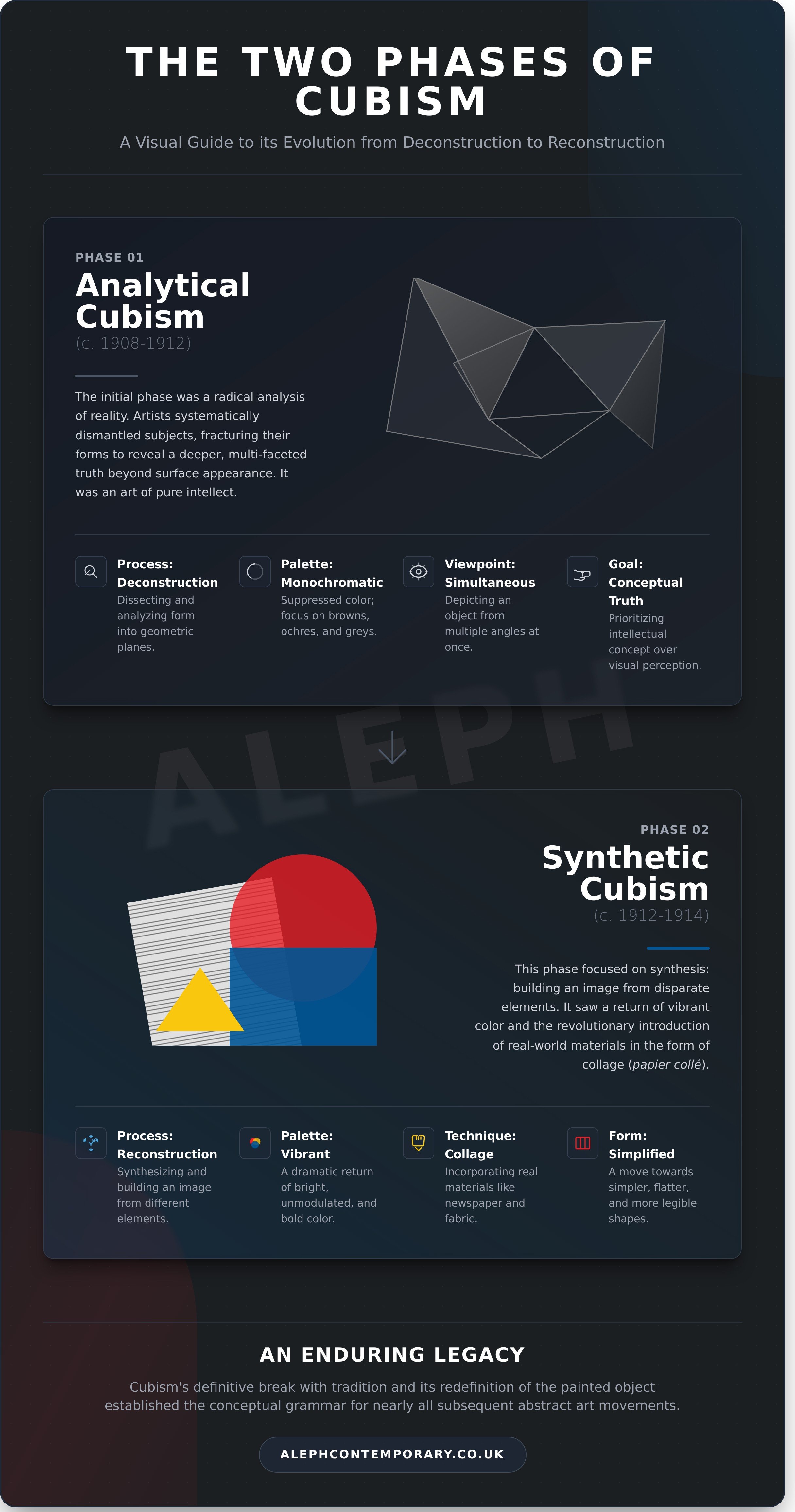
The trajectory of cubism was not an accidental stylistic drift but a deliberate and profound intellectual progression, an artistic inquiry that methodically unfolded across two primary phases. These periods represent two distinct, yet deeply interconnected, approaches to pictorial construction, charting a revolutionary course from the deconstruction of form to its subsequent reconstruction. This critical evolution, a sustained dialogue between analysis and synthesis, did more than just challenge centuries of painterly tradition; it provided the conceptual grammar for nearly all of modern abstract art. The distinction between Analytical and Synthetic Cubism, as chronicled by major institutions like The Metropolitan Museum of Art, reveals an artistic movement in constant, rigorous conversation with itself, pushing the very boundaries of what a painting could be.
Analytical Cubism (c. 1908-1912): The Deconstruction
The initial phase was an exercise in radical analysis, a near-scientific dissection of visual reality. Artists like Georges Braque and Pablo Picasso systematically dismantled their subjects-be it a figure, a landscape, or a still life-fracturing their forms into a complex, shimmering network of geometric planes and simultaneous viewpoints. To privilege this structural investigation, colour was deliberately suppressed in favour of a severe, near-monochromatic palette of browns, ochres, and greys, ensuring that nothing would distract from the rigorous exploration of form. This was an art of pure intellect, prioritising the analysis of an object's structure over sentimental expression. Works such as Braque’s iconic Violin and Palette (1909) exemplify this cerebral approach, where the object is shattered and reassembled not out of chaos, but to reveal a deeper, multi-faceted truth of its existence in space.
Synthetic Cubism (c. 1912-1914): The Reconstruction
Following the intense deconstruction of the analytical period, a new, constructive impulse emerged: to synthesise, or build, an image from disparate elements, signs, and textures. This phase heralded a dramatic return of vibrant, unmodulated colour and a decisive move towards simpler, flatter, and more legible shapes. Its most revolutionary contribution, however, was the introduction of collage (papier collé), where non-art, real-world materials like newspaper clippings, wallpaper, and fabric were incorporated directly onto the canvas, blurring the line between art and life. Picasso’s seminal Still Life with Chair Caning (1912), with its notorious piece of oilcloth printed with a chair-caning pattern, announced this new direction, fundamentally interrogating the nature of representation, illusion, and the very materiality of the artwork itself.
Cubism's Enduring Legacy: From Paris to the Cotswolds
To view cubism as a self-contained stylistic episode, confined to the early 20th century Parisian avant-garde, is to fundamentally misunderstand its revolutionary impact. It was not merely a new way to paint; it was a profound restructuring of artistic vision, a philosophical and formal rupture that dismantled centuries of perspectival tradition. This was a seismic event whose tremors reconfigured the entire landscape of visual culture. Its principles became so deeply embedded within the artistic discourse that to trace the full legacy and influence of Cubism is to map the very DNA of modernism itself.
From its epicentre in the studios of Picasso and Braque, this new language radiated outwards, providing the foundational grammar for a host of subsequent movements. The Italian Futurists seized upon its fragmented planes to express the dynamic velocity of the machine age; Robert and Sonia Delaunay’s Orphism translated its geometric structure into pure, lyrical colour; and in Britain, the Vorticists harnessed its sharp, angular aesthetic to capture the harsh, mechanical energy of modern urban life. Cubism was the catalyst. It provided the tools for a new generation to deconstruct and rebuild the world in their own image.
How Cubism Shaped Contemporary Art Practice
The dialogue initiated by Cubism continues with resounding vitality in the studios of contemporary artists today. The liberation of form from the demands of realistic representation is perhaps its most enduring gift, allowing artists the freedom to interrogate, abstract, and re-imagine their subjects. We see its echoes in the persistent exploration of fragmentation and multiple, simultaneous viewpoints, which now serve not just as a visual strategy but as a potent metaphor for the complex, multifaceted nature of modern experience. Furthermore, the Cubist embrace of collage-the radical incorporation of everyday materials onto the canvas-opened a gateway to the mixed-media practices and the intense focus on surface and materiality that are central to so much current work.
Echoes of Cubism in the Stroud Valleys
This enduring language finds a unique resonance even here, in the ancient landscapes of Gloucestershire. One can imagine a contemporary artist looking out upon the Cotswolds not with a picturesque sensibility, but through a Cubist lens. They might perceive the rolling hills not as gentle curves but as a series of interlocking geometric forms; the iconic honey-coloured stone of a dry-stone wall becomes a mosaic of faceted planes, each catching the light at a different temporal moment. The very fracturing of sunlight as it moves across the escarpment becomes a subject in itself. This ongoing conversation between a revolutionary past and a vibrant present is palpable. Discover artists in dialogue with modernism in our Stroud gallery and witness these profound echoes for yourself.
A Collector's Dialogue: Viewing Contemporary Art Through a Cubist Lens
To understand the trajectory of twentieth-century art is to understand cubism; its revolutionary interrogation of form and perspective continues to echo profoundly in the studios of contemporary artists today. Moving beyond a purely historical appreciation, the discerning collector can learn to perceive this enduring legacy, engaging with new work not as a passive observer, but as an active participant in a century-long artistic dialogue. Viewing contemporary art through a Cubist lens transforms the act of looking into an intellectual exploration, revealing layers of influence and innovation that connect the present moment to its pivotal modernist past.
What to Look For in a Contemporary Piece
When approaching a contemporary work, certain formal qualities may signal a conceptual kinship with Cubist principles. This is not about identifying imitation, but rather about recognising a shared sensibility in the deconstruction and reassembly of visual language. Look for:
- A compressed pictorial space: Notice how an artist might deliberately flatten the picture plane, rejecting the illusion of traditional, single-point perspective in favour of a more complex and layered spatial arrangement.
- Fragmented forms and geometric interplay: Observe the use of fractured, angular forms where subjects are broken down into their geometric constituents and then recomposed, creating a dynamic tension across the canvas.
- Simultaneous viewpoints: Consider how the artist presents multiple facets of a subject at once, challenging the viewer to synthesise different angles and moments into a single, cohesive image.
Questions to Ask at a Gallery in Stroud
Engaging with a gallerist can deepen your understanding and reveal the conceptual underpinnings of a work. Whether visiting a gallery in Stroud or elsewhere, these inquiries can open up a richer discourse:
- Inquire about the artist's dialogue with modernist influences, specifically asking if they consciously engage with the legacy of Analytical or Synthetic Cubism.
- Ask how the work engages with or subverts traditional ideas of perspective and representation.
- Discuss the materiality of the piece-its texture, the substance of the paint, the inclusion of collage elements-a key concern that has its origins in the tactile experiments of Synthetic Cubism.
These questions shift the focus from mere aesthetics to a more profound consideration of an artwork's place within art history. They are the first steps in building a collection of enduring significance. Begin your collecting journey. View our curated collection online.
The Enduring Dialogue: Cubism and the Contemporary Collector
More than a mere stylistic departure, cubism represented a profound philosophical rupture-a deliberate deconstruction of singular perspective that forever altered the course of visual expression. From the austere, intellectual rigour of its Analytical phase to the playful materiality of its Synthetic evolution, the movement established a new visual language whose echoes are still palpably felt in the most forward-thinking contemporary practices.
This enduring legacy forms the very core of the discourse we cultivate at Aleph Contemporary. Our collection, born from the expert curation of a leading contemporary gallery in Stroud, fosters a powerful dialogue between modernism and today’s artists. We invite you to continue this exploration. Explore our collection of contemporary artworks and discover this vital conversation for yourself. As an introduction to our gallery, we are pleased to offer complimentary UK delivery for your first acquisition.
Begin your own dialogue with the art that will define the collections of tomorrow.
Frequently Asked Questions About Cubism
What is the main difference between Cubism and Abstract Art?
The principal distinction lies in their relationship to objective reality. Cubism, in its analytical pursuit, deconstructs and reassembles subjects from multiple viewpoints, yet it never completely severs its ties to the observable world; a guitar or a portrait, however fragmented, remains the conceptual anchor. Pure abstraction, conversely, often abandons representational origins entirely, creating a visual language of form, colour, and line that exists independently of any external reference, engaging in a wholly different artistic discourse.
Why is Picasso's 'Les Demoiselles d'Avignon' considered a proto-Cubist masterpiece?
While not strictly a Cubist work, this seminal 1907 painting is considered its most vital precursor because it fundamentally ruptured Western artistic conventions. Picasso shattered traditional perspective, flattened pictorial space, and rendered the human form with sharp, geometric planes inspired by Iberian and African sculpture. It was a radical interrogation of representation that introduced the nascent visual language and conceptual framework from which the entire Cubist movement would subsequently emerge and develop.
Did Cubism only exist in painting?
Although intrinsically linked with the canvases of Picasso and Braque, the revolutionary principles of Cubism extended far beyond painting. The movement’s discourse permeated sculpture, with artists like Alexander Archipenko and Jacques Lipchitz exploring fragmented volumes in three dimensions. Furthermore, the invention of collage introduced new materiality to the flat plane, while its aesthetic of geometric simplification profoundly influenced international architecture, decorative arts, and even literary theory throughout the early 20th century.
Why did the early Cubists use such a limited, neutral colour palette?
During the initial, Analytical phase of Cubism (c. 1908-1912), colour was deliberately subordinated to form. Artists like Picasso and Braque employed a restrained palette of ochres, umbers, and greys to concentrate the viewer’s attention on the work's primary intellectual objective: the structural deconstruction of the subject and the complex interplay of shifting planes. This cerebral exploration of form and space was deemed more critical than the emotive or descriptive potential of a vibrant palette.
How did the name 'Cubism' originate?
The term was coined, somewhat pejoratively, by the French critic Louis Vauxcelles in 1908. After viewing an exhibition of landscapes by Georges Braque, he commented that the artist had reduced everything to "geometric outlines, to cubes." The description, initially intended as a dismissal of this radical new style, was quickly adopted. It became the enduring, if overly simplistic, name for one of modern art’s most significant and intellectually rigorous movements.
Is it possible to collect art with Cubist influences without a museum-level budget?
Absolutely. While a seminal painting from the 1910s is unattainable for most, collecting works that engage in a dialogue with Cubism is entirely feasible. One might explore limited edition prints or works on paper by the movement's key figures, which can be acquired from a few thousand pounds. Alternatively, acquiring paintings by later 20th-century or contemporary artists who absorbed and reinterpreted Cubist principles offers a rich field for collectors, with prices at UK auctions or galleries starting from under £1,000.

