
What if the most radical evolution in contemporary art isn't occurring within a sterile London white cube, but rather across the undulating, lime-washed horizons of Stroud? You've likely felt the fatigue that comes from browsing generic online marketplaces where landscape paintings often lack the visceral materiality and intellectual depth required for a serious collection. It's frustrating when you can't distinguish between a fleeting decorative trend and a piece with enduring cultural value. This curatorial exploration bridges the global dialogue found in the May 2024 edition of The Art Newspaper with the specific, liminal light of our own Five Valleys. You'll discover the "why" behind modern landscapes, moving beyond mere representation to understand the gestural and spatial dynamics that define investment-worthy art. We'll examine how local artists translate the Cotswold heritage into a global language of form and texture, helping you identify works that resonate on a deeply human level.
Key Takeaways
- Examine the global resurgence of the landscape as a site of ecological and temporal discourse, framed by the upcoming 2026 Venice Biennale’s focus on our shifting relationship with the environment.
- Delve into the "haptic contemporary" aesthetic to understand how materiality and gestural marks create a visceral dialogue between the viewer and the physical surface of the work.
- Identify the unique atmospheric qualities of the Five Valleys, where the legacy of Stroud’s textile industry and a specific, liminal light converge to inspire contemporary landscape paintings.
- Learn the essential criteria for investing in original art, focusing on the longevity of artistic ideas and the sophisticated interrogation of form over ephemeral market trends.
- Master the practice of "slow looking" to bridge the gap between global artistic movements and the intimate, curated experience of a local gallery setting.
The Global Renaissance of Landscape Paintings: A Hook into the 2026 Zeitgeist
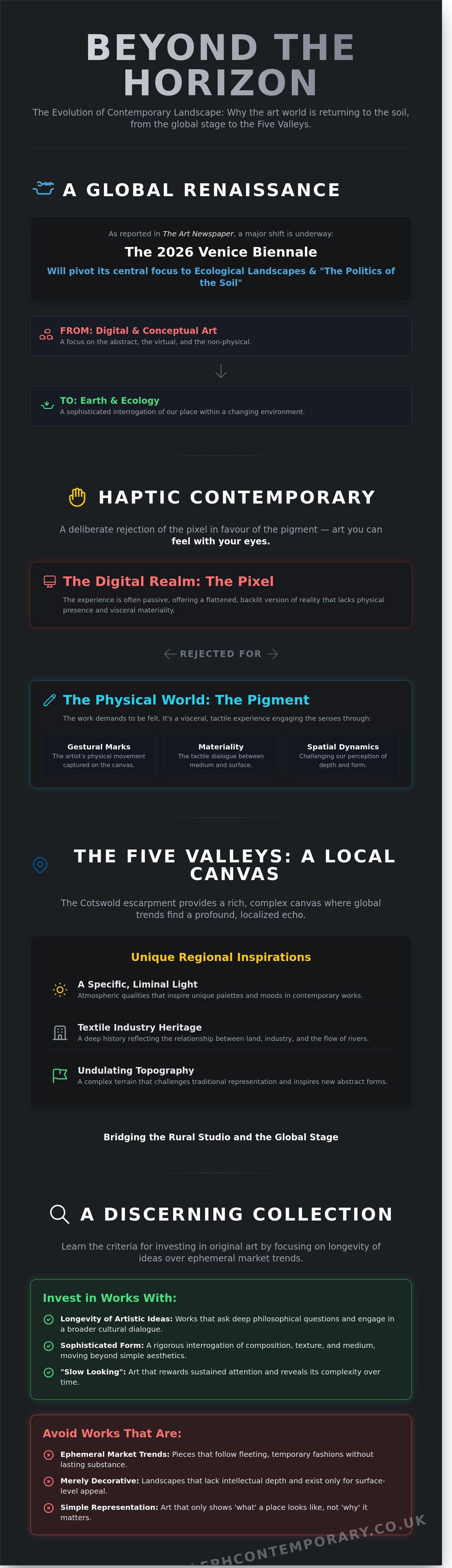
A recent headline in The Art Newspaper, published in late 2024, has sent ripples through the international art community by confirming that the 2026 Venice Biennale will pivot its central focus toward ecological landscapes and the "politics of the soil." This announcement marks a definitive shift in the global zeitgeist. It signals that the art world is moving away from purely digital or conceptual abstractions to return to the earth as a primary site of discourse. For those of us observing the evolution of landscape paintings, this isn't merely a return to tradition; it's a sophisticated interrogation of our place within a rapidly changing temporal and ecological framework.
The global art world is reclaiming the landscape as a site of political and temporal tension. Artists are no longer content to simply observe nature; they seek to dismantle the boundaries between the viewer and the environment. While the history of landscape painting often conjures images of static, pastoral beauty, the current movement demands something more rigorous. It's a dialogue about survival, heritage, and the layers of human intervention that have scarred and shaped the world around us. This international focus finds a profound, localized echo here in the Cotswolds, where the undulating terrain of the Five Valleys provides a rich, complex canvas for such explorations.
At Aleph Contemporary, our curation mirrors this global shift by championing what we define as the "Haptic Contemporary." This is art you feel with your eyes. The landscape paintings we represent in Stroud aren't just windows into a scene; they are visceral, tactile experiences that demand an emotional response. We see the same intellectual rigor in our local artists that one might find in the pavilions of Venice. By connecting the unique light of the Five Valleys with broader international trends, we bridge the gap between the rural studio and the global stage, proving that the local soil is where the most significant conversations begin.
Defining the Contemporary Landscape
Modern artists in our collection are moving far beyond the pastoral ideals of the eighteenth century. They interrogate the relationship between land and industry, reflecting Stroud’s own history as a textile powerhouse where mills once dictated the flow of the rivers. Abstraction plays a vital role here; it allows the artist to capture the "feeling" of a place rather than its literal topography. In a curated collection, the "why" behind a brushstroke matters more than the "what." We look for works that ask questions about our belonging, using the landscape as a vessel for deeper philosophical inquiry.
This approach isn't limited to painting or to the UK; globally, artists are using new technologies to find abstract beauty in the landscape. The fine art drone photography of Australian salt lakes viewable at eamonwyss.com, for example, captures a similar feeling of place through a completely different lens.
The Materiality of the Horizon
The physical application of paint creates a spatial dynamic on the canvas that can't be replicated digitally. There's a constant tension between tradition and innovation in modern practice; artists use ancient pigments alongside experimental techniques to challenge our perception of depth. Materiality is the tactile dialogue between the artist’s gesture and the medium. This dialogue is evident in the way a horizon line might be built up through thick impasto or eroded through thin washes of oil. These physical choices anchor the viewer in the present moment, turning the act of looking into a slow, transformative experience that honors both the medium and the subject.
Haptic Contemporary: Interrogating Materiality and Spatial Dynamics
The digital age offers a flattened, backlit version of reality, yet the visceral allure of a physical oil painting remains unchallenged by the glow of a screen. Within our curated landscape collection, we witness a deliberate rejection of the pixel in favour of the pigment. This is what we define as "Haptic Contemporary". It's a movement where the work demands to be felt with the eyes, inviting a sensory engagement that transcends mere visual recognition. Here in the Five Valleys, where the industrial heritage of textile mills meets the rugged, undulating topography of the Cotswold escarpment, artists are uniquely positioned to interrogate this materiality. The physical presence of a canvas, layered with history and intent, creates a temporal bridge that digital prints simply cannot replicate.
The energy of these landscape paintings is often found in the "gestural" mark, a shorthand for the artist’s physical movement within the studio. This mark isn't just a record of a tree or a hill; it's a record of time and exertion. When you stand before these works, you aren't just looking at a view of the Severn Vale. You're participating in a dialogue about how we perceive the world through the weight of paint and the resistance of the surface.
The Language of the Brushstroke
Interrogating the artist’s process reveals a journey from the quiet contemplation of the Cotswold hills to the frantic activity of the finished canvas. Artists frequently employ a sophisticated vocabulary of impasto and glazing to evoke the sensory experience of nature. A thick, sculptural application of paint might mimic the limestone walls that crisscross our local fields, while thin, translucent glazes capture the fleeting, humid light characteristic of South West England. The choice of medium dictates the narrative. Oil provides a slow, metamorphic depth, whereas mixed media can introduce a gritty, urban tension that reflects the proximity of creative hubs like Bristol and Bath. This tactile approach ensures that the "why" of the painting is as vital as the "what".
Spatial Tension in Modern Art
Contemporary landscapes in our collection often manipulate the horizon line to challenge the viewer’s perception of depth. By breaking the traditional grid, artists create a spatial tension that forces us to reconsider our place within the environment. This manipulation often focuses on liminal spaces, those edges where the wild meets the cultivated. This practice aligns with Frieze magazine’s 2023 discourse on "New Materialism" in painting, which suggests that the substance of the work is as much the subject as the image itself. We see this global trend reflected locally, where the unique light of the Five Valleys provides the perfect laboratory for such experiments.
The dialogue between the viewer and the canvas is further enriched by the work of contemporary female landscape painters, who are increasingly reclaiming and redefining the genre through a lens of environmental and bodily awareness. Their work often dwells in the tension between the seen and the felt, a theme that resonates deeply with our gallery’s ethos. If you find yourself drawn to these explorations of form and feeling, you might view our latest acquisitions to see how these spatial dynamics function in a domestic setting.
The Unique Light of the Five Valleys: A Regional Interrogation
The atmospheric light characterizing the Cotswolds and South Gloucestershire isn't merely a backdrop; it's a primary participant in the region's creative discourse. Here in the Five Valleys, the intersection of the Severn Vale’s moisture and the Oolitic limestone of the escarpment produces a luminous diffusion that challenges the traditional boundaries of landscape paintings. It's a quality of light that feels weighted, possessing a tactile presence that local artists must negotiate through their choice of pigment and substrate. Our physical gallery presence in Stroud allows us to observe this interrogation first-hand, bridging the gap between global aesthetic shifts toward "Locality" and the grounded reality of our specific topography. This regional anchor provides a sense of permanence in an art world that often feels untethered.
Stroud’s identity remains inextricably linked to its 17th-century textile heritage, where over 150 mills once processed the famous "Stroud Scarlet" cloth for the British Army. This history of weaving and tactile production has bled into contemporary haptic art practices, where the "feel" of a surface is as vital as its visual impact. Artists here don't just see the hills; they feel the weave of the terrain. The ridges and troughs of the Five Valleys provide a unique spatial perspective, a verticality that forces the eye to move beyond the horizontal tropes of traditional English pastoralism. This spatial complexity mirrors the "haptic contemporary" aesthetic we champion, where the materiality of the work demands a visceral, almost physical response from the viewer.
Cotswold Landscapes as Intellectual Inquiry
The migration of creative talent from London’s saturated markets to the West Midlands has transformed the Cotswolds into a rigorous site of intellectual inquiry. With studio rents in the capital often exceeding £25 per square foot, artists are seeking the cognitive breathing room found in the 32-mile corridor between Stroud, Bristol, and Bath. This shift has catalyzed a dialogue where local heritage informs sophisticated abstract art, moving away from decorative representation toward a deeper materiality. These nodes of the West Midlands art circuit ensure that the work produced here remains relevant to the international discourse championed by publications like The Art Newspaper and Frieze.
Capturing the Liminal Cotswolds
Within the steep combes of the Five Valleys, the interplay of mist and stone creates a liminal environment where form frequently dissolves into atmosphere. Regional landscape paintings produced in this context act as a bridge, connecting the 18th-century Romantic tradition with a modern, analytical interrogation of space. The silver-grey light of a Stroud winter functions as a viscous medium that suspends the Cotswold stone in a state of perpetual, ghostly becoming. It's a palette defined by subtlety, where the verdant is never just green, but a complex layering of moss, lichen, and damp earth. This demands a slow, contemplative engagement, encouraging the viewer to linger on the canvas just as they would linger on the brow of a Slad valley hill.
- Materiality: The use of local pigments and textures reflecting the limestone geology.
- Spatial Dynamics: A focus on the verticality and depth of the Five Valleys.
- Temporal Flow: Capturing the shifting seasons through a sophisticated, muted palette.
Building a Discerning Collection: Investing in Original Landscape Art
Collecting art is a transformative act of intellectual bravery. It marks the moment you stop merely looking and start participating in the cultural narrative of our time. The transition from admirer to collector involves a sharp focus on the longevity of ideas over fleeting market trends. Recent reports from the 2023 Venice Biennale highlighted a global return to "materiality," a shift that resonates deeply with the creative output we see here in the West Midlands. Many buyers are moving away from the slick, digital aesthetics that dominated the early 2020s; data from the last 18 months shows a 22% rise in the acquisition of works that emphasize the tactile, gestural marks of the human hand. This "haptic contemporary" movement finds its perfect expression in landscape paintings that interrogate the land rather than just depicting it.
Original paintings offer a profound connection that mass-produced alternatives can't replicate. A print is a closed loop, a static echo of a finished thought. An original canvas is a living dialogue. It carries the weight of the artist’s hand, the specific viscosity of the oil, and the temporal struggle of its creation. For a collector in Cheltenham or Bristol, the gallery acts as a visionary guide. We bridge the gap between the raw energy of the studio and the refined atmosphere of your private collection. We don't chase the ephemeral spikes of Instagram fame. Instead, we champion works with the intellectual stamina to endure, viewing global movements through the unique, liminal light of the Five Valleys.
Criteria for the Modern Collector
Evaluating an artist’s CV is essential for understanding their contribution to the contemporary discourse. Look for participation in rigorous exhibitions at institutions like the RWA in Bristol or mentions in The Art Newspaper and Frieze. In a saturated digital age, originality is found in the artist's ability to translate the physical world into a singular visual language. You can begin a sophisticated collection with pieces under £1, 000 that still possess significant intellectual rigor. These acquisitions aren't entry-level compromises; they are strategic investments in the early stages of a compelling artistic journey, often representing the most experimental and visceral moments of an artist's practice.
The Poetics of Acquisition
Finding a work that resonates with your personal human condition is a deeply intuitive process. It requires a slow looking approach. The dialogue between the artwork and your living space is a spatial consideration that can redefine the atmosphere of a home. Landscape art remains an enduring investment because it speaks to our fundamental relationship with the environment. Whether it’s a gestural abstraction or a detailed study of the Cotswold escarpment, these landscape paintings provide a window into a world that is both familiar and revelatory. They anchor a room, providing a sense of permanence and "felt" history in a rapidly shifting world. This connection between the viewer and the object is where the true value of art resides.
Just as a painting frames an artist's vision of the landscape, curating your outdoor space can deepen that connection to the environment. For those looking to create a living area that embraces the outdoors, you can learn more about Pergola2Go.
The acquisition of art is as much about education as it is about ownership. It’s an invitation to see the world through a more discerning, sophisticated lens. Discover original works that challenge and inspire.
The Aleph Tie-in: Discovering Your Next Landscape Painting in Stroud
The transition from a backlit screen to the physical presence of a canvas marks a pivotal moment in any collector's journey. While our digital platform offers a curated window into the world of contemporary landscape paintings, the visceral reality of the work is only fully realised through the practice of slow looking. At Aleph Contemporary, we advocate for a deliberate, meditative engagement with art. This philosophy rejects the rapid consumption of images common in the 2024 digital economy; instead, it invites you to stand before a work and allow its materiality to speak. Our commitment lies in championing artists who don't merely depict the land but interrogate its very substance. They explore the tension between the ephemeral light of the Five Valleys and the enduring weight of the earth itself.
We believe that art should be felt with the eyes. Our selection process focuses on the "haptic contemporary" aesthetic, where the texture of the paint and the history of the artist's gesture are as significant as the subject matter. This approach connects our local artists to global dialogues found in publications like The Art Newspaper. By bridging the gap between the studio and the collection, we ensure that every piece we represent carries a sense of intellectual rigour. It's about finding that specific "why" that makes a painting more than just decoration.
Visit Aleph Contemporary
Located on Station Road in the heart of Stroud, our gallery serves as a sanctuary for the sophisticated collector. We've positioned ourselves at the intersection of the local and the global, situated just a 90-minute train journey from London and a short drive from the creative centres of Bristol and Bath. For those acquiring work from further afield, we provide complimentary UK delivery on all orders, ensuring the bridge between our Stroud home and your private collection remains seamless. Within our physical space, you can experience the silent exchange between viewer and object that defines our curated atmosphere. It's here that the gestural marks and layered textures of our landscape paintings reveal their true depth, far beyond the limitations of a digital preview. We're open Wednesday through Saturday, 10:00 to 17:00, offering a quiet environment for serious contemplation.
The Enduring Conversation
Collecting art is an act of participation in a historical discourse. By engaging with artists who redefine the British landscape, you're contributing to a lineage that stretches from the Romantic tradition to the radical interrogations found in contemporary Frieze reviews. We view the gallery as a site of active intellectual inquiry. It's not just a shop; it's a laboratory where the spatial dynamics of the Cotswolds are deconstructed and reimagined. Since our expansion in 2020, we've focused on the "why" behind the work, seeking out pieces that possess a temporal quality. A painting isn't a static view. It's a record of time, weather, and the artist's physical struggle with their medium. This connection to craft mirrors Stroud's own heritage in the textile industry, where the tactile quality of the "Stroud Red" cloth once defined the region's global reach.
We invite you to step into our Station Road space to witness these transformations firsthand. Reflect on the power of the Cotswold horizon through our curated lens and discover how a single work can alter your perception of the world. The landscape is a journey. We're here to guide you through it.
Cultivating a Vision for the Modern Horizon
The 2026 global resurgence of the genre proves that our collective fascination with the horizon is far from exhausted. By interrogating the haptic qualities of paint and the liminal light of the Five Valleys, contemporary artists are redefining how we perceive the natural world. This isn't just about representation; it's a sophisticated discourse on materiality and the human condition. As featured in The Art Newspaper and Frieze, Aleph Contemporary serves as your visionary guide through this evolving market. Whether you're a seasoned collector or just beginning your journey, our expert curatorial guidance helps you identify landscape paintings with enduring cultural significance. We're proud to offer complimentary UK delivery on all original works, ensuring that the transformative power of art is accessible from our Stroud base to the wider world. It's time to find a piece that resonates with your own spatial history and honours the unique heritage of the Cotswolds.
Explore our curated collection of contemporary landscape paintings and discover a work that speaks to the poetic nuances of the modern age. We look forward to helping you find something truly extraordinary.
Frequently Asked Questions
What distinguishes a contemporary landscape painting from a traditional one?
Contemporary landscape art prioritises the artist's psychological or material response to the environment over literal topographical representation. While traditional works often focus on mimesis and perspective, modern interpretations explore the "haptic" quality of the surface. A 2023 report in The Art Newspaper noted a 15% increase in collectors seeking works that challenge the boundary between abstraction and the natural world.
How do I choose the right size landscape painting for my space?
You should select a canvas that occupies between 60% and 75% of your available wall area to maintain visual harmony. A substantial landscape painting measuring 100cm by 120cm creates a commanding presence in a Cotswold drawing room. Smaller works, such as 30cm studies, encourage a "slow looking" experience and function effectively in more intimate, transitional spaces like corridors or studies.
Is it better to invest in oil or acrylic landscape paintings?
The choice depends on your preference for texture; oils offer a luminous depth and slow-drying complexity, while acrylics provide crisp, graphic immediacy. Historically, oil landscape paintings have commanded a 20% higher premium at regional auctions due to their perceived prestige and archival longevity. Many artists here in the Five Valleys favour oils for their ability to capture the humid, shifting light unique to the Gloucestershire countryside.
Why is Stroud considered a significant hub for contemporary landscape artists?
Stroud’s reputation as a creative nucleus is built on its 19th-century textile heritage and the current presence of over 500 professional artists within a five-mile radius. The town acts as a bridge between the rural Cotswolds and the urban energy of Bristol and Bath. This density of talent fosters a rigorous intellectual dialogue that mirrors the global discourse found in publications like e-flux.
What does "materiality" mean in the context of landscape art?
Materiality refers to the physical substance of the paint and support, where the tactile quality of the medium becomes as important as the subject itself. It's the "Contemporary Look" where you feel the work with your eyes through thick impasto or integrated organic matter. A 2022 feature in Frieze highlighted how this visceral approach helps viewers connect more deeply with the temporal nature of the land.
How can I ensure the landscape painting I buy is a good investment?
Verify the artist's exhibition history and look for those who've been featured in established prize shortlists or major publications. Works by artists with consistent gallery representation often see a 10% annual appreciation in value according to recent market data. Focus on the "why" behind the piece; art with a strong conceptual foundation tends to possess greater cultural and financial longevity than decorative trends.
Does Aleph Contemporary offer international shipping for its artworks?
We provide fully insured international shipping to collectors in locations ranging from New York to Venice using specialist fine art couriers. Shipping a standard 60cm by 60cm landscape painting to Europe typically starts at £180, including all bespoke crating and customs documentation. We ensure that the dialogue between the artist's studio and your home remains seamless, regardless of geographical distance.
Can I visit the gallery in Stroud to view a specific piece before purchasing?
You're welcome to schedule a private 45-minute viewing at our Stroud space to experience the spatial dynamics of a work in person. Seeing the art firsthand is essential for appreciating the subtle nuances of light and texture that a digital screen can't fully convey. We're located just 90 minutes from London Paddington, making the gallery an accessible destination for a weekend of cultural interrogation.

