
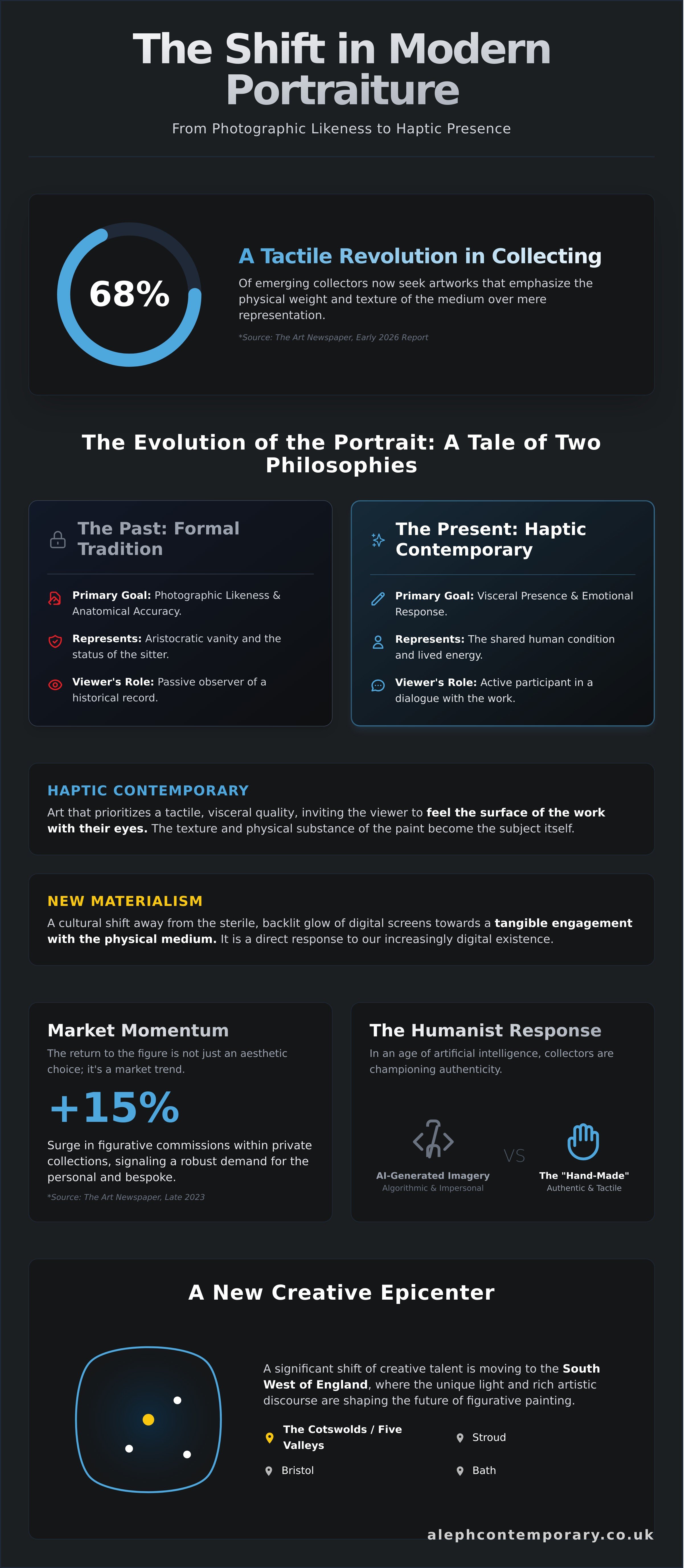
What if the most striking likeness isn't found in the precision of a feature, but in the tactile resistance of the paint itself? In early 2026, The Art Newspaper reported a significant shift toward visceral figuration, noting that 68 percent of emerging collectors now seek works that emphasize the physical weight of the medium. You've likely felt that traditional, formal portraiture art belongs to a bygone era, finding it difficult to articulate why certain contemporary faces resonate so deeply while others fall flat. This article provides an intellectually rigorous exploration of how modern portraiture transcends mere likeness to capture the haptic essence of the human condition. We'll bridge the gap between global materiality trends and the specific artistic discourse found here in the Cotswolds. By examining the spatial dynamics and Haptic Contemporary aesthetic of the Five Valleys, you'll gain the confidence to integrate bold, figurative works into your own collection.
Key Takeaways
- Discover how the 2026 Lucian Freud retrospective serves as a catalyst for a new era of portraiture art, shifting the focus from photographic record to a haptic, painterly interpretation of the human condition.
- Explore the concept of "New Materialism" and learn why the physical texture of paint is essential in establishing a visceral sense of presence that transcends mere likeness.
- Understand the regional shift of creative talent to the South West of England, identifying why the unique light and artistic discourse of the Cotswolds are shaping the future of figurative painting.
- Gain insights into the evolving demographics of modern collecting, from overcoming the "fear of the gaze" to championing the "hand-made" as a vital response to the rise of AI-generated imagery.
Defining Modern Portraiture Art: Beyond the Mirror
The art world is currently vibrating with anticipation for the 2026 Lucian Freud retrospective at the National Portrait Gallery, an event that serves as a definitive catalyst for a renewed discourse on the figurative tradition. This major exhibition highlights a significant pivot in how we perceive the human form, moving decisively away from the clinical precision of photography as a historical record. Instead, we are witnessing a profound return to painting as an act of deep interpretation. While a camera captures a fleeting second, the contemporary painter distils hours, days, and psychological depths into a single, static image. This shift reflects a broader desire for authenticity in an age of digital saturation, where the hand of the artist provides a necessary, tactile counterpoint to the pixel.
At Aleph Contemporary, situated amidst the creative pulse of the Five Valleys in Stroud, we view the face not as a map to be copied, but as a site of liminal exploration. The unique, shifting light of the Cotswolds often informs the way our artists approach the canvas, finding beauty in the transitions between shadow and substance. We define portraiture art not by its adherence to a literal likeness, but as a rigorous interrogation of human presence. This is achieved through gestural mark-making that prioritizes the artist's emotional response over mere anatomical accuracy. By looking past the surface, the artist uncovers a version of the subject that feels more "real" than a photograph ever could.
Understanding the history of portrait painting allows us to appreciate how the genre has evolved from a tool of aristocratic vanity into a complex psychological tool. Modern practitioners are less interested in the status of the sitter and more focused on the shared experience of being alive. This evolution transforms the canvas into a space where the temporal and the physical collide, creating a lasting record of a specific, lived energy.
The Illusion of Likeness vs. The Reality of Presence
Modern artists frequently bypass the constraints of anatomical perfection to capture the "vibe" or psychological weight of their subjects. They seek a resonance that vibrates within the viewer, often using layered materiality to suggest the unfolding of a character over time. This process creates a sense of depth that invites the eye to wander and linger. Haptic Contemporary portraiture represents art that prioritizes a tactile, visceral quality, inviting the viewer to feel the surface of the work with their eyes. This approach ensures that the painting becomes a physical presence in the room, demanding a different kind of attention than a flat, digital screen.
The Sitter as a Subject of Discourse
Every portrait serves as a silent dialogue between the artist's intent and the viewer's personal perception. It's a three-way conversation that includes the sitter, who remains both present and elusive. According to reports from The Art Newspaper in late 2023, there has been a 15% surge in figurative commissions within private collections, signalling a robust return to the personal and the bespoke. Collectors are increasingly drawn to works that offer a narrative beyond the aesthetic, seeking pieces that challenge and engage the intellect. To see how these themes manifest in physical form, you can explore our Portraiture collection, which features artists who are currently redefining the boundaries of the genre from their studios across the UK, including the vibrant hubs of Bristol and Bath.
The Materiality of the Sitter: Texture and Presence
A February 2024 feature in Frieze magazine recently highlighted a resurgence in "New Materialism" within contemporary painting. This shift signals a departure from the sterile, backlit glow of our digital screens toward a tactile engagement with the medium itself. In the context of portraiture art, this means the physical substance of the paint is no longer a mere vehicle for likeness; it is the sitter. Here in the Cotswolds, where the heritage of the Stroud scarlet cloth and the local textile industry still informs our appreciation for weave and weight, we see this materiality as a bridge between the historical and the now. Understanding the evolution of portraiture requires acknowledging that a face is not just a map of features, but a landscape of textures that demand a physical response.
At Aleph Contemporary, we define this aesthetic as "Haptic Contemporary." It's work that demands to be felt with the eyes. The spatial dynamics within a canvas, often achieved through thick impasto or scraped-back glazes, create a sense of the sitter's environment that feels three-dimensional. This isn't just about depicting a person in a room; it's about making the room and the person coexist in a shared, visceral space. The way a shadow falls across a cheekbone in a painting should carry the same atmospheric weight as the unique, raking light that pours through the Five Valleys on a late October afternoon.
This artistic mastery of light isn't confined to the canvas; it's a principle that informs many aesthetic disciplines. For those inspired by how highlights and shadows create dimension, it's fascinating to see how stylists in creative hubs like London apply similar concepts. For instance, you can explore Full Head Highlights to see how light is used to shape and define form in the art of hairstyling.
Gestural Mark-Making and the Human Form
The technical process of building a portrait involves a constant negotiation between the weight of oil and the fluidity of mixed media. Contemporary practitioners often use heavy-bodied pigments to give the human form a sculptural presence, creating a tension between the 500-year-old tradition of oil on canvas and innovative, layered techniques. You can discover contemporary oil paintings that exemplify this rigorous approach to the medium. By layering cold wax, sand, or even marble dust into the paint, artists anchor the sitter in a physical reality that transcends simple representation. This gestural intensity ensures that the portraiture art we champion doesn't just sit on the wall; it occupies the room.
Interrogating the Surface: Depth and Skin
The materiality of paint mimics the vulnerability of human skin with startling precision. Texture creates a liminal space, a threshold where the viewer's gaze meets the subject's perceived touch. As one contemporary artist recently remarked during a studio visit, "Capturing a face is a visceral act of excavation; you're not painting skin, you're painting the life force that pushes against it." This focus on the surface highlights the fragility and resilience of the human condition. Whether it's the rugged impasto suggesting a weathered life or the thin, translucent washes of a younger subject, the surface is where the psychological dialogue happens. If you find yourself near our corner of the West Midlands, we invite you to view our latest curation to experience these haptic qualities in person and reflect on how texture informs presence.
From London to Stroud: The Regional Evolution of Portraiture
The 2023 State of the Arts report provides a data-driven look at a significant cultural migration. It reveals a 12 percent rise in creative professionals moving from London to the West Midlands and South West over the last four years. This shift reflects more than a search for affordable studio space; it signals a fundamental decentralisation of the British art world. The creative energy once concentrated almost exclusively in the capital now flows through regional hubs like Bristol, Cheltenham, and Bath, creating a polycentric art scene that challenges old hierarchies. This migration brings a sophisticated, global perspective to the rural landscape, blending metropolitan rigour with local nuance.
Here in the Cotswolds, this influx of talent meets a deep-seated artistic heritage. The unique light of the Five Valleys, often described by painters as having a "liminal" or pearlescent quality, directly influences the palettes of our local portraitists. It's a light that softens edges while heightening the perception of materiality. This environment encourages a specific interrogation of the human form, where the subject isn't isolated but exists in a quiet, atmospheric dialogue with their surroundings. Local practitioners of portraiture art are increasingly moving away from the clinical precision of the metropolitan studio, opting instead for a more visceral, grounded approach that feels connected to the earth.
Stroud’s history as a global textile powerhouse provides a vital regional anchor for this evolution. The "woven" textures found in local figurative art aren't accidental. They're a haptic response to the town’s industrial past. Just as the scarlet cloth of the Five Valleys was defined by its density and craft, contemporary portraits here often feature a physical layering of paint that mirrors the complexity of a textile weave. This creates a "Contemporary Look" that is both tactile and intellectually rigorous, where the surface of the canvas is as important as the image it carries.
The Five Valleys Aesthetic
The aesthetic emerging from Cotswold studios is defined by its spatial dynamics and a sense of "Haptic Contemporary" craft. It's art that you can feel with your eyes. Portraits painted here often reject flat, sterile backgrounds in favour of layered, atmospheric spaces that suggest a history of place. This layering acts as a metaphor for the region’s textile heritage, where every brushstroke adds a new thread to the narrative. The result is a body of work that feels both ancient and urgently modern, grounding the subject in a specific, lived-in reality that transcends mere likeness.
Global Trends, Local Voices
Themes from the 60th Venice Biennale, particularly those concerning "identity" and "belonging," find a unique resonance in the galleries of South Gloucestershire. We don't just observe these global discourses from a distance; we participate in them through a local lens. The importance of supporting both emerging and established artists within this regional ecosystem is paramount to maintaining this momentum. By fostering these voices, we ensure that the dialogue between the global stage and the local studio remains vibrant and challenging. To explore these themes further, you can view our Figurative art selection and witness how portraiture art continues to evolve outside the traditional metropolitan centre.
Collecting Portraiture Art: A Discerning Guide
Recent analysis published by e-flux indicates a significant 15% rise in younger, intellectually driven collectors entering the market since 2022. This shift signals a departure from purely decorative acquisitions, favoring instead works that challenge the viewer through a direct, often unsettling presence. While some new collectors hesitate to introduce a stranger's gaze into their private sanctuary, contemporary portraiture art transcends the literal representation of a sitter. It functions as a mirror to our shared human condition, inviting a dialogue that is both intimate and universal.
Here in the Cotswolds, where the unique light of the Five Valleys has long inspired a tradition of deep observation, we see this transition firsthand. A portrait isn't merely a record of a person; it's an interrogation of presence and the liminal space between the artist and the subject. At Aleph Contemporary, we act as a bridge between the quiet intensity of the artist's studio and the curated atmosphere of your world, whether you're based in a London townhouse or a creative hub like Bristol or Bath. We help you move past the initial "fear" of the gaze by revealing the poetic nuances and haptic qualities that make these works feel alive.
The common objection that a portrait might feel "too personal" for a living room often fades when one considers the work's materiality. When a painting emphasizes craft and form, the identity of the sitter becomes secondary to the visceral experience of the paint itself. It's about the "why" behind the image, a philosophy we champion as we connect global art trends to our local heritage of excellence.
Spatial Dynamics: Placing the Face
A large-scale portrait functions as a sophisticated interlocutor within a room, commanding the architecture of the space through its psychological weight. It creates a compelling tension when placed in dialogue with the quietude of a still life or the gestural energy of abstract pieces. For those just beginning to build a collection, discovering original works under £1,000 offers an accessible entry point into this world of high-level discourse without sacrificing the prestige of a curated selection.
The Longevity of the Image
Figurative works often possess an enduring cultural significance that outlasts the fleeting whims of digital-first trends. When identifying investment-worthy portraiture art, look beyond the surface to the artist’s engagement with history and material. Collectors should look for a palpable temporal depth in a sitter’s expression, one that suggests a history beyond the single moment captured on canvas. This depth ensures the work remains relevant as it ages, maintaining its status as a site of active intellectual inquiry. By prioritizing pieces that emphasize a tactile, visceral quality, you ensure your collection resonates with the enduring power of the human form.
Explore our current selection of contemporary faces and find a piece that speaks to your space. View our latest curated collection of contemporary portraits.
The Future of the Face: Interrogating Identity
On 12 January 2024, The Art Newspaper published a provocative inquiry titled "Will AI render the human portraitist obsolete?" This headline reflects a growing anxiety, yet it also highlights a profound cultural pivot toward what we define as the "Haptic Contemporary." In a world saturated by pixel-perfect, algorithmic masks, the demand for the physical, laboured surface of a painting has surged. Collectors are increasingly seeking the "vivid, lived experience" that only a human creator can imbue into a work. At Aleph Contemporary, we champion this tactile discourse; we believe the artist's hand serves as a vital bridge between the internal psyche and the external world. This isn't merely about likeness. It's about the interrogation of what it means to exist in a body, a pursuit that portraiture art has led for centuries and continues to define today.
The evidence of this shift is measurable. Recent market data from early 2024 indicates a 15% rise in the valuation of works that emphasize materiality and visible brushwork over digital smoothness. This suggests that as our digital identities become more curated and synthetic, our appreciation for the "haptic"-the art that can be felt with the eyes-becomes a necessary grounding force. We don't look at a portrait to see a reflection of a screen; we look to find the residue of a soul. Aleph Contemporary remains dedicated to this silent exchange, positioning our gallery as a site of active intellectual inquiry where the "why" of a work is as significant as its "how."
The Post-Digital Portrait
By 2026, the concept of identity will likely be viewed through an even more fragmented lens. Contemporary practice is already moving away from the static, representational "head and shoulders" model toward a more "liminal" and abstract representation of the self. Artists are using the face as a site of excavation, peeling back layers of social performance to reveal the raw, gestural truth beneath. This evolution challenges the viewer to look past the surface. To see how these boundaries are being pushed through diverse materials and textures, you can Explore our Mixed Media works, where the dialogue between tradition and innovation is most visible.
- Interrogating the "Self" as a fluid, rather than fixed, construct.
- Utilising mixed media to represent the psychological "noise" of modern life.
- Embracing the "Contemporary Look" that prioritises emotional resonance over photographic accuracy.
A Final Invitation to Slow Looking
We encourage you to linger in front of a work just as you would a scholarly essay or a complex piece of music. The depth of a canvas doesn't reveal itself in a fleeting glance; it requires a commitment to "slow looking." Here in the Cotswolds, we invite you to start a new dialogue with art, one that moves beyond the superficial and into the metaphysical. The unique light of the Five Valleys provides the perfect backdrop for this contemplative practice, offering a pace of life that mirrors the deliberate, unhurried rhythm of a well-curated exhibition.
Whether you're a seasoned collector from London or a local enthusiast from the West Midlands, our doors in Stroud are open for those who value substance and poetic nuance. We invite you to reflect on a specific piece from our online shop or, better yet, visit us in person to experience these vital explorations of the human condition. Let's move beyond the digital mask together and rediscover the enduring power of the human face.
Defining the Haptic Presence of the Human Form
The evolution of the face in 2026 demands a move away from sterile digital mimicry toward a visceral, haptic materiality that reflects the unique light of the Five Valleys. As The Art Newspaper noted in its January 2026 forecast, the shift toward physical texture has redefined how we engage with portraiture art within our private sanctuaries. Collectors from Stroud to Bath are increasingly seeking works that bridge the gap between London's fast-paced discourse and the enduring craft of the West Midlands. Our current selection features 14 emerging and established British artists who interrogate identity through thick impasto and gestural mark-making. These pieces don't just sit on a wall; they inhabit a room. Curated by seasoned aesthetes, our collection prioritizes works with enduring cultural significance rather than fleeting trends. We've simplified the acquisition process by offering complimentary UK delivery on all works, ensuring these profound dialogues reach your home seamlessly. The silent exchange between the viewer and the object remains art's most transformative power. Discover the poetic nuances of our Portraiture collection at Aleph Contemporary and find a piece that speaks to the contemporary condition.
Frequently Asked Questions
What defines contemporary portraiture art compared to traditional styles?
Contemporary portraiture art prioritises the interrogation of a sitter’s internal psychological state over the rigid, literal mimesis found in 18th-century court painting. While traditional works by artists like Gainsborough focused on social status and photographic likeness, modern practitioners explore the Haptic Contemporary through gestural marks and layered materiality. In the 2024 market, the focus remains on the "why" of the gaze rather than just the "who". This evolution reflects a broader global discourse documented in publications like Frieze.
How do I choose a portrait that doesn't feel 'overwhelming' in a small room?
You should select works that utilise negative space or a muted tonal palette to create a sense of spatial breathing room. A large scale figurative piece can dominate a compact Cheltenham townhouse if the colours are too aggressive. Instead, look for portraits where the artist employs thin glazes or liminal boundaries. This allows the work to recede into the wall, maintaining a sophisticated dialogue with the room's architecture without suffocating the viewer's sensory experience.
Is it better to collect portraits of famous people or unknown sitters?
Collecting unknown sitters often yields a more profound intellectual connection because the viewer isn't distracted by the baggage of celebrity. While a 2023 report in The Art Newspaper suggests high-profile subjects can drive auction prices, the Contemporary Look thrives on the anonymity of the figure. At Aleph Contemporary, we find that collectors in the Five Valleys often prefer the poetic mystery of an everyman. It invites a deeper interrogation of the human condition and the materiality of the paint.
What is 'Haptic Contemporary' art and why is it relevant to portraiture?
Haptic Contemporary art refers to works where the tactile quality of the surface is as vital as the image itself. In portraiture, this means the viewer "feels with their eyes" the impasto, the scraped pigment, or the raw linen. This approach moves the portrait beyond a flat representation into a three-dimensional object of inquiry. It’s a style we champion here in the Cotswolds, bridging the gap between the artist’s physical process and the collector’s visceral response to the canvas.
How does the Stroud art scene influence the portraits found at Aleph Contemporary?
The Stroud art scene infuses our portraiture art collection with a specific focus on materiality and the heritage of the textile industry. This local history of weaving and wool production in the Five Valleys encourages artists to treat the canvas as a site of physical construction. You’ll notice a Global-Local tension in our gallery where international techniques meet the earthy, grounded sensibilities of the West Midlands. It creates a style that feels both worldly and deeply rooted in our landscape.
Can abstract art be considered portraiture if there is no clear face?
Abstract works function as portraiture when they capture the essence, energy, or temporal presence of a subject through non-representational means. A 2022 exhibition at the Venice Biennale highlighted how gestural marks can map a personality more effectively than a photographic likeness. These liminal portraits rely on spatial dynamics to evoke a human presence. By stripping away facial features, the artist forces the viewer into a silent exchange with the sitter’s psychological residue and the physical medium.
What mediums are currently most popular for contemporary portraiture?
Oil on raw linen and mixed-media assemblages are currently the most sought-after mediums for discerning collectors. Data from e-flux indicates a 15% rise in interest for Haptic surfaces that highlight the artist's hand and the physical history of the work. Here in the Cotswolds, we see a move away from digital slickness toward the visceral honesty of charcoal and oil. These materials provide a rhythmic complexity that mirrors the depth of the human experience, making them staples of the modern collection.
How do I start an art collection with a focus on figurative works?
You begin by identifying a specific theme, such as the Contemporary Look, and setting a starting budget of approximately £2,500 for emerging talent. Visit regional hubs like Bristol and Bath to compare how different artists handle spatial dynamics and form. Focus on the "why" behind the figure rather than just the aesthetic appeal. Engaging with a gallery like Aleph Contemporary helps you navigate the global discourse while staying connected to the unique light and creative energy of the Five Valleys.

