
Often relegated to the quiet corners of art history, dismissed as a mere academic exercise in mimesis, the genre of still life possesses a profound and enduring capacity for radical reinvention. For those who perceive it as an antiquated form, this perception belies its vibrant and continuous dialogue with the present; the arrangement of humble objects on a surface is not simply an act of representation, but a complex and layered meditation on materiality, the temporal nature of existence, and the very act of looking. This tradition, rich with symbolic weight, is currently undergoing a compelling re-interrogation, not in the sprawling metropolitan centres, but in the unexpected creative crucible of the English countryside.
This exploration will trace the profound lineage of the genre, moving from its historical roots to its dynamic contemporary resurgence. We will journey into the heart of the Cotswolds, a region unexpectedly fertile for artistic innovation, to discover how a new generation of artists are dismantling and reassembling its conventions. Join us as we uncover the conceptual depth behind these new works, offering a guide to appreciating—and perhaps acquiring—art that speaks with a quiet, yet insistent, contemporary voice, proving that the silent object has never had more to say.
Key Takeaways
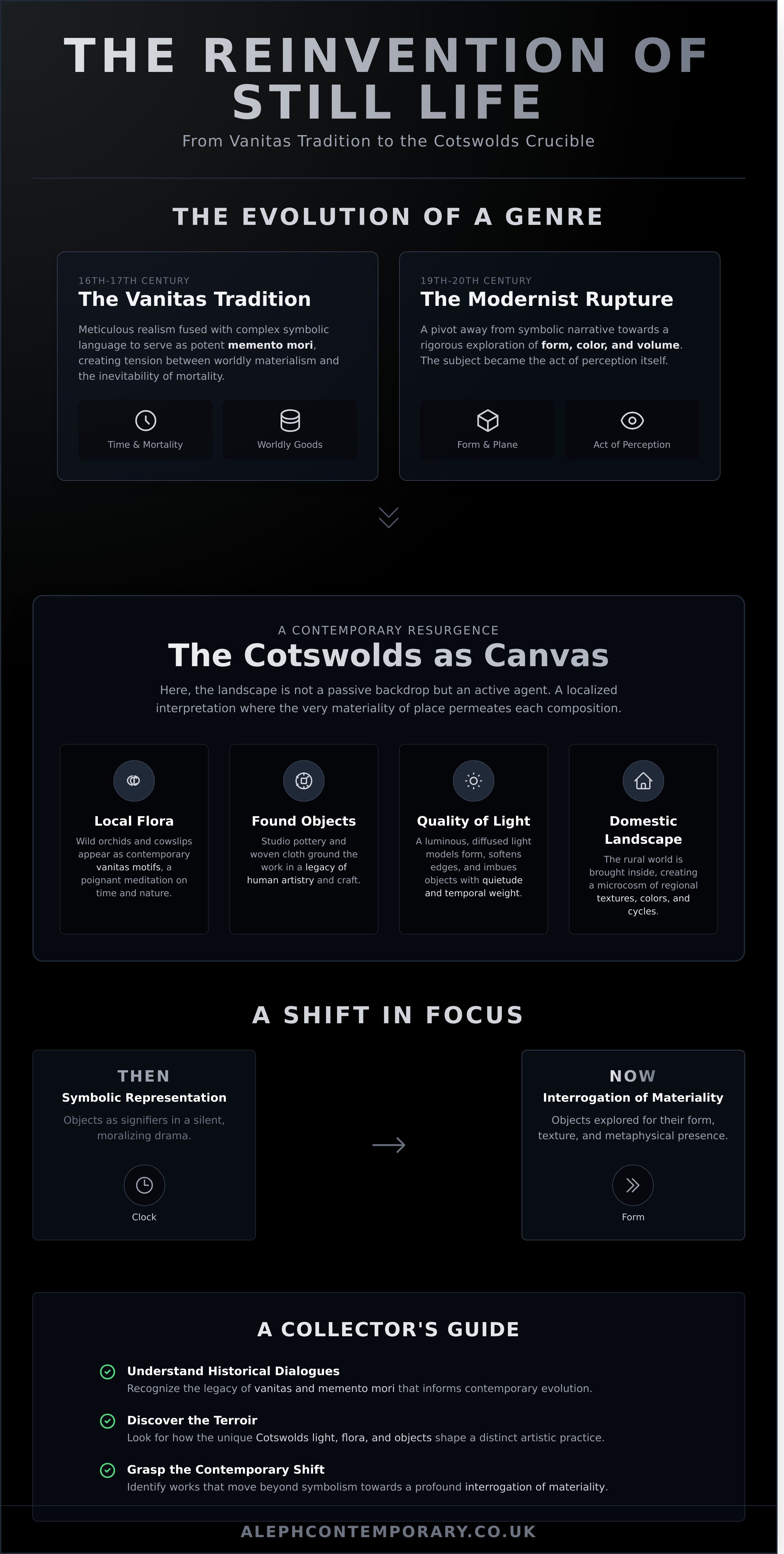
- Understand the historical dialogues of vanitas and memento mori that continue to inform the genre's contemporary evolution.
- Discover how the unique terroir of the Cotswolds—its specific light, flora, and objects—shapes a distinctly regional artistic practice.
- Grasp the contemporary shift from symbolic representation towards a profound interrogation of materiality in the modern still life.
- Acquire key principles for identifying significant contemporary works and learn how to integrate them into an established collection.
An Interrogation of Still Life: Beyond the Vanitas Tradition
To engage with the genre of still life is to enter a profound and centuries-old discourse on materiality, time, and the human condition. Originating in the lavishly detailed paintings of 16th and 17th-century Europe, the form was historically relegated to the lower rungs of academic hierarchy, yet it has persistently served as a crucible for artistic innovation. Within its seemingly modest arrangements of inanimate objects—from banquet tables to humble studio effects—artists have consistently located a space for the most resonant of human themes, interrogating the very nature of seeing itself.
The Semiotics of the Silent Object
The Dutch Golden Age marks the genre's apotheosis, where meticulous realism was fused with a complex symbolic language. These compositions, rich with the allegorical vocabulary of the Vanitas tradition, served as potent memento mori. A skull, a guttering candle, or a timepiece would sit amidst opulent displays of fruit and flowers, creating a deliberate tension between worldly materialism and the inevitability of mortality. Every object was a signifier in a silent, moralising drama. Contemporary artists often re-contextualise this semiotic legacy, stripping the symbols of their overt didacticism to explore more personal or ambiguous meanings in the quiet object.
From Cézanne to Cubism: A Modernist Rupture
The modernist epoch instigated a fundamental rupture, pivoting the genre away from symbolic narrative towards a rigorous exploration of form. Paul Cézanne, in his obsessive studies of apples and pitchers, dismantled traditional perspective, reassembling objects not as symbols but as arrangements of colour, plane, and volume. This revolutionary approach laid the groundwork for Picasso and Braque, who weaponised the still life as the primary laboratory for their Cubist experiments. Later, Giorgio Morandi’s contemplative, lifelong devotion to arrangements of bottles and jars revealed a different path—a meditative inquiry into the metaphysical presence of the mundane. For modernism, the subject was no longer the object itself, but the act of perception.
The Cotswolds as Canvas: Finding Still Life in the Stroud Valleys
To engage with the contemporary art emerging from the Stroud Valleys is to understand that the Cotswolds landscape is not merely a passive backdrop but an active agent in the creative discourse. While the classical definition of still life often frames the genre as a universal exercise in formal arrangement, artists here are proposing a deeply localised interpretation, one where the very materiality of place permeates each intimate composition. The region's unique geology, its rich history of craft and making, and its specific ecology converge on the canvas, creating works that are inextricably tied to their geographic origins. This is a dialogue between the artist’s interior world and the ancient, rolling hills that contain it.
Local Flora and Found Objects
The objects chosen for these compositions form a distinctly regional vernacular. Wild orchids and cowslips foraged from the footpaths of the Cotswold Way appear not merely as decoration, but as contemporary vanitas motifs, their fleeting beauty a poignant meditation on time and nature. These ephemeral elements are often placed in dialogue with the quiet permanence of local studio pottery or a fragment of woven cloth from the valleys' historic mills, grounding the work in a legacy of human artistry. This creates a 'domestic landscape' within the home, a microcosm where the rural world—its textures, colours, and cycles—is brought inside, contrasting sharply with the manufactured objects that often populate the urban still life tradition.
The Quality of Light: Painting in the Cotswolds
Perhaps the most defining characteristic of Cotswolds painting is its profound sensitivity to light. A luminous, often diffused light, filtered through the region’s famously mutable weather systems, washes over the limestone hills and valleys. This unique atmospheric quality, a quality that historically drew artists like William Rothenstein to these hills, profoundly influences colour palettes, muting them towards earthy ochres, soft greys, and the deep, resonant greens of a rain-soaked pasture. This same light, when filtered through a studio window, transforms the interior space. It does not merely illuminate; it models form, softens edges, and imbues the humble objects of a still life with a profound sense of quietude and temporal weight.
Contemporary Practice: Materiality and New Dialogues
The contemporary Cotswolds art scene, mirroring a global shift, reveals a profound interrogation of the still life tradition. Artists today are less concerned with faithful mimesis and more with the conceptual and material possibilities of the object. This evolution has opened a vibrant discourse between the historical weight of the genre and the innovations of modern practice, transforming the quiet tableau into a dynamic site of aesthetic and philosophical inquiry. The dialogue is no longer solely about mortality or wealth; it is about the very texture of modern existence.
Innovations in Medium and Technique
The classical hierarchy of oil on canvas has been productively dismantled, giving way to a rich exploration of new forms. While Tate's definition of still life grounds the genre in the arrangement of inanimate objects, contemporary practitioners expand the very material possibilities of that arrangement through mixed media, sculptural assemblages, and digital collage. The influence of photography is pervasive, informing compositional strategies that fragment and reframe the object, while the painterly surface itself has become a subject of investigation. We see a fascinating tension between the meticulous precision of hyperrealism and the raw, gestural brushwork of more abstract interpretations, each offering a distinct meditation on the act of looking.
The Enduring Relevance of the Mundane
In an age of mass production, artists increasingly turn their focus to the quotidian, finding a strange and compelling beauty in the objects that populate our daily lives. The plastic container, the discarded smartphone, the crumpled receipt—these items enter the still life lexicon, charged with the psychological weight of personal and collective experience. This focus on the mundane becomes a powerful lens through which to explore complex themes of consumer culture, domesticity, and the fleeting nature of our material world. The arrangements are no longer mere vanitas; they are quiet, potent reflections on a life lived amongst things. Discover contemporary artists exploring these themes.
A Collector's Guide to Acquiring Still Life in the Cotswolds
To acquire a work of art is to enter into a dialogue—one that extends from the artist’s studio into the intimate context of one’s own space. For the discerning collector in the Cotswolds, the enduring genre of still life offers a particularly rich field for this exchange, bridging historical precedent with the most urgent of contemporary aesthetic interrogations. Investing in this genre is an investment in a quiet, contemplative power that holds its value not through fleeting trends, but through its profound connection to the history of seeing.
Developing a Discerning Eye
Cultivating an informed perspective requires looking beyond the superficial subject to the artist’s unique vision and conceptual rigour. One must consider the formal elements—composition, the nuanced application of colour theory, the materiality of the medium—as evidence of technical mastery. Yet, it is the artist’s intellectual engagement with the tradition that truly distinguishes a significant work. Understanding an artist’s history and a work’s provenance are crucial, but nothing can replace the direct encounter. To experience the physical presence and subtle textures of a piece in person, at galleries like our own space in Stroud, is an indispensable part of this critical process.
Building a Collection with Narrative
A collection achieves its greatest resonance when its individual works converse with one another. A contemporary still life can create a compelling dialogue when placed alongside a gestural landscape or an incisive portrait, each piece informing and complicating the other. This narrative can be further deepened by juxtaposing historical and contemporary interpretations of the genre, tracing a lineage of thought across centuries. Within a domestic setting, a carefully chosen work can anchor the aesthetic of an entire room, its scale and placement thoughtfully considered to create a focal point for contemplation and conversation.
Aleph Contemporary: Your Stroud-Based Guide
At Aleph Contemporary, our curatorial approach is predicated on identifying artists who are not merely practicing within a genre but are actively expanding its discourse. The artists we represent engage with the formal and philosophical questions of the still life, offering works of enduring intellectual and aesthetic substance. Navigating this landscape requires a trusted interlocutor, and our role is to provide the critical context that illuminates an artwork’s significance. We invite you to extend this exploration. Begin a conversation with our curators today.
The Enduring Dialogue of the Quiet Object
As we have explored, the contemporary reinterpretation of still life, particularly within the fertile artistic landscape of the Cotswolds, transcends the didactic moralism of the vanitas tradition. It is a genre reborn, engaging in a profound new discourse where the materiality of the object and the unique temporal quality of the Stroud Valleys converge to challenge our perceptions of the quiet, everyday object.
This ongoing dialogue between historical precedent and contemporary innovation is precisely what informs our mission. As a leading contemporary art gallery in Stroud, our expert curation presents a unique collection of works by established and emerging British artists who are redefining the genre. For new and experienced collectors alike, we offer personalised guidance to help you navigate this compelling artistic landscape. We invite you to explore our curated collection of contemporary still life and discover the powerful resonance of these works for yourself.
Frequently Asked Questions
Is still life painting considered a good art investment?
Still life has demonstrated remarkable longevity within the art market, often representing a stable and discerning investment. The value of a particular work is contingent upon several factors, including the artist's exhibition history, the quality of the execution, and its place within their broader oeuvre. For collectors in the UK, acquiring a piece from an artist with a growing reputation can yield significant cultural and financial returns. Ultimately, the soundest investments are those pieces that possess enduring artistic significance.
How does contemporary still life differ from traditional works?
While traditional still life often engaged with themes of vanitas and the transience of life through meticulous realism, contemporary interpretations embark on a more conceptual interrogation. Today’s artists deconstruct the genre, exploring the materiality of modern objects, the psychology of domestic space, and the liminal state of the inanimate in a hyper-mediated world. This shift represents less a rejection of history and more a complex, ongoing dialogue with its formal and symbolic legacies.
What is the best way to display a still life painting in a modern home?
Displaying a still life within a modern interior is an exercise in creating a focused, contemplative moment. Consider placing the work against a minimalist wall to allow its compositional intricacies to command attention. Utilise a dedicated picture light to accentuate texture and colour. Positioning a piece in a less conventional space, such as a study or a dining area, can initiate a profound daily dialogue between the artwork and its domestic environment, transforming the mundane into the meaningful.
Can I find high-quality, original still life art for sale near Stroud?
Indeed, the area surrounding Stroud is a vibrant nucleus for contemporary art within the Cotswolds, offering discerning collectors numerous opportunities. Esteemed galleries in the region, including our own Aleph Contemporary, frequently exhibit artists who are reinterpreting the genre. We also recommend exploring the renowned open studio events, such as those by SIT select, which provide direct access to the creators shaping the local and national artistic discourse. The quality of work is exceptionally high.
What should I look for in the technique and composition of a still life?
Beyond verisimilitude, one should assess the artist's command of materiality and spatial dynamics. Examine the gestural quality of the brushwork and the way light is rendered to articulate form and atmosphere. A compelling composition creates a visual rhythm, guiding the viewer’s eye through a deliberate arrangement of forms, colours, and negative space. The most profound examples of still life are those where technical prowess is not an end in itself but a vehicle for deeper conceptual exploration.
How do artists in the Cotswolds incorporate the local environment into still life?
Cotswolds artists often move beyond direct representation, embedding the local environment into the very essence of their work. This is evident not merely in the choice of subject—such as locally foraged flora or unearthed geological fragments—but in a profound sensitivity to the region's unique quality of light. The pastoral landscape informs the palette, the mood, and the temporal sense of the piece, creating a powerful dialogue between the interior domestic scene and the ancient land beyond.

