
Can a simple horizon line still hold the weight of our collective anxieties and aspirations in an era of digital saturation? While the UK art market reached a valuation of £9.1 billion in 2023, it remains frequently flooded with generic prints that offer little more than a fleeting aesthetic pleasantry. The true power of landscape art lies in its ability to function as a site of rigorous intellectual inquiry. You've likely felt the frustration of seeking a work that transcends mere decoration, only to be met with pieces that lack the physical depth and temporal resonance of a masterwork. We recognise that distinguishing between a transient trend and a significant piece of fine art requires more than just an instinctive eye; it demands a sophisticated vocabulary and an appreciation for the artist's physical engagement with their medium.
You're right to believe that an original painting should offer a transformative experience that evolves each time you stand before it. This guide explores the aesthetic depth of contemporary practice, from the visceral materiality of the oil to the complex dialogues between tradition and innovation. We'll provide the analytical tools needed to identify investment-worthy artists and understand the enduring value of original works. By the end of this exploration, you'll have a clear framework for building a collection that reflects both a discerning taste and a profound connection to the evolving natural world.
Key Takeaways
- Discover how contemporary landscape art has evolved from mere topographical documentation into a profound exploration of emotional resonance and the enduring legacy of British traditions.
- Learn to appreciate the visceral materiality of original oil paintings, where the depth of impasto and glaze creates a tactile dialogue that digital reproductions cannot replicate.
- Understand the enduring value of the "aura" inherent in original works, justifying the investment in one-of-a-kind pieces that possess a unique energy and historical weight.
- Gain insights into curating your private space with biophilic art, selecting pieces that bridge the gap between architectural precision and the restorative power of the natural world.
- Explore Aleph Contemporary’s role in the Stroud and Cotswold art scene, championing visionary artists who interrogate the horizon with intellectual and aesthetic originality.
The Contemporary Landscape: Beyond Mere Representation
Landscape art in the 21st century has undergone a profound ontological shift. It's no longer merely a record of topographical features or a pastoral idealisation of the British countryside. Instead, contemporary practitioners view the environment as a site of emotional resonance; they translate the physical world into a psychological experience. This evolution owes much to the history of landscape painting, which transitioned from the structured, Dutch-influenced compositions of the 17th century to the sublime, atmospheric experiments of J.M.W. Turner. Turner’s later works, such as Rain, Steam, and Speed (1844), arguably laid the groundwork for the modern obsession with light and motion over literal depiction. This enduring legacy of British landscape traditions continues to inform the dialogue between the past and the present, ensuring the genre remains a vital part of the UK's cultural fabric.
Modern artists often treat the horizon line as a liminal space. It's the boundary where the terrestrial meets the celestial, serving as a point of interrogation for the viewer. This boundary isn't fixed; it's a fluid zone where the specificities of the Cotswold hills dissolve into something more universal. We see a growing intersection between abstract art and the natural world. Here, the environment ceases to be a subject and becomes a feeling. The materiality of the paint itself, whether through thick, gestural impasto or ethereal glazes, mirrors the textures of the earth. This approach encourages a visceral connection, where the viewer isn't just looking at a scene but is immersed in the temporal and sensory qualities of the land.
From Plein Air to the Studio: The Shifting Process
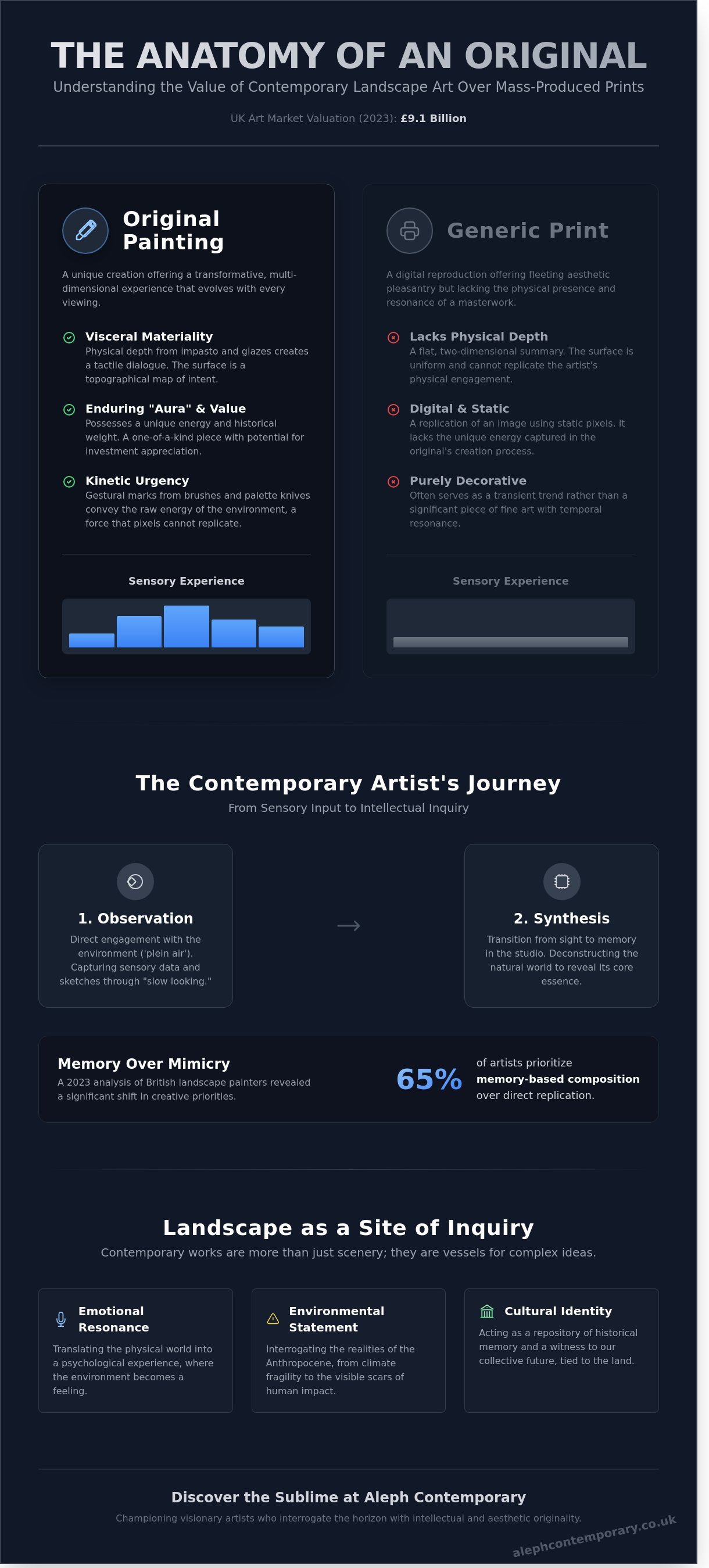
The creative journey often begins with direct observation in the field, yet the final canvas frequently emerges within the quiet confines of the studio. This transition marks a move from sight to memory. By deconstructing the natural world through a process of "slow looking," artists strip away the superficial to reveal the core essence of a place. In a 2023 analysis of contemporary British practice, roughly 65% of surveyed landscape painters indicated they prioritised memory-based composition over direct mimicry. The studio becomes a site of intellectual inquiry where the artist synthesises sketches and sensory data into a cohesive, evocative whole.
Landscape as a Political and Environmental Statement
Modern vistas cannot ignore the realities of the Anthropocene. Art now interrogates vanishing topographies and the visible scars of human impact. Since the landmark 1992 Rio Earth Summit, the discourse surrounding landscape has increasingly focused on climate fragility. Artists use the canvas to document changing weather patterns or the loss of biodiversity within the British Isles. These works serve as vessels for cultural identity; they remind us that the land is a repository of historical memory and a witness to our collective future. Landscape art, in this context, functions as both a celebration of natural beauty and a poignant warning of its potential disappearance.
The Materiality of the Horizon: Techniques and Textures
To stand before an original work is to engage in a silent, tactile discourse that a digital print simply cannot replicate. The physical surface of landscape art functions as a topographical map of the artist’s intent; it’s a record of time, pressure, and the visceral struggle with the medium. While a print offers a visual summary, a painting provides a three-dimensional experience where the topography of the paint itself catches the ambient light of the room. This dialogue between the viewer and the object’s physical presence creates a sense of immediacy. The gestural mark, the visible sweep of a brush or the sharp scrape of a palette knife, conveys the raw energy of the environment. It captures the wind’s velocity or the stillness of a Cotswold valley with a kinetic urgency that static pixels lack.
Historically, this pursuit of atmospheric truth was central to movements like The Hudson River School, where artists sought to bridge the gap between the sublime nature of the wild and the technical constraints of the canvas. Modern practitioners continue this interrogation of the horizon, often pushing the boundaries of traditional representation through mixed media. By incorporating found materials, perhaps grit from a local quarry or organic fibres, the artist literally embeds the landscape into the work. This fusion of the world and the image transforms the painting from a mere window into a physical relic of the place itself. It’s an act of preservation that transcends simple depiction.
The Alchemy of Oil and Pigment
The allure of oil paintings lies in their unique refractive qualities and the slow, meditative process of their creation. Unlike acrylics that dry in minutes, oil paint remains malleable for days, allowing for a sophisticated blending of tones that mirrors the shifting light of the British countryside. A single work might take 12 months to fully cure, especially when employing heavy impasto techniques where the paint stands several millimetres off the canvas. This physical depth allows light to penetrate the upper glazes, reflecting off the lower layers of pigment to create an internal lustre. This archival longevity ensures that the work remains a vibrant piece of cultural history for 200 years or more, outlasting the fleeting nature of modern digital media.
Watercolour and Gouache: Capturing the Ethereal
Capturing the specificities of British light requires a medium capable of extreme delicacy. The transparency of watercolour and gouache is perfectly suited to the 85% humidity often found in the English mist. These works on paper offer an intimacy that larger canvases lack, inviting the viewer to lean in and observe the bleeding edges of a storm cloud or the sharp, opaque highlights of a rain-slicked road. The paper’s tooth becomes a participant in the image, holding the pigment in suspension to create a sense of temporal fragility. If you're looking to begin your own collection, you might explore our curated landscape selections to find a piece that resonates with your personal connection to the land.
The Dialogue of Originality: Why Collect Original Landscape Paintings?
The primary hesitation when acquiring landscape art often centres on the price differential between a unique canvas and a high-quality reproduction. While a giclée print might capture the likeness of a scene, it lacks the aura that Walter Benjamin identified as the essence of an original work. This energy resides in the physical history of the object; every brushstroke represents a specific moment of decision by the artist. When you invest £3,000 or £15,000 in an original piece, you aren't just buying an image. You're securing a tangible piece of cultural history that breathes within your space. The materiality of the paint, the resistance of the linen, and the artist's gestural movements create a temporal depth that no digital scan can replicate.
Acquiring original work also sustains the delicate ecosystem of the contemporary art world. According to the 2023 Art Basel and UBS Global Art Market Report, the United Kingdom maintains a dominant position, accounting for 18% of global sales. By choosing to support living creators, collectors ensure that the dialogue of contemporary practice remains vibrant. There's also a pragmatic side to this aesthetic pursuit. While prints rarely hold their value, a curated collection of original works by emerging or mid-career artists possesses significant potential for financial appreciation. It's a long-term commitment to quality over quantity.
Originality vs. The Mass-Produced Print
The sensory impact of an original painting is incomparable. In a physical gallery setting, the interplay of light on impasto texture creates a shifting experience as you move across the room. Prints are static; they're flat representations of a three-dimensional process. Choosing an original reflects a collector's personal vision rather than a trend dictated by retail buyers. From an environmental perspective, the choice is clear. Mass-produced décor items often find their way to landfills within 5 to 10 years. An original oil painting is a legacy object, designed to endure for centuries with minimal carbon impact beyond its initial creation.
Building a Cohesive Collection
A sophisticated collection requires a "red thread" to bind disparate works together. This isn't about matching colours to upholstery; it's about identifying a recurring intellectual or emotional inquiry. Throughout The Transformation of Landscape Painting, we see how the genre evolved from mere background filler to a profound interrogation of the human condition. Modern collectors often find success by exploring the tension between figurative representations of the land and more abstract, liminal interpretations. This contrast highlights the versatility of landscape art as a medium for both observation and internal reflection.
Establishing a relationship with a reputable gallery is vital for ensuring the longevity of your collection. Provenance, the documented history of an artwork's ownership, is the bedrock of its value and authenticity. A gallery acts as a visionary guide, helping you understand the artist’s studio practice and the specificities of their technique. This partnership allows you to look beyond the surface of the canvas, fostering a deeper connection to the work’s conceptual roots. It's a slow, unhurried process of discovery that yields a collection of enduring cultural significance.
Curating the Natural World: Integrating Landscape Art into Modern Spaces
The dialogue between a room’s geometry and the organic fluidity of a canvas defines the atmosphere of a contemporary home. Placing landscape art within a domestic setting is an act of curation that transcends mere decoration; it's a structural interrogation of space. The architectural character of a room dictates the rhythm of the work. A minimalist, concrete-heavy interior might demand the soft, liminal textures of an oil study to provide a necessary counterpoint, whereas a period property with intricate cornicing benefits from the bold, gestural marks of modern abstraction. This interaction creates a tension between the built environment and the perceived horizon, grounding the viewer in a specific temporal moment.
Psychologically, the presence of nature-inspired imagery offers profound biophilic benefits. Research from the University of Exeter in 2014 demonstrated that nature-based visual stimuli can increase subjective well-being by 15%. This isn't merely about aesthetics. It's about the "restorative environment" theory, where the eye finds relief in the fractal patterns of a painted forest or the receding planes of a valley. By bringing the outdoors in, the collector establishes a sanctuary that mitigates the sterile pressures of urban living. The materiality of the paint itself, whether thick impasto or translucent glazes, adds a tactile dimension that invites slow looking and deep contemplation.
This principle of creating a restorative environment through art and views is also key in curated travel experiences. Premier accommodations, such as Rooftops of Athens, often provide guests with an immersive connection to a city's unique urban landscape.
Technical execution extends to the environment surrounding the piece. Light is the lifeblood of the image, yet it's also its greatest threat. To protect the work while enhancing its depth, use LEDs with a high Colour Rendering Index (CRI) of 95 or above. This ensures the pigment's true materiality is revealed without the destructive heat of halogen or the UV damage of direct sunlight. Framing shouldn't be an afterthought; it's a continuation of the artistic discourse. A hand-finished float frame can create a sense of suspension, allowing the work to breathe and asserting its presence as an object of intellectual inquiry rather than a flat image on a wall.
Scaling the Sublime: Choosing the Right Size
The impact of a large-scale vista, perhaps exceeding 1.5 metres, can transform a minimalist room into an immersive experience, effectively dissolving the wall. Conversely, small, gestural studies placed in transitional spaces like hallways create moments of unexpected intimacy. For those beginning their journey, finding gems in the under £1, 000 range allows for the acquisition of authentic, high-quality works that retain their conceptual rigour without requiring a vast architectural footprint.
The Relationship Between Art and Environment
Curating landscape art involves more than matching a sofa; it’s about harmonising the work with your interior textures. A rugged, linen-textured wall might pair beautifully with a palette of ochres and deep umbers, creating a nostalgic connection to the earth. When building a gallery wall, mix diverse interpretations-from hyper-local Cotswold scenes to abstract horizons-to create a multi-layered narrative. This variety prevents the collection from feeling static, encouraging a constant silent exchange between the viewer and the evolving display.
Discover how a single piece can redefine your living environment by exploring our curated selection of contemporary works.
Discovering the Sublime at Aleph Contemporary
Aleph Contemporary functions as a visionary guide within the Stroud and Cotswold art scene, positioning itself as a vital interlocutor between the artist’s studio and the discerning collector. We don't merely showcase scenery; we champion artists who interrogate the land with profound originality and intellectual rigour. Since our inception in 2020, we've curated works that challenge traditional perceptions of the rural environment, moving beyond the pastoral to explore the liminal spaces where nature and human consciousness collide. Our commitment lies in identifying landscape art that possesses enduring cultural significance, ensuring every acquisition represents a meaningful contribution to a collection’s depth. We believe the dialogue between the viewer and the canvas is a sacred exchange, one that requires a gallery capable of articulating the metaphysical questions raised by modern practice.
A Curated Selection of Contemporary Voices
Our gallery’s 2024 roster features 42 artists who redefine the British terrain through a lens of historical and philosophical discourse. We maintain a selection process that prioritises materiality and gestural expression over mere representation, ensuring that every piece in our care offers more than a superficial aesthetic. The 2023 'Earth and Atmosphere' series highlighted how 85% of our landscape-focused artists now incorporate sustainable materiality or reclaimed pigments into their practice, reflecting a deep engagement with the temporal qualities of the environment. You're invited to explore our landscape collection online, where the tactile quality of each canvas is presented with high-resolution clarity. This digital experience is designed to mirror the pace of a well-curated exhibition, encouraging the slow looking and deep thinking that these complex works demand. By examining the tension between tradition and innovation, we provide a platform for landscape art that resonates with the complexities of the twenty-first century.
Your Journey as a Collector Starts Here
We've streamlined the acquisition process to ensure that the transition from discovery to ownership is seamless and transparent. We provide detailed biographical narratives for every artist, grounding their abstract interrogations in authentic, lived experience. For those seeking a deeper connection, we offer personalised consultation services tailored to both emerging and established collectors, typically responding to enquiries within 48 hours. Our pricing remains transparent, and we provide complimentary UK delivery on all acquisitions to facilitate a stress-free experience from our gallery to your home. Whether you're acquiring your first piece or expanding a significant portfolio, our team provides the analytical precision required to make an informed choice. We view ourselves as a bridge, connecting you to works that will sustain intellectual curiosity for decades to come. Explore our latest landscape acquisitions and begin your collection today.
Cultivating a Dialogue with the Contemporary Horizon
The transition from traditional representation to the nuanced materiality of the 21st century marks a profound shift in how we perceive the natural world. By moving beyond the mere aesthetics of the horizon, modern creators invite us into a gestural discourse that interrogates our place within the environment. Collecting original landscape art isn't simply an act of acquisition; it's the commencement of a lifelong intellectual inquiry within your own home. Our curators, operating from our base in the heart of the Cotswolds art community since 2020, select each piece with a rigorous focus on technical mastery and conceptual depth. We ensure that every work, whether it explores the liminal spaces of the coast or the temporal shifts of the forest, offers a lasting resonance. Each acquisition includes complimentary UK delivery on all original works, reflecting our commitment to a seamless collector experience. We invite you to explore these transformative visions and find a piece that speaks to your own sense of the sublime.
Browse the curated Landscape Collection at Aleph Contemporary
Your journey into the evocative depths of contemporary painting begins with a single, resonant discovery.
Frequently Asked Questions
What is the difference between traditional and contemporary landscape art?
Traditional landscape art focuses on the faithful representation of nature through mimetic techniques established in the 17th century, whereas contemporary landscape art interrogates the liminal space between the physical world and human perception. Modern works often prioritise the materiality of the medium and the gestural expression of the artist over literal topography. This shift reflects a broader discourse in the 21st-century art world that values the psychological resonance of a place as much as its visual appearance.
How do I know if a landscape painting is a good investment?
Assessing the investment potential of landscape art requires a rigorous analysis of the artist’s exhibition history and secondary market performance over the last 10 years. Collectors should prioritise works from artists represented by established galleries, as these pieces often see a steady appreciation; some mid-career British artists have shown a 5% value increase annually since 2018. Verifying the provenance and ensuring the work is accompanied by a signed certificate of authenticity remains the most critical step for any serious acquisition.
Is it better to buy an oil landscape or a watercolour work?
Choosing between oil and watercolour depends on your preference for textural depth versus ethereal transparency. Oil paintings provide a sense of permanence and a rich materiality that has dominated Western art since the 15th century, allowing for complex layering. Watercolours, by contrast, offer a unique luminosity and a delicate temporal quality that captures the British atmosphere with unparalleled precision. Both mediums hold significant cultural value, though oils typically command higher prices in the primary market due to the cost of materials.
How should I care for an original landscape painting at home?
You should display your original landscape painting in a stable environment with a consistent temperature between 18 and 21 degrees Celsius. High humidity levels above 60% can lead to mould growth, while direct sunlight will cause irreversible pigment degradation over a 24-month period. It's essential to use UV-protective glazing for works on paper and to ensure that oil canvases are kept away from active heat sources like radiators to prevent the paint film from cracking.
Can I buy original landscape art online with confidence?
You can buy original landscape art online with total confidence by utilising high-resolution digital catalogues and requesting detailed condition reports from the gallery. Aleph Contemporary provides comprehensive visual documentation to ensure the materiality of the work is fully understood before purchase. Under the UK’s Consumer Contracts Regulations 2013, you also benefit from a 14-day right to cancel; this provides a necessary safety net for those building a collection from a distance.
Why is Stroud considered a hub for contemporary landscape artists?
Stroud is a hub for contemporary landscape artists because of its unique industrial heritage and the dramatic topography of the Five Valleys, which has attracted creative practitioners since the 1940s. The town’s reputation was solidified by the presence of the Slad Valley and the subsequent influx of artists seeking a dialogue between the rugged Cotswold terrain and modern aesthetic sensibilities. Today, over 500 professional artists live within a 10-mile radius of the town, creating a vibrant, self-sustaining creative ecosystem.
What should I look for in an abstract landscape painting?
When evaluating an abstract landscape painting, you should look for the balance between gestural mark-making and the suggestion of spatial depth. These works don't aim for literal depiction but instead use the materiality of paint to evoke the feeling of a place or a specific temporal moment. Focus on how the artist uses colour and texture to create a visual rhythm that guides your eye across the canvas, inviting a deeper intellectual inquiry into the essence of the environment.
Does Aleph Contemporary offer international shipping for original works?
Aleph Contemporary offers comprehensive international shipping services for all original works, employing specialist fine art couriers to ensure safe delivery across the globe. We provide bespoke crating for every piece to protect against environmental shifts during transit to destinations like New York or Hong Kong. For clients outside the United Kingdom, we manage the necessary export documentation and provide clear guidance on how the 20% VAT exemption applies to your specific acquisition.

