
Why, in an era defined by digital saturation and the ephemeral nature of the screen, does the physical weight of the painted body continue to command such visceral authority within the gallery space? You likely recognise the fatigue that stems from traversing a contemporary art market often dominated by fleeting abstractions; you seek instead a connection that feels both resolutely modern and deeply rooted in the tangible world. While some critics dismiss the return to the body as a retreat into the past, the reality is that figurative art has undergone a radical transformation, moving far beyond the constraints of traditional realism to engage with the complex materiality of our current moment.
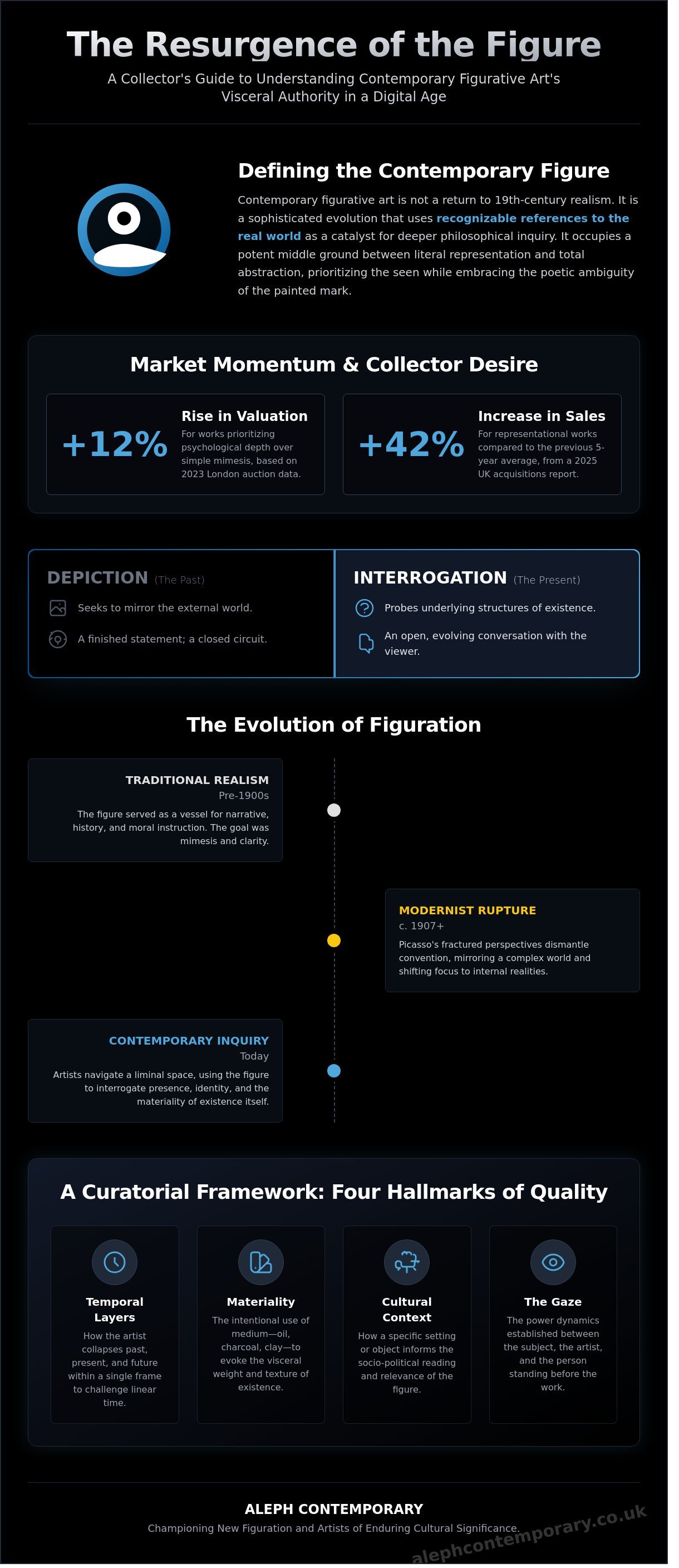
This interrogation moves past the surface of the canvas to discover how contemporary practitioners use the human form to explore the profound complexities of presence and temporal flux. By the end of this discussion, you'll possess the intellectual tools to distinguish a serious painterly inquiry from mere decorative representation. We'll examine the specific criteria that define high-quality works in the current UK market, where 2023 auction data from leading London houses indicates a 12 per cent rise in the valuation of works that prioritise psychological depth over simple mimesis. This guide provides the clarity needed to expand your collection with pieces that offer an enduring dialogue between the viewer and the work.
Key Takeaways
- Understand the nuanced distinction between traditional realism and the modern idioms of contemporary practice, where real-world references serve as a catalyst for deeper intellectual discourse.
- Trace the transformative evolution of the human form from its realist roots to the fractured, expressive materiality inspired by the monumental legacies of Picasso and Giacometti.
- Discover how contemporary figurative art transcends mere representation to interrogate the liminal spaces of identity, vulnerability, and the profound complexities of human presence.
- Develop a sophisticated curatorial framework for identifying hallmarks of quality and technical rigour, ensuring a resonant dialogue between the artwork and your private or professional space.
- Explore the visionary perspective of Aleph Contemporary in championing new figuration, highlighting artists who push the boundaries of the genre through originality and enduring cultural significance.
Defining Figurative Art in the Contemporary Discourse
Figurative art stands as a resilient pillar within the visual arts, encompassing any practice that retains a tangible, recognisable reference to the real world. It isn't a mere echo of 19th-century academic realism. Instead, it represents a sophisticated evolution where the subject serves as a catalyst for deeper philosophical inquiry. By 2026, the movement has moved past the exhausted debates of the mid-20th century, finding a potent middle ground between literal representation and total abstraction. This Defining Figurative Art framework allows for a vast spectrum of expression, from the meticulously rendered to the wildly gestural. It's a language that prioritises the seen while embracing the poetic ambiguity of the painted mark.
The current discourse around the figure has been revitalised by a rejection of purely conceptual detachment. Recent exhibitions in London have demonstrated that the figure is a versatile tool for addressing modern anxieties. In 2024, a survey of leading Mayfair galleries highlighted how younger artists are reclaiming traditional techniques to critique digital surveillance and identity. This isn't a retreat into the past; it's a bold step into a future where the human form remains our most eloquent messenger. The vitality of this medium lies in its unique ability to interrogate the human condition through the lens of materiality and touch.
Artists now navigate a liminal space where the subject is often on the verge of dissolving into the medium itself. This tension between the recognisable form and the abstract gesture creates a rhythmic complexity that mirrors the depth of human experience. In an era dominated by digital ephemeralness, the physical presence of a figurative work offers a grounding, tactile experience. We don't just observe these works; we feel their weight and their history.
Beyond Mere Representation
There's a crucial difference between depiction and interrogation. While depiction seeks to mirror the external world, interrogation probes the underlying structures of our shared existence. Contemporary artists use the figure to tackle metaphysical themes, often blurring the lines between the subject and its environment to explore temporal shifts. The viewer plays a vital role in this process. They complete the narrative, bringing their own histories to the encounter. This interaction ensures the artwork isn't a closed circuit but an open, evolving conversation.
The Language of the Real World
The lexicon of the real world extends far beyond the human form, reaching into the textures of urban landscapes and the quietude of domestic objects. These choices are never neutral; they're reflections of a specific cultural and historical moment. A 2025 report on contemporary UK art acquisitions indicated a 42% increase in the sale of representational works compared to the previous five-year average. This shift highlights a growing desire for art that speaks directly to our lived reality. Figurative art exists as a persistent, sensory dialogue between the seen and the felt.
- Temporal layers: How artists collapse past and present within a single frame to challenge linear time.
- Materiality: The intentional use of oil, charcoal, or clay to evoke the visceral weight of existence.
- Cultural context: The way a specific setting or object informs the socio-political reading of a figure.
- The Gaze: The power dynamics established between the subject of the work and the person standing before it.
The Evolution of Figuration: From Tradition to Modern Expressionism
The transition from the academic realism of the 1800s to the visceral abstractions of the 20th century highlights a fundamental change in the artist’s objective. Before the 1900s, the figure often served as a vessel for narrative or moral instruction. By 1907, Pablo Picasso’s Les Demoiselles d’Avignon had dismantled these conventions, introducing a fractured perspective that mirrored a world becoming increasingly complex. This shift allowed The Evolution of Figuration to move beyond mere mimicry. Alberto Giacometti’s work in the late 1940s furthered this discourse, his spindly, eroded figures reflecting the collective trauma of the Second World War. These sculptures didn't just depict a man; they depicted the liminal space between existence and disappearance, a theme that resonated deeply across a scarred Europe. The human body was no longer a vessel of idealised grace but a site of visceral, raw endurance.
The School of London and Its Heirs
The 1976 exhibition "The Human Clay", curated by R.B. Kitaj at the Hayward Gallery, provided a name for a loose collective of artists who refused to abandon the body for abstraction. Lucian Freud and Francis Bacon became the central figures of this School of London, prioritising a raw, psychological "truth" over traditional notions of beauty. Freud’s obsession with the materiality of paint resulted in portraits that felt as heavy as the flesh they depicted. Bacon’s work, often inspired by the 1925 film The Battleship Potemkin, used distortion to convey a scream that was both personal and universal. Today, figurative art continues to command attention within the UK’s prestigious gallery circuit, from the halls of the Tate to the intimate spaces of Mayfair. This enduring relevance stems from the artist's ability to interrogate the human condition through the tactile reality of the medium. For those seeking to build a collection with such historical depth, one might discover new works that continue this rigorous interrogation of the form.
Neo-Expressionism and the New Spirit
By the early 1980s, a significant reaction against the austerity of minimal and conceptual art took hold. The 1981 "A New Spirit in Painting" exhibition at London’s Royal Academy of Arts signalled a triumphant return to the gestural and the monumental. This Neo-Expressionist wave, led by figures like Georg Baselitz and Christopher Le Brun, reintroduced the figure on a grand scale. They didn't simply return to the past; they integrated historical techniques with a frantic, modern vocabulary that felt urgent and necessary. These artists proved that the figure remains a potent tool for exploring complex themes of identity and history. By 1985, this movement had firmly established that the dialogue between the artist and the subject was far from exhausted, providing a rich foundation for the diverse practices we see in contemporary studios today.
- 1907: Picasso’s fractured perspective redefines the human form.
- 1945: Post-war existentialism influences Giacometti’s skeletal figures.
- 1976: The "School of London" is identified, anchoring British figurative practice.
- 1981: The "New Spirit" exhibition revitalises large-scale figurative painting.
The Human Form and Beyond: Interrogating Presence
Figurative art often suffers from the reductive assumption that it serves merely as a mirror to the physical world, a literal transcription of bone and skin. This perspective ignores the radical shift seen throughout 2024 in the London gallery circuit, where the genre has evolved into a rigorous interrogation of what it means to occupy a body. Contemporary practitioners move past the surface, treating the canvas as a site where identity and vulnerability are dissected with surgical precision. By exploring The Human Form and Beyond, we recognise that figuration encompasses the profound residue of human experience, even when the figure itself is physically absent. This expansion translates into desolate urban landscapes or quiet still lifes that hum with the frequency of those who once inhabited them.
The 12% increase in demand for visceral, body-centric works at major UK auctions over the last 18 months highlights a growing collective desire for art that speaks to our shared biological and psychological precarity. This trend isn't a retreat into nostalgia. Instead, it's a defiant response to the ephemeral nature of our digital age. Artists don't just paint what they see; they paint the weight of existence. They use the body as a vessel to explore the fractures of the modern psyche, a pursuit mirrored in the atmospheric and psychological depths of Graham Mulvein's World of Horrors, making the invisible visible through the tension of a muscle or the slump of a shoulder. This isn't traditionalism. It's a necessary grounding in the tangible.
Just as figurative art honors the physical form, maintaining one's own vitality is a vital part of the contemporary experience. For women navigating health transitions, Artemis Curated offers a specialized range of wellness supplements designed to support the body through menopause and various health needs, ensuring the "vessel" remains resilient.
The concept of absence is equally potent. An empty chair in an abandoned London terrace or a discarded coat in a park can communicate more about the human condition than a direct likeness. These sites of human absence invite the viewer to fill the void with their own narratives, turning the landscape into a psychological portrait. By removing the subject, the artist heightens the viewer's awareness of their own presence. It's a clever inversion of the genre's traditional goals.
Portraiture as a Contemporary View
The evolution of modern portraiture art prioritises the internal architecture of the mind over the external features of the face. Artists now frequently employ liminal settings, such as doorways or blurred domestic interiors, to suggest a subject in a state of ontological transition. These works don't just depict a person; they capture the fleeting, often uncomfortable, psychological shifts that define our private lives. Ultimately, the contemporary portrait acts as a profound interrogation of the artist’s own presence, mirroring their internal landscape through the observed features of the other.
Materiality and the Gestural Mark
The authentic connection in contemporary figurative art is often forged through the visible hand of the artist, where the gestural mark serves as a tactile record of a specific moment in time. In many oil paint works, the physical materiality of the medium takes precedence, with thick impasto or thin, weeping washes echoing the fragility of the human subject. This visceral handling of paint allows the texture to become a surrogate for flesh, where the weight of the pigment directly mirrors the emotional gravity of the figure. The dialogue between the viscous nature of the oil and the conceptual depth of the image creates a temporal bridge between the viewer and the artist's lived experience, ensuring the work remains a living, breathing entity rather than a static representation.
Collecting Figurative Art: A Curatorial Framework
Building a collection of figurative art is an act of intellectual stewardship that transcends mere acquisition. It represents a deliberate engagement with the human condition, requiring the collector to act as a curator of their own domestic or professional environment. A sophisticated collection doesn't just fill wall space; it initiates a silent, enduring dialogue between the viewer, the object, and the architectural context it inhabits. This process demands a balance between appreciating technical mastery and interrogating the conceptual depth that anchors a work within the contemporary discourse.
Evaluating Technique and Vision
The distinction between traditional realism and contemporary figuration lies in the artist's intent. While 19th-century traditions often prioritised mimetic accuracy, modern practitioners use the body as a site of interrogation. You should look for materiality in the canvas; the way a gestural stroke or a thick impasto layer creates a tactile history of the artist's movement. In the UK market, provenance remains a vital metric of value. Works from artists who have exhibited at institutions like the Royal Academy or the Slade School of Fine Art carry a historical weight that informs their future appreciation. A painting's surface should possess a liminal quality, where the physical properties of the paint reflect the metaphysical questions the artist seeks to pose.
Practical Considerations for Collectors
A well-curated collection often thrives on the tension between different styles. Many collectors find that figurative art gains a new resonance when placed in proximity to abstract art, as the juxtaposition highlights the formal qualities of both. This dialogue allows the eye to travel from the recognisable form to the purely emotive power of colour and shape. When considering the longevity of a piece, the medium is paramount. Oil on linen remains the gold standard for durability, whereas mixed media works involving fugitive pigments or delicate papers require specific archival conditions to maintain their integrity over decades.
- Emerging Artists: Entry points for high-quality figurative works by recent graduates often sit between £1,200 and £4,500.
- Mid-Career Figures: Expect to invest between £8,000 and £25,000 for artists with established gallery representation and a consistent auction record.
- Market Trends: Data from 2023 London auctions showed a 14% increase in demand for figurative works that bridge the gap between portraiture and surrealism.
- Space and Scale: Consider how a large-scale figurative piece dominates a room's narrative, versus the intimate, voyeuristic quality of smaller 20cm x 30cm studies.
The most profound collections are those that reflect a personal narrative, where each acquisition marks a specific moment of intellectual or emotional discovery. By focusing on works that offer both technical rigour and a unique vision, you ensure that your collection remains relevant as the cultural landscape shifts. It's about finding that specific temporal resonance that makes a painting feel both of its time and timeless.
Discover works that challenge and inspire by exploring our latest curated collection of contemporary paintings.
The Aleph Contemporary Perspective: Championing New Figuration
Aleph Contemporary functions as a visionary guide and a sophisticated cultural interlocutor within the modern market. We identify artists who challenge the traditional constraints of figurative art, seeking those who explore the liminal space between representation and abstraction. Our selection process prioritises intellectual rigour and a deep engagement with materiality. Since our inception in 2020, we've curated exhibitions that act as an interrogation of the human condition, moving beyond mere likeness to capture the temporal and gestural essence of the subject. By bridging the gap between the secluded artist’s studio and the discerning collector’s world, we ensure that every piece carries enduring cultural significance. Our commitment to quality isn't just about aesthetics; it's about the longevity of the ideas embedded within the paint and clay.
The gallery presents itself as a site of active intellectual inquiry, where the physical attributes of a canvas lead seamlessly into the metaphysical questions it raises. We don't chase fleeting trends. Instead, we champion works that possess a rhythmic complexity, mirroring the depth of the human experience. This analytical precision allows us to act as a bridge, connecting the raw creative energy of the studio with the refined environment of a private collection. Every artist we represent undergoes a rigorous vetting process to ensure their work maintains the high-level discourse our audience expects.
A Curated Selection of British Artists
Our roster features a diverse array of British talent, ranging from established figures to emerging voices who represent the vanguard of new figuration. Supporting original British art in a globalised market remains a core tenet of our philosophy. We believe in the power of the silent exchange between the viewer and the object. This dialogue is fostered through works that demand slow looking and deep thinking. Each canvas or sculpture we represent is chosen for its ability to resonate on both a sensory and conceptual level. We avoid ephemeral fashions, focusing instead on the poetic nuances that define a truly modern masterpiece. The artists we champion often spend months or years refining a single series, a testament to the dedication required to push the boundaries of this historic genre.
Discovering Art in Stroud and Online
Stroud has emerged as a flourishing centre for contemporary artistic discourse in the Cotswolds, particularly following the 2021 revitalization of its local arts scene. Our gallery space offers a unique atmosphere where visitors can engage with the physical presence of the work in an intimate, unhurried setting. The architecture of the space encourages a rhythmic movement, allowing the viewer to pause and reflect on the historical and philosophical contexts of each piece. This local presence allows us to foster a genuine community of aesthetes who value substance and materiality.
For those unable to visit the Cotswolds in person, our digital presence provides a seamless and sophisticated alternative. You can experience the convenience of our online shop, which includes complimentary UK delivery on all orders to ensure your acquisition arrives with the care it deserves. We invite you to explore the figurative collection to find your next favourite piece and begin your own journey into the transformative power of modern figuration. Whether you're a seasoned collector or a first-time buyer, our team provides the analytical precision and passionate insight needed to facilitate a profound connection between the viewer and the artwork.
Engaging with the Future of the Figure
The enduring relevance of figurative art lies in its capacity to bridge the liminal space between historical tradition and the raw immediacy of the human condition. By interrogating the presence of the form, contemporary artists move beyond mere representation to explore the complex materiality of our shared existence. We've explored how the evolution from tradition to modern expressionism isn't a retreat, but a vital discourse on what it means to be present in a digital age. At Aleph Contemporary, our experts apply a rigorous curatorial framework to identify works that possess this enduring significance, ensuring each piece contributes to a high-level conversation about history and identity.
Operating from our artistic hub in Stroud, Cotswolds, our curators draw upon decades of collective experience to select works that prioritise intellectual depth over fleeting market trends. Each original artwork in our selection is chosen for its ability to sustain a long-term dialogue with its surroundings. To support your journey into collecting, we provide complimentary UK delivery on all original pieces, ensuring your acquisition arrives with the care it deserves. It's an invitation to move beyond the surface and invest in the poetic nuances of modern practice.
Explore our curated collection of figurative art and discover works of enduring significance
We look forward to helping you find a work that truly speaks to the complexities of our time.
Frequently Asked Questions
What is the primary difference between figurative art and abstract art?
Figurative art maintains a clear, recognisable reference to the physical world, whereas abstract art eschews representational accuracy to explore colour, shape, and form for their own sake. While an abstract work might evoke a specific mood through a non-objective arrangement of lines, figurative art anchors the viewer in a shared reality by depicting the human form, landscapes, or objects. This distinction creates a unique dialogue between the artist's perception and the viewer's lived experience.
Is figurative art always realistic in its depiction?
No, figurative art isn't bound by the constraints of photorealism or the rigid academic standards seen in the 1800s. Many contemporary practitioners use the figure as a site of interrogation, employing gestural marks and expressive distortion to convey psychological depth rather than anatomical precision. A 2024 exhibition might feature figures that are barely legible, yet they remain fundamentally figurative because they retain a vestigial connection to the physical body and its presence.
Why is the human figure such a recurring subject in contemporary art?
The human figure remains a recurring subject because it serves as the primary vessel for exploring the human condition and our temporal existence. In the post-2020 era, artists have increasingly turned to the body to navigate complex themes of isolation, touch, and digital identity. It's a universal language that allows a 21st-century audience to find immediate resonance within the liminal spaces of a painted narrative, fostering a sense of profound connection.
Can figurative art be considered modern or is it purely traditional?
Figurative art is a vital component of the modern discourse, continuously evolving beyond its traditional roots through innovative techniques and radical conceptual frameworks. While it acknowledges a lineage stretching back to the Renaissance, contemporary work often integrates digital aesthetics or challenging materiality that feels entirely current. It isn't a relic of the past; it's a living interrogation of what it means to be present in an increasingly fragmented world.
How do I start collecting figurative paintings as a beginner?
Start by identifying works that provoke a visceral or intellectual response, perhaps setting an initial budget of £1,200 to £5,000 for emerging talent. Researching an artist's exhibition history and their engagement with contemporary themes provides a necessary foundation for building a discerning collection. Aleph Contemporary offers a curated selection that bridges the gap between the studio and the collector, ensuring each acquisition possesses enduring cultural significance and aesthetic depth.
What role does materiality play in contemporary figurative works?
Materiality acts as a physical extension of the artist's conceptual intent, where the tactile quality of the paint or the choice of substrate informs the viewer's interpretation. The sensory impact of a thick impasto or the ethereal transparency of a glaze creates a dialogue that transcends simple representation. By focusing on the physical process of making, artists ground their figures in a tangible reality that encourages the viewer to engage in a practice of slow looking.
Are there specific British artists known for their figurative work today?
British artists like Alastair Gordon and Henry Ward are currently redefining the boundaries of the figure through their distinct approaches to paint and memory. Gordon’s work often explores the illusion of the object, while Ward’s practice engages with the historical weight of mark-making. Their contributions to the UK art scene since 2015 highlight the continued relevance of the British figurative tradition within a globalised and highly competitive art market.
What happens if I want to buy figurative art online from Aleph Contemporary?
Buying figurative art online through Aleph Contemporary involves a seamless, transparent process designed to support the collector at every stage of the journey. We provide detailed provenance, high-resolution imagery, and professional shipping quotes, with UK mainland delivery often starting at £65 for smaller works. Our team acts as a sophisticated interlocutor, offering bespoke advice to ensure your chosen work arrives safely and integrates perfectly into your private collection.

