
What if the perceived silence of a non-representational canvas is actually a sophisticated interrogation of physical presence and historical discourse? Many collectors share the frustration of feeling adrift when a work refuses to offer a recognisable subject. It's difficult to distinguish between a hollow aesthetic exercise and the profound output of a dedicated abstract artist painter whose work challenges the boundaries of materiality. You aren't alone in seeking a more rigorous connection to the art you acquire.
This guide serves as your visionary interlocutor, providing the analytical precision needed to decode technical mastery and identify works with lasting significance. By examining the 2024 market's emphasis on haptic textures and the silent dialogue between the viewer and the object, you'll develop a deeper vocabulary for your collection. We'll unfold the nuances of the artist's process, ensuring you can invest with confidence in pieces that offer both intellectual resonance and enduring value within the British art market.
Key Takeaways
- Understand how the contemporary abstract artist painter moves beyond historical Modernism to engage in a deliberate interrogation of materiality, form, and space.
- Discover the physical relationship between medium and canvas and how the choice of oil, acrylic, or mixed media dictates the emotional resonance of a work.
- Master the philosophy of "slow looking" to decipher the silent dialogue within a piece and identify its unique emotional frequency through composition.
- Gain practical insights into curating a sophisticated collection, from discovering emerging works under £1,000 to selecting pieces that harmonise with your personal aesthetic.
- Learn how the Aleph Contemporary philosophy bridges the gap between the studio and the collector by championing artists who interrogate the human condition.
Defining the Role of the Abstract Artist Painter in the 21st Century
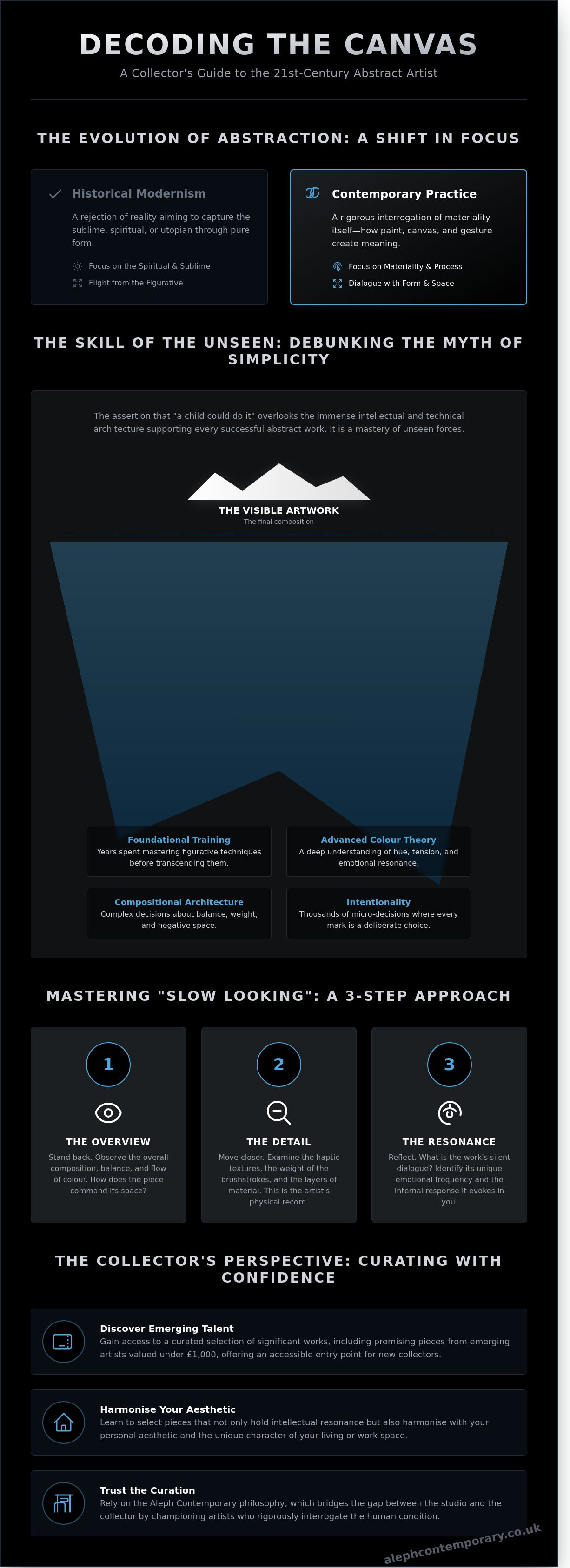
The role of the abstract artist painter in the 21st century has evolved into a sophisticated interrogation of the very foundations of visual language. Abstraction is no longer a simple rejection of reality or a flight from the figurative; it's a rigorous exploration of how form, colour, and space interact to create meaning without the crutch of representation. While the history of abstract art began with a desire to reach the sublime or the spiritual, contemporary practice is often more concerned with materiality. The physical weight of the paint, the texture of the linen, and the temporal nature of the brushstroke all contribute to a dialogue that is both ancient and urgently modern.
Digital trends may dominate much of the current cultural landscape, yet the hand-painted canvas remains central to global art discourse. There's an irreplaceable quality in the physical object that a digital file cannot mirror. A screen offers a flat, backlit approximation; a painting offers a three-dimensional encounter with history and process. Maintaining this non-representational narrative over a lifetime requires a level of intellectual discipline that is frequently underestimated. It's a constant negotiation between chaos and order, requiring the artist to justify every mark without the safety net of a recognisable subject.
Contemporary painters don't just apply pigment. They curate experiences of pure perception. This shift toward a nuanced materiality reflects a desire to ground the viewer in the present moment, away from the rapid-fire consumption of digital imagery. The abstract artist painter acts as a bridge between the visceral reality of the studio and the metaphysical questions of the soul.
This dedication to pure perception and artisanal depth is often mirrored in other sensory fields that prioritize complexity and provenance. For collectors who value the same level of curation in fragrance as they do in visual art, you can learn more about Maison Ephyr and their specialized collection of luxury and niche fragrances.
Beyond Representation: The Evolution of the Abstract Subject
The "subject" in contemporary abstraction has migrated from the external horizon to the internal psyche and the medium itself. Practitioners often inhabit the liminal space where the familiar dissolves into the unknown, creating works that function as mirrors for the viewer's own consciousness. This transition means the painting is no longer a window to another world but an object that exists on its own terms. The abstract artist painter acts as a visionary who translates the metaphysical into the physical through pigment and gesture. By focusing on the internal, the work achieves a universal resonance that transcends specific cultural or geographical boundaries.
The Skill of the Unseen: Debunking the Myth of Simplicity
Sceptics often dismiss non-figurative work with the claim that a child could replicate the marks. This view ignores the complex architecture of composition and colour theory that governs every successful work. Every stroke is a choice; it's an intentionality born from years of practice and observation. Consider that many of the most celebrated names in the field spent years mastering figurative techniques before choosing to transcend them. This foundational training provides the structural integrity that prevents a work from collapsing into mere decoration. The intellectual rigour found in a balanced composition is the result of thousands of micro-decisions regarding weight, tension, and hue. It's a mastery of the unseen forces that dictate how we perceive the world around us.
The Materiality of Abstraction: From Gestural Marks to Liminal Spaces
The physical relationship between the abstract artist painter and their medium is never merely transactional; it's a visceral, often exhausting dialogue that transforms the studio into a site of physical theatre. Every sweep of the brush or scrape of the palette knife leaves a permanent record of a specific moment in time. This gestural approach treats the canvas as a field of action rather than a passive receptacle for imagery. It creates a liminal space where the artist's movement and the viewer's perception eventually meet. The canvas becomes a topographic map of a singular human event, captured in pigment and binder.
To truly grasp what is abstract art?, one must acknowledge that the subject is frequently the process itself. The tension between the control of the hand and the unpredictability of the medium creates a unique emotional resonance that transcends representational forms. Modern techniques often push against traditional boundaries, using industrial tools or unconventional pigments to challenge the historical weight of the fine art canon. This evolution ensures that the materiality of the work remains at the forefront of the viewer's experience, forcing a direct confrontation with the object's physical reality and its temporal origins.
The Alchemical Allure of Oil and Mixed Media
The enduring prestige of oil paintings lies in their unique luminosity and the way they hold light within their complex layers. Because oil can take up to six months to fully oxidise and cure, the artist must work with a sense of patience that dictates a slow, meditative pace. This temporal weight adds a layer of seriousness to the work. In contrast, mixed media works introduce a three-dimensional grit that disrupts the smooth flow of traditional painting. By incorporating elements like pumice, textiles, or found objects, the artist adds a sensory layer that demands the viewer's physical presence. It turns the flat surface into a sculptural environment, inviting a tactile curiosity that goes beyond mere sight.
Pencil, Graphite, and the Power of the Line
There is a profound intimacy found in pencil and graphite works that often feels more direct than a heavily worked canvas. The line serves as a raw interrogation of space; it’s a carrier of rhythmic energy that reveals the artist's initial spark of thought without the distraction of hue. While a sketch might be a precursor to a larger work, a finished abstract drawing stands as a complete intellectual statement. It uses the stark contrast of carbon on paper to explore the architecture of the mind. The abstract artist painter who chooses graphite is often seeking a stripped-back clarity, where every mark is visible and every hesitation is exposed. This transparency creates a silent dialogue between the creator's hand and the viewer's eye, grounded in the simplicity of the mark.
This interplay of material and movement ensures that abstraction remains a living, breathing discourse. It's a field where the weight of a brushstroke can carry as much meaning as the colour itself. Those who wish to view contemporary examples of this material mastery can find works that bridge the gap between historical tradition and avant-garde exploration, offering a window into the evolving soul of modern practice.
Deciphering the Silent Dialogue: How to Engage with Abstract Artworks
To engage with an abstract work is to enter a state of active contemplation. It isn't a puzzle to be solved or a code to be cracked. Instead, it's a visceral encounter that requires a shift from the literal to the liminal. Most viewers approach art with a desire for recognition, yet the true power of abstraction lies in its refusal to offer easy answers. A 2017 study by the Art Institute of Chicago revealed that the average museum visitor spends a mere 28.6 seconds in front of a masterpiece. To truly witness the depth of a non-representational canvas, one must reject this hurried pace. Time is the collector's most potent instrument; it's the medium through which the painting begins to speak.
This "slow looking" allows the viewer to move past the initial shock of the unfamiliar and into a deeper resonance with the work's internal logic. When we stop searching for a recognisable figure or a landscape, we open ourselves to the painting's emotional frequency. This frequency is dictated by the vibration of colour and the tension of form. The meaning isn't found in a dictionary or a gallery guide; it's found in the silent exchange between the object and the viewer's current state of mind. A painting that feels aggressive on a day of personal turmoil might offer a sense of cathartic release on another. The artwork doesn't change, but our perception of its layers does.
Interrogating Colour and Composition
In the hands of a master, colour isn't merely a decorative element; it's the primary subject. It possesses a weight and a temperature that can alter the viewer's physical state. Consider how a saturated field of ochre can feel grounded and ancient, while a flick of neon violet introduces a jarring, contemporary anxiety. This emotional weight is balanced by the use of negative space, which functions as a breath or a silence within a musical composition. The void is just as vital as the mark. To fully absorb the atmospheric weight of a large-scale canvas, one should stand at a distance where the peripheral edges of the work just exceed the field of vision, allowing the chromatic field to dissolve the surrounding architecture.
The Rhythmic Complexity of the Gestural Mark
The surface of a painting is a map of a specific temporal event. By tracing the "hand" of the abstract artist painter, we can begin to reconstruct the speed, intensity, and physical exertion involved in the work's creation. Every drip, scrape, and impasto ridge captures a moment in time that has been frozen in pigment. This focus on the physical act of painting was a hallmark of the Abstract Expressionism movement, where the canvas transitioned from a window into a world to an arena in which to act.
There's a profound dialogue here between the artist’s original intention and the viewer’s unique interpretation. The abstract artist painter provides the syntax, but the viewer provides the narrative. It's a collaborative process of meaning-making that respects the intelligence of the audience. By embracing the rhythmic complexity of the brushwork, we acknowledge the painting as a living entity, one that continues to evolve each time a new pair of eyes meets its surface. It's an invitation to feel first and think later.
The Collector’s Perspective: Curating an Abstract Collection
The act of curating a private collection transcends mere acquisition; it’s a profound interrogation of one’s own relationship with materiality and the gestural language of the abstract artist painter. To live with a canvas is to engage in a perpetual dialogue with the artist’s intent, where the rhythmic complexity of the work informs the atmosphere of the domestic or professional space. While many begin their journey by exploring accessible works under £1, 000, the transition toward established masterpieces requires a discerning eye for provenance. A gallery functions as a visionary guide in this process, ensuring that the emotional resonance felt at first sight is anchored by the artist’s long-term cultural significance. Selecting a piece isn't just about matching a palette to a room; it’s about identifying a work that possesses a temporal weight, capable of holding its own within the historical discourse of modernism.
Acquiring Original Paintings Online
Collectors now possess the confidence to buy original paintings online in the UK through trusted galleries that prioritise transparency and scholarship. Digital catalogues have evolved beyond simple imagery; they now offer high-resolution details that allow for a meticulous evaluation of impasto, glaze, and the subtle interplay of light across a surface. Virtual exhibitions provide a sense of scale that was previously difficult to gauge outside a physical space. This digital shift is supported by the logistical ease of complimentary UK delivery, ensuring that the transition from the screen to the collector’s wall is seamless. Professional curation remains at the heart of this experience, providing the intellectual framework necessary to understand a work’s position within contemporary practice.
Investing in Emerging vs. Established Abstract Painters
The tension between the speculative thrill of the "up and coming" talent and the defensive stability of an established abstract artist painter defines the strategic side of collecting. Identifying an artist before they reach the secondary market requires an appreciation for raw innovation and a willingness to embrace the liminal stages of a career. Conversely, established painters offer a sense of prestige and historical continuity, their works having already been vetted by institutional exhibitions and academic discourse. Balancing these two categories allows a collection to feel both vibrant and grounded. The following table delineates the primary considerations for each category within the current UK market:
| Category | Price Entry Point | Risk Profile | Historical Context |
|---|---|---|---|
| Emerging | £500 - £4,500 | High (Speculative) | Fresh from the studio; early career. |
| Established | £15,000 - £100,000+ | Low (Defensive) | Proven secondary market; museum presence. |
A sophisticated collection seeks a synthesis between these worlds. It looks for the poetic nuances in a new graduate's gestural marks while respecting the authoritative brushwork of a painter who has defined the medium for decades. This balance ensures the collection remains a living, breathing entity rather than a static investment. By focusing on works that challenge the viewer intellectually, a collector contributes to the ongoing preservation of artistic legacy.
Discover your next acquisition by exploring our curated selection of original abstract paintings at Aleph Contemporary.
Discovering the Visionary Roster at Aleph Contemporary
Aleph Contemporary operates on a foundational belief that art should transcend mere decoration to interrogate the very essence of the human condition. Our gallery, situated in the historic town of Stroud within the Cotswolds, serves as a vital centre for contemporary discourse where the weight of tradition meets the friction of innovation. We curate a specific selection of abstract art that functions as more than a visual object; it's a primary document of a creator's intellectual journey. By positioning our physical space in Gloucestershire's creative heart, we provide a sanctuary for slow looking and deep thinking. This geographic choice isn't accidental. Stroud has fostered artistic rebellion and craftsmanship for over 100 years, making it the ideal landscape to host a dialogue between the past and the future of the abstract artist painter.
Our exhibition programme is designed to unfold like a scholarly essay, moving beyond simple aesthetics to explore how materiality and form can articulate the unspoken. We don't simply hang paintings; we stage explorations of space, light, and history. This commitment to depth ensures that every work we present carries a sense of prestige and authority. The dialogue we foster isn't limited to the gallery walls. It extends into the homes of collectors who seek works with a palpable sense of purpose and a connection to the broader movements of art history.
A Bridge Between the Studio and the World
We act as a sophisticated cultural interlocutor for the discerning collector. Our roster carefully balances the raw energy of emerging voices with the refined precision of established figures who've spent decades honing their craft. We don't chase the ephemeral trends that often flicker and fade in the global market. Instead, we focus on enduring significance and the longevity of artistic ideas. Each piece undergoes a rigorous selection process to ensure it possesses the gravitas required for a serious collection. You're invited to explore our full collection of contemporary artworks, where the boundary between the artist’s private studio and the public sphere dissolves. It's a space where the collector becomes a participant in the artist's ongoing narrative.
The Poetic Nuance of the Aleph Roster
The artists within our portfolio often explore the liminal space between form and feeling. Their work highlights a deep interrogation of materiality, where the physical properties of oil, pigment, and canvas become vessels for complex philosophical inquiries. We see this in the gestural urgency of our featured painters, whose marks on the surface record a temporal performance of thought. The sensory and conceptual impact of these works is palpable whether experienced in our Stroud gallery or through our digital exhibitions.
Our online shop offers a curated window into these practices, allowing collectors to acquire works that resonate with intellectual rigour and poetic nuance. Every abstract artist painter we represent is chosen for their ability to push the boundaries of the medium while maintaining a reverence for the craft's history. We encourage you to engage with our current programme, either by visiting us in the heart of the Cotswolds or navigating our virtual viewing rooms to witness how contemporary practice continues to redefine our understanding of the world. Through these works, we find a silent exchange that challenges, inspires, and ultimately transforms the viewer's perspective.
Elevating the Dialogue through Modern Abstraction
Embracing the work of an abstract artist painter involves more than a visual encounter; it's a commitment to a silent, ongoing dialogue between the viewer and the material world. We've explored how the 21st-century artist navigates the liminal spaces between gestural mark-making and philosophical inquiry, transforming the canvas into a site of active interrogation. By focusing on the nuanced materiality of each piece, you unlock a sensory experience that resonates far beyond the gallery walls.
Aleph Contemporary operates from the historic art centre of Stroud, Cotswolds, where we champion a meticulously selected roster of 40 international artists. Our collection bridges the gap between emerging talent and established masters, offering works that possess enduring cultural significance. To support your journey as a collector, we provide complimentary UK delivery on all original works, ensuring every piece arrives with the care it deserves. It's time to find the work that speaks to your unique perspective and enriches your personal environment.
Explore our curated collection of original abstract paintings
We invite you to begin this transformative exploration and discover a piece that truly resonates with your spirit.
While our focus remains on the collection of professional abstract works, the underlying power of art to transform and heal is universal. For those interested in the practical application of these principles in a professional setting, Art Therapy offers insights into how creative workshops can foster wellness and team cohesion.
Frequently Asked Questions
What is the difference between an abstract artist and a figurative painter?
The primary difference is that an abstract artist painter abandons the mimesis of the physical world to explore the internal logic of form and colour. While figurative art relies on recognisable subjects, abstraction prioritises the materiality of the medium itself. This shift gained momentum in 1910 when Wassily Kandinsky produced his first non-objective watercolour. Today, the distinction remains a vital dialogue between the seen and the felt.
How do I know if an abstract painting is "good" or of high quality?
Identifying high-quality abstract art requires an interrogation of the work's technical execution and its place within contemporary discourse. You should examine the artist's exhibition history, specifically looking for acquisitions by public institutions like the Tate or the Arts Council Collection. A work's value often correlates with its provenance and its ability to sustain a complex visual narrative over a 10-year period.
Is abstract art a good investment for new collectors in 2026?
Abstract art remains a resilient investment for 2026, particularly as the UK market adapts to new post-Brexit trade dynamics. Collectors should look for artists whose secondary market prices have shown a steady 5% annual appreciation over the last five years. Investing in works with documented provenance ensures that your capital is tied to an asset with enduring cultural and financial significance.
Why are some abstract paintings so expensive if they look simple?
High prices for seemingly simple paintings reflect the artist's intellectual legacy and the work's historical importance rather than mere visual complexity. For instance, Cy Twombly’s gestural works command millions because they represent a radical interrogation of language and mark-making. You aren't just purchasing pigment; you're acquiring a pivotal moment in art history that's been validated by decades of critical scholarship.
How should I display abstract art in my home to best effect?
Effective display requires placing the centre of the canvas at the standard gallery height of 145cm from the floor. This positioning facilitates a direct, intimate dialogue between the viewer and the work's surface. Ensure the room uses 3000K colour temperature lighting to highlight the nuances of the paint without causing the thermal degradation often seen with older halogen bulbs.
Can I buy original abstract paintings online safely?
You can safely acquire original works online by vetting the gallery’s digital security and its adherence to the Consumer Contracts Regulations 2013. Reputable UK platforms provide high-resolution zoom functions and comprehensive condition reports to bridge the gap between the screen and the physical object. Always confirm that the shipping includes specialist fine art insurance covering the full £5,000 or £50,000 value of the piece.
What should I look for in an abstract artist’s biography or CV?
A robust biography should detail a progression of solo exhibitions and mentions in peer-reviewed journals such as The Burlington Magazine. Look for artists who've participated in prestigious residencies or received grants from bodies like the Paul Mellon Centre. These markers indicate a serious commitment to the craft and a trajectory that suggests the work will hold its relevance for the next 20 years.
How does the medium (oil vs. acrylic) affect the value of an abstract work?
Oil paint typically commands a 15% price premium over acrylic due to its historical association with the Old Masters and its unique refractive qualities. While an abstract artist painter might choose acrylic for its rapid drying time and crisp edges, collectors often favour the depth and longevity of oil. This preference is reflected in auction results from 2023, where oil-on-canvas remains the dominant medium for high-value contemporary acquisitions.

