
You might assume that a compact room requires equally modest frames, but the opposite is often true; a wall crowded with small, busy pieces can actually shrink your perspective. At our light-filled gallery in Stroud, we often notice collectors hesitating before a larger canvas, fearing it might overwhelm a smaller living area. We understand that concern, but choosing the right contemporary art to make a room feel bigger is less about physical dimensions and more about how a work invites the eye to travel through the surface.
In this guide, I'll share a curator's perspective on transforming your home into a sophisticated, expansive sanctuary. You'll discover how to select original British art that acts as a visual aperture, bringing light and a sense of infinite scale to your walls. We'll explore how different styles, from gestural abstracts to deep landscapes, can create an airy atmosphere that feels both modern and incredibly easy to live with.
Key Takeaways
- Learn how to identify "visual breathing room" within a composition to give your walls a sense of calm and openness.
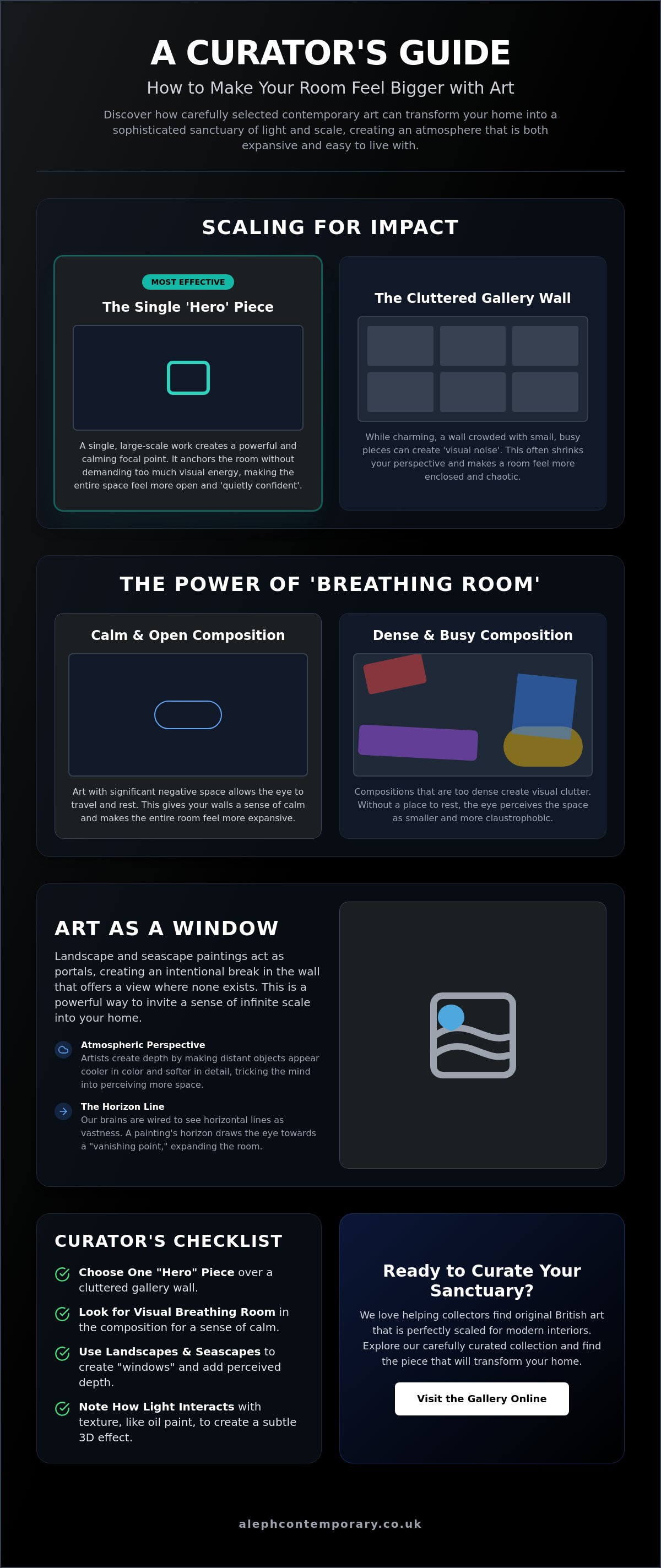
- Discover why a single large-scale "hero piece" is often the most effective art to make a room feel bigger compared to a cluttered gallery wall.
- See how landscape and seascape works act as architectural portals, using atmospheric perspective to push the boundaries of your living space.
- Understand how the interaction of natural light and oil paint textures can add perceived depth to even the most compact interiors.
- Gain confidence in selecting original British art that transforms your home into a sophisticated sanctuary of light and scale.
The Science of Visual Breathing Room: How Art Creates Space
When we discuss choosing art to make a room feel bigger, we're really exploring the concept of visual breathing room. This isn't a technical architectural term; it simply refers to the negative space within a composition and the area surrounding the frame. In our light-filled gallery in Stroud, visitors often notice how a single, thoughtfully placed canvas can make our white walls feel even more expansive. It works because the eye needs a place to travel and, eventually, a place to rest. Without these resting points, a room can quickly feel cluttered and claustrophobic.
A busy gallery wall of small prints often creates visual noise that closes in on the viewer. In contrast, a "quietly confident work" provides a focal point that anchors the room without demanding too much energy. We find that contemporary paintings, particularly oil paint works, offer a unique materiality that flat prints lack. The way natural light catches the texture of a brushstroke creates a subtle sense of three-dimensional depth. This historical technique of creating an illusion of space is part of a long tradition in The Science of Visual Breathing Room, where the artist uses clever perspectives to deceive the eye into seeing a larger world beyond the wall.
The Psychology of the Horizon Line
Our brains are hardwired to interpret horizontal planes as indicators of vastness. When you hang a landscape or seascape, you're essentially installing a visual window. The "vanishing point" within these compositions draws the viewer's gaze toward a distant point, tricking the mind into perceiving more square footage than actually exists. It's a simple but powerful tool for any small interior. A single, well-placed horizon can anchor a small room, providing a sense of stability and endless scale that vertical or busy patterns often disrupt.
Abstract vs. Figurative: Which Expands More?
Abstract art is often the most effective choice for creating a feeling of limitless space. Because there's no fixed subject to "crowd" the room, the viewer’s imagination is free to wander across the canvas. However, figurative art shouldn't be ignored. While a large, complex figure might feel heavy, a smaller, delicate figurative piece can provide a human connection that grounds a room. We always look for pieces that are "easy to live with," ensuring they offer intellectual depth without overwhelming the physical space. Choosing the right balance allows the art to breathe, making the entire environment feel more open and sophisticated.
Expansive Horizons: Using Landscape and Seascape Art as Windows
While we previously explored the abstract concept of breathing room, I often encourage collectors to view landscape art as something far more functional than mere decoration. Think of a well-chosen painting as a portal; it's an intentional break in the wall that offers a view where none exists. This is particularly effective in narrow hallways or compact dining areas where physical windows are scarce. By using atmospheric perspective, where colors become cooler and details softer in the distance, an artist can create a profound sense of three-dimensional depth. This technique is a cornerstone of how a curator selects art to make a room feel bigger, as it invites the viewer to look through the wall rather than at it.
At our light-filled gallery in Stroud, we love how the natural light from our floor-to-ceiling windows interacts with these painted vistas. There's a specific "Cotswolds warmth" in many of the works Nicholas Wells curates, which helps a small room feel intentionally intimate and cozy rather than cramped. Recent studies into how art creates space suggest that our psychological response to a horizon line can actually lower stress levels while expanding our perception of the physical environment. It's about finding that balance between a sophisticated "London eye" for quality and the welcoming atmosphere of a home sanctuary.
Bringing Coastal Calm Indoors with Seascapes
We often find that seascape art is the most immediate way to introduce "blue space" into a home. The play of light on water in a finely executed oil painting can mimic the refreshing effect of a window overlooking the coast. When you're dealing with low ceilings, we suggest looking for works that feature vast, unburdened skies. These compositions "lift" the room, drawing the eye upward and outward. It's a simple way to ensure your living space feels airy and serene, regardless of its actual square footage.
Urban Perspectives and Linear Depth
For those who prefer a more structured environment, urban art and cityscapes offer a different kind of spatial expansion. These works use architectural lines to elongate walls, creating a sense of linear depth that leads the eye deep into the composition. It’s a reflection of our London roots; we enjoy finding beauty and infinite scale within the geometry of a metropolitan skyline. We recommend balancing these hard architectural lines with the soft, natural light found in modern interiors to keep the space feeling approachable. If you're looking for a piece that anchors a room with quiet confidence, you might explore our carefully curated landscape collection to find your perfect visual portal.
Scaling for Impact: Why Large-Scale Pieces Outperform Gallery Walls
Many of our visitors at the Stroud gallery initially worry that a large canvas will "swallow" their living room. It's a common misconception that small rooms require small art. In fact, one of the most effective strategies when choosing art to make a room feel bigger is to embrace scale. We call this the "Hero Piece" rule. While gallery walls of smaller works are charming, they often create a fragmented visual experience; the eye jumps from frame to frame, which can feel like visual noise. A single, large-scale work allows the eye to settle, providing a sense of calm and order that actually makes the walls feel wider. By filling a larger portion of your peripheral vision, a significant canvas tricks the brain into perceiving the entire room as more expansive.
Nicholas Wells curated selections are often chosen specifically because they are perfectly scaled for modern interiors, offering that quiet confidence I’ve mentioned before. However, the success of a large piece depends heavily on the white space, or margins, around the frame. You must let the art "breathe." If a canvas is squeezed into a corner, it will feel cramped. When given proper room on the wall, the same piece will radiate a sense of luxury and space. This is something we often demonstrate in our light-filled gallery, where the interaction of art and open wall space is central to the experience.
How to Measure Your Wall for a Large Work
Don't just guess where to hang your new acquisition. First, identify your "centre of vision," which is usually eye level. This ensures the work feels grounded. Next, try to leave at least 15 to 20cm of clear wall space on either side of the work to avoid a crowded look. Finally, consider your furniture. Art should "float" about 15 to 20cm above a sofa or sideboard, rather than sitting directly on it, to maintain a sense of height and airiness.
Triptychs and Diptychs: The Secret to Long Walls
If you have a particularly long wall, triptychs or diptychs are a wonderful solution. These multi-panel works "stretch" the viewer’s gaze across a room, creating a horizontal rhythm. The narrow gaps between the panels act as architectural breaks, suggesting that the space continues beyond the frames. We love how abstract paintings can span across several canvases, guiding the eye through the room with a fluid, expansive energy that single works sometimes lack.
Materiality and Light: How the Gallery Environment Informs Home Curation
In our light-filled gallery in Stroud, visitors often notice how natural light performs a silent dialogue with the works on our walls. Since moving to this space in late 2023, we've been captivated by how the floor-to-ceiling windows and sharp spotlights reveal the true materiality of contemporary painting. This environment serves as a wonderful laboratory for understanding how to select art to make a room feel bigger. It isn't just about the subject matter; it’s about how the physical surface of the work handles light. When a painting has depth in its very construction, it invites the eye to linger, creating a sense of space that feels both physical and atmospheric.
We always encourage a "slow looking" approach to appreciate these nuances. For instance, oil paint works possess a unique ability to create depth through layers of glaze and texture. As light passes through these translucent layers and reflects back, it creates a sense of internal space within the canvas. This "glow" effect can be incredibly useful in a domestic setting. Using works with soft whites or warm yellows can brighten a dim corner, making the entire room feel more expansive and welcoming. It's a technique we frequently use when curating our intimate exhibitions to ensure every piece acts as a quietly confident presence that is "easy to live with."
Oil vs. Watercolour: Capturing the Light
Choosing between mediums often depends on the specific light in your home. The rich, layered depth of oil paint is magnificent in rooms with shifting natural light, as the texture changes throughout the day. Conversely, the airy, translucent nature of watercolour and gouache works beautifully in sun-drenched rooms where you want to maintain a sense of lightness. For darker, north-facing spaces, a vibrant oil painting can provide the necessary visual weight to anchor the room without making it feel heavy. We love how these different materials help curate a sanctuary that feels perfectly scaled to your lifestyle.
The Role of Framing in Spatial Perception
The frame is the final threshold between the art and your wall. To keep a room feeling open, we often recommend "floated" frames or even frameless canvases. These choices allow the work to feel more integrated into the architecture of the wall rather than being "boxed in." We suggest avoiding heavy, dark frames that can shrink a room by creating a harsh boundary. Instead, look for "Cotswolds warmth" in your selection; natural woods and light tones complement the art and maintain a breezy, sophisticated atmosphere. If you’re ready to see how these elements come together, you can explore our latest oil paint works to find a piece that brings light and scale to your home.
Curating Your Sanctuary: An Invitation to the Stroud Gallery
Choosing the right contemporary art is more than a design decision; it’s a long-term investment in your daily well-being. Throughout this exploration, we've seen how the strategic selection of art to make a room feel bigger can transform a cramped corner into a site of quiet contemplation. At Aleph Contemporary, we believe that the works you bring into your home should be easy to live with and a constant source of joy. Whether it's a vast landscape that acts as a window or a gestural abstract that offers visual breathing room, the right piece creates a sophisticated environment that feels both expansive and deeply personal.
Visitors often notice how our light-filled gallery in Stroud provides the perfect backdrop for these discoveries. Our relocation to the Cotswolds in late 2023 allowed us to create a space where floor-to-ceiling windows and sharp spotlights show exactly how natural light interacts with a canvas. We invite you to step into this environment to experience the materiality of our carefully curated exhibitions first-hand. Seeing a painting in person, where you can observe every brushstroke and glaze, is the best way to understand how it will function within your own four walls.
Personal Consultations and the Cotswolds Experience
We take pride in our personal, curator-led approach. Nicholas Wells curated selections are chosen with a "London eye" for quality but presented with "Cotswolds warmth." If you're unsure about scale, we love helping collectors find pieces that are perfectly scaled for their specific rooms. Choosing art to make a room feel bigger is a rewarding process when you have a guide to help you explore the nuances of scale and light. During an intimate exhibition visit, we can discuss how a particular work might anchor your space or lead the eye toward a new horizon.
Finding Art for Every Budget
Starting an art collection shouldn't feel exclusionary. We've thoughtfully assembled curated collections under £1,000 to help new collectors begin their journey with confidence. While mass-produced prints might fill a gap, they rarely offer the spatial impact or the soulful presence of an original work. An original painting possesses a life of its own, changing with the light and growing with your home over time. We invite you to explore our online shop or visit our contemporary art gallery Stroud to find that quietly confident work that will truly open up your living space.
Transform Your Home into an Expansive Sanctuary
Selecting the right piece is a transformative act that extends far beyond simple decoration. We've seen how embracing scale through a single "hero" work provides more clarity than a busy gallery wall, and how the materiality of oil paint catches the light to add physical depth. By viewing landscapes as visual portals, you can easily find the perfect art to make a room feel bigger while creating a sanctuary that feels sophisticated and easy to live with. It's about finding that balance between intellectual depth and daily joy.
To complete this sense of openness, consider how your choice of surfaces interacts with your art; for instance, the light-reflective finishes available through Frankly Flooring can help bounce natural light across the room, perfectly complementing your new acquisitions.
Our light-filled gallery in Stroud is designed to show you exactly how these principles work in practice. Whether you visit us in person or browse our online shop, you'll find works that have been Nicholas Wells curated to ensure they bring both beauty and a sense of scale to your home. We're pleased to offer complimentary UK delivery on all our original works, making it simpler than ever to start your collection. Discover our carefully curated collection of contemporary paintings and find the piece that truly opens up your world. We look forward to seeing you soon at our contemporary art gallery Stroud.
Frequently Asked Questions
Does large art really make a small room look bigger?
Yes, large-scale art acts as a single focal point that anchors a room and reduces the visual clutter often caused by multiple small frames. By filling the peripheral vision, a large canvas tricks the mind into perceiving the entire wall as wider and more significant. We often display large works on the white walls of our Stroud gallery to show how they create a sense of calm and expansive scale in any interior.
Should I use a frame if I want my room to feel more open?
A floated frame or a frameless canvas is generally the best choice for maintaining an open feel. Heavy, dark frames can "box in" a painting, creating a hard boundary that makes the wall feel smaller and more restricted. In our light-filled gallery, we prefer slim, natural wood frames that provide "Cotswolds warmth" without shrinking the artwork's impact. This ensures the transition between the art and your wall remains seamless and airy.
Where is the best place to hang a landscape painting for maximum depth?
Hanging a landscape at eye level opposite a doorway or window creates a "visual window" that draws the eye into the distance. This placement maximizes the effect of atmospheric perspective, making the room feel like it extends naturally into the painted vista. For those seeking examples of such immersive scenes, you can click here to explore the marine and lake landscapes of Gaëlle Mot. It’s a classic technique when choosing art to make a room feel bigger, as it provides a deep resting point for the gaze that transcends physical walls.
Can abstract art help with narrow hallways?
Abstract art is incredibly effective in narrow hallways because it doesn't have a fixed subject that "crowds" the viewer's physical space. The open, gestural compositions allow the imagination to wander, creating a feeling of limitless depth where there is none. We love how abstract works can lead the eye down a corridor, making the transition between rooms feel more fluid, sophisticated, and less restricted by the architecture.
How does the colour of the artwork affect the size of the room?
Cooler tones like blues and soft greys tend to recede visually, which makes the walls appear further away than they actually are. On the other hand, warm yellows and soft whites can "glow" in dim corners, reflecting natural light and brightening the entire space. Selecting the right palette is a key part of using art to make a room feel bigger, as it directly influences the perceived atmospheric weight of your home.
Is it better to have one big painting or a gallery wall in a small flat?
One significant painting is almost always better than a gallery wall in a compact living space. A gallery wall creates fragmented visual noise that can make a room feel busy and cramped. A single, quietly confident work provides a clear anchor for the eye, creating a more sophisticated and airy environment. This approach reflects a focused, curator-led philosophy that prioritizes quality and spatial harmony over cluttered arrangements.
How do I know if a piece of art is "too big" for my wall?
A piece is usually too big if it leaves less than 15cm of wall space on either side of the frame. You must let the art "breathe" within its environment to avoid a squeezed appearance. If the edges of the canvas are touching furniture or corners, the room will inevitably feel smaller. In our Stroud space, we emphasize leaving generous margins to ensure every piece feels perfectly scaled and easy to live with.

