
What if the most stressful part of acquiring a beautiful new landscape or abstract work isn't finding the perfect spot, but the actual moment the drill touches the wall? We've all stood there with a heavy frame in hand, feeling that familiar prickle of anxiety about whether the plaster will hold or if a single slip might damage a precious investment. At Aleph Contemporary, we believe that learning how to hang a large painting safely is just as important as the art itself. It's about creating a secure, lasting dialogue between the work and your home.
We understand the hesitation that comes with drilling into expensive walls, but we're here to share the same professional techniques we use for every intimate exhibition in our light-filled gallery in Stroud. Bringing our London eye to the warmth of the Cotswolds, we've curated this guide to transform installation into a confident experience. We'll walk you through the best hardware, from toggle bolts rated for 100 pounds to the stability of French cleats. You'll learn how to find studs with precision and achieve a level finish that lets you enjoy your artwork with total peace of mind.
Key Takeaways
- Understand the specific materiality of your walls, from modern plasterboard to traditional masonry, to ensure a secure foundation for every piece.
- Discover our professional secrets on how to hang a large painting safely by using French cleats for a flush, secure mount that avoids the risks of traditional wire.
- Master the curator's "Eye Level" rule by centering your artwork 145cm to 150cm from the floor for a perfectly balanced, gallery-style finish.
- Learn how to position your works to interact beautifully with natural light—just like in our Stroud gallery—while protecting them from direct UV damage.
The Foundation of Artful Living: Why Secure Hanging Matters
Bringing a large-scale piece into your home is a transformative moment, yet it's often accompanied by a quiet sense of trepidation. Whether you've chosen a bold figurative work or one of our abstract paintings, the weight of the canvas carries both emotional and physical significance. We often see collectors hesitate, worried that a heavy frame might damage their walls or, worse, fall and suffer irreparable harm. This anxiety is completely valid. At Aleph Contemporary, we believe that understanding how to hang a large painting safely is the first step toward living harmoniously with your collection.
While leaning art against a wall can offer a temporary, casual charm, it rarely serves as a long-term solution for a quietly confident work. A leaning painting is susceptible to accidental knocks and doesn't allow the viewer to experience the piece at the correct height or in the best light. By moving our gallery from London to the heart of the Cotswolds, we've brought a London eye for precision to the beautiful, often complex architecture of country homes. Whether your walls are modern plasterboard or historic stone, a secure installation ensures your art becomes a permanent, safe part of your home's story.
Protecting Your Investment
A painting is more than just a surface; it's a structural object. A deep dive into understanding the picture frame reveals that its primary role is to provide stability and protection. If a large work isn't supported correctly, the frame can actually warp over time, placing unnecessary tension on the canvas itself. In high-traffic areas of the home, subtle vibrations from footsteps or closing doors can gradually loosen insecure fixings. Proper installation mitigates these risks, preserving the longevity of your investment for decades to come. We love how a securely mounted piece allows the collector to relax, knowing the work is protected from the unexpected movements of daily life.
The Curator’s Approach to Safety
In our light-filled gallery in Stroud, we treat every installation as a focused exercise in balance. Nicholas Wells curated our space to show how art needs breathability, but that aesthetic lightness must be backed by technical strength. When considering how to hang a large painting safely, we look at weight distribution across the entire wall. It's about more than just a single nail; it's about using professional-grade hardware that respects the materiality of the work. This meticulous approach is what we bring from the gallery floor to your living room, ensuring every piece feels perfectly scaled and entirely secure in its new environment.
Assessing Your Architecture: Understanding Your Walls
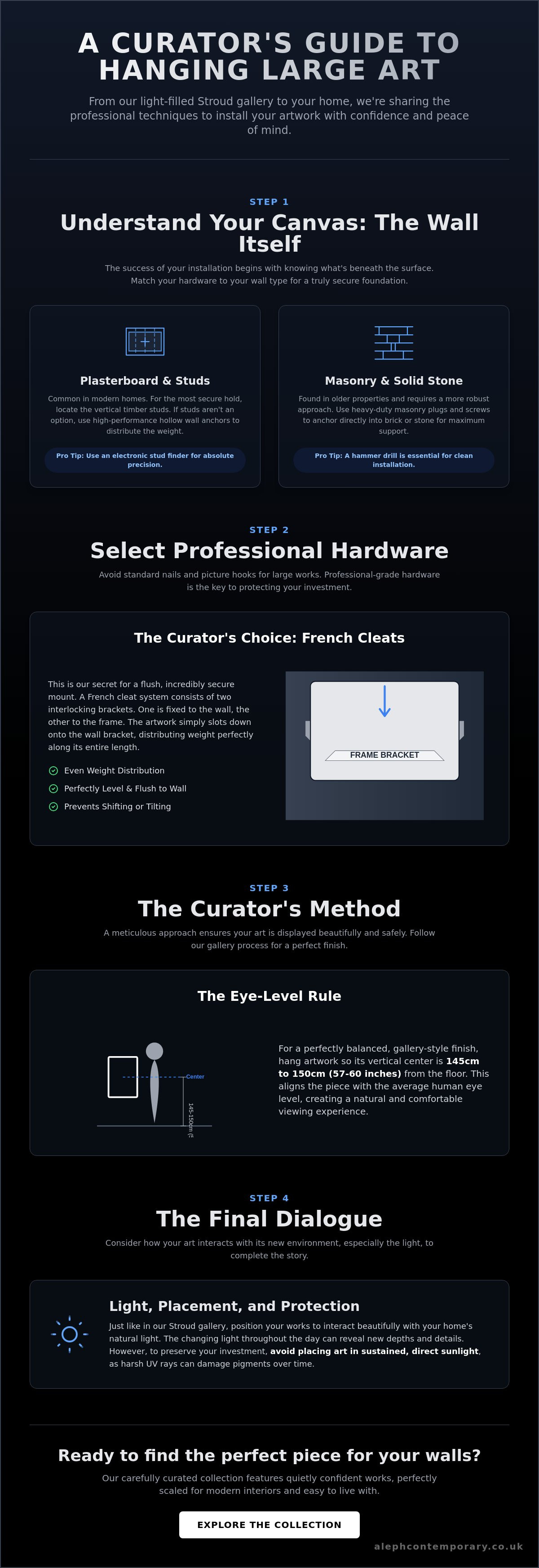
Before you even lift the drill, you need to understand the canvas of your room—the wall itself. In our light-filled gallery in Stroud, we work with pristine white walls designed specifically for display, but domestic spaces often present a more varied landscape. Whether you're in a modern London apartment or a historic Cotswolds cottage, the success of your installation depends on identifying what lies beneath the surface. Following conservation best practices means matching the strength of your fixings to the specific materiality of your home to ensure long-term stability.
We often find that collectors are surprised by the diversity of UK architecture. Modern builds typically use plasterboard over timber studs, while older properties might feature solid masonry or delicate lath and plaster. Determining the load-bearing potential of your display area is crucial. A stud finder is an essential tool for any modern interior, allowing you to locate the vertical timber supports that provide the most reliable anchor point for a quietly confident work. If you're looking for a piece that harmonizes with these varied textures, you might view our latest curated selections for inspiration.
Plasterboard and Stud Walls
In many contemporary homes, your art will rest on plasterboard. To understand how to hang a large painting safely on these surfaces, you must differentiate between shear weight and pull-out weight. Shear weight is the downward force gravity exerts on the hook, while pull-out weight is the force pulling the fixing away from the wall. Whenever possible, align your fixings with timber studs. If the studs don't match your desired placement, you'll need high-performance hollow wall anchors, such as toggle bolts, which spread the weight across a wider area of the board.
Masonry and Solid Stone
Victorian brickwork and Cotswold stone require a more robust approach. For heavy landscape art, you'll typically need a hammer drill and high-quality wall plugs. It's vital to ensure your fixings reach a sufficient depth to bite into the solid material rather than just the surface plaster. In older properties, be mindful of damp-proof courses when drilling lower on the wall. We love how natural light interacts with the rugged texture of stone, but this density means you must be precise with your measurements, as mistakes are harder to hide than in plasterboard.
Selecting Professional Hardware for Heavy Works
Once you've understood the architecture of your walls, the next step is choosing the right dialogue between the frame and the surface. It’s a common misconception that a single sturdy nail is enough for a substantial piece. In truth, when you’re dealing with substantial canvases, the distribution of weight becomes a matter of physics as much as aesthetics. Mastering how to hang a large painting safely requires moving beyond the standard hardware store kits and adopting the same professional standards we use at Aleph Contemporary.
While hanging wire is a familiar choice for smaller pieces, it’s often the enemy of larger, figurative works. Wire exerts a constant inward pressure on the frame's side rails, which can cause bowing or even structural failure over time. We prefer systems that allow the frame to remain under natural tension. This ensures the longevity of the work and maintains the "perfectly scaled" look that Nicholas Wells curated for our light-filled gallery in Stroud. Choosing screws that match your wall plugs and frame depth is a small detail, but it’s the difference between a secure finish and a potential disaster.
The Case for French Cleats
For the heaviest works, we often turn to French Cleats, sometimes called Z-bars. These consist of two interlocking metal brackets: one mounted to the wall and one to the back of the painting. This system is a favorite because it distributes the weight evenly across the entire top rail rather than concentrating it on two points. It also provides a "lock-in" security that prevents the art from being easily dislodged by a passing shoulder or a curious pet. Most importantly, it achieves that crisp, flush-to-wall gallery finish that makes a piece feel like an integral part of the room architecture.
D-Rings and Two-Point Hanging
If you aren't using cleats, heavy-duty D-rings are the industry standard. We always recommend two points of contact. A single central hook is a recipe for a crooked painting and a stressed frame. By using two hooks, you halve the load on each fixing and ensure the piece remains perfectly level. We suggest measuring the offset from the top of the frame to the D-ring with a spirit level to ensure precision. Finally, don't forget small rubber bumpers on the bottom corners. They allow the art to breathe and prevent the frame from marking your carefully curated walls.
The Step-by-Step Installation: A Curator’s Method
The actual process of installation is where technical precision meets the physical reality of your home. We find that gathering a complete toolkit—a spirit level, a sharp pencil, a reliable drill, and a roll of masking tape—removes the frantic energy that often leads to mistakes. This methodical preparation is the core of how to hang a large painting safely; it’s a calm, step-by-step progression rather than a rushed chore. We always suggest centering your artwork so the midpoint sits at roughly 145cm to 150cm from the floor. This gallery standard creates a cohesive visual line throughout your home, much like the curated environment we’ve created in our Stroud space.
Adopting a "Measure Twice, Drill Once" philosophy is vital when handling substantial works. In our light-filled gallery, we often spend as much time measuring as we do hanging, ensuring every piece has the room it needs to breathe. This attention to detail reflects the London eye we bring to Cotswolds interiors, blending professional authority with a welcoming atmosphere. By taking your time, you ensure that the work isn't just up on the wall, but is positioned to interact perfectly with your architecture and natural light.
Measuring and Marking
Before making any permanent marks, we love using masking tape to visualize the painting’s footprint on the wall. This allows you to step back and see how the work sits within the room without leaving any scars on your plaster. Once you're happy with the placement, you'll need to calculate the "drop." This is the distance between the top of the frame and the actual hanging point on your D-rings or cleats. Use your spirit level at every stage of the marking process; even a few millimeters of tilt can disrupt the quiet confidence of a large work. If you’re looking for a new centerpiece to install with this precision, browse our latest oil paintings to find a work that resonates with your interior.
Drilling and Fixing
When you're ready to drill, set your drill depth carefully to avoid any internal wiring or pipes hidden within the wall. Seating your wall plugs firmly is essential for a secure fit that won't loosen over time. We cannot stress enough that the final lift should always be a two-person job. Large works are often heavier than they appear, and having an extra pair of hands ensures both your safety and the safety of the painting. This final step transforms the piece from an object in a crate to a permanent, secure part of your living environment.
The Final Dialogue: Light, Placement, and Maintenance
Once the physical labor is complete, the true dialogue between the artwork and your home begins. In our light-filled gallery in Stroud, we've seen how the right environment transforms a canvas from a mere object into a profound presence. Understanding how to hang a large painting safely includes more than just the hardware; it's about safeguarding the work's materiality against the elements. We often watch how natural light moves across our white walls, shifting the mood of an intimate exhibition from morning to dusk. In your own home, positioning a large work to avoid the harsh, direct touch of UV rays is essential for preserving the vibrant pigments of your collection. While we love the floor-to-ceiling windows of our Cotswolds space, we always ensure that the most delicate pieces are shielded from the sun's most aggressive hours.
Lighting is the final brushstroke of any installation. While natural light reveals the soul of a piece, sharp spotlights can dramatically enhance the materiality of mixed media works, catching the ridges of found materials or the sheen of varied glazes. This interaction creates a sense of depth that draws the viewer in, encouraging the kind of slow looking we champion at Aleph Contemporary. Safety, however, remains an ongoing commitment. As the seasons change in the Cotswolds, shifts in humidity and temperature can cause walls and wooden frames to expand and contract. We recommend periodic safety checks to ensure your professional fixings remain tight and your quietly confident work stays exactly where it was intended to be.
The Gallery Experience at Home
We love how natural light interacts with textured oil paint, and you can emulate this gallery feel by keeping your display area focused. In our Stroud space, we use white walls and minimal clutter to let large works "breathe," a technique that works beautifully in modern interiors. By giving a painting space, you respect its scale and allow its narrative to unfold without distraction. This approach mirrors the 2026 trend toward warmer, more personalized spaces where each carefully curated object is given the room to tell its own story. It's about creating a sanctuary where art and architecture live in perfect harmony.
Invitation to the Cotswolds
If you find yourself near Stroud, we warmly invite you to visit our Cotswolds art gallery to see these installation techniques in person. Nicholas Wells curated our collection to ensure that every work, regardless of its size, feels "easy to live with" and perfectly scaled for the home. We've brought our London roots to this beautiful part of the world to offer a focused, thoughtful environment for experiencing contemporary painting. There is a specific joy in seeing a well-placed painting finally find its home on the wall. We hope this guide gives you the confidence to complete your own installation, turning your living space into a private gallery that inspires you every day.
Bringing Your Collection to Life
Mastering how to hang a large painting safely is the final step in the journey of collecting, turning a beautiful object into a permanent part of your home’s story. By understanding the materiality of your walls and selecting professional hardware like French cleats, you ensure your artwork remains secure and level for years to come. We've explored how the dialogue between light and placement can elevate a canvas, much like the floor-to-ceiling windows and sharp spotlights do in our Stroud gallery. It's about finding that perfect balance between technical precision and aesthetic breathability.
If you're ready to find a new centerpiece for your home, we invite you to explore our carefully curated collection of large-scale paintings. Every original work comes with complimentary UK delivery and the benefit of curator-led advice from Nicholas Wells. We'd love for you to visit our light-filled gallery in the Cotswolds to see these techniques in person and experience the quietly confident works we champion. There's nothing quite like the feeling of a painting finally finding its place, and we're here to help you make that happen with complete peace of mind.
Frequently Asked Questions
Is it safe to hang a heavy painting on a plasterboard wall without a stud?
Yes, you can hang heavy works on plasterboard without a stud, provided you use high-performance anchors like toggle bolts or molly bolts. These fixings spread the weight across a larger surface area of the board. While a stud is always the most secure foundation, modern hollow wall anchors are rated for significant loads, some up to 100 pounds. It's vital to check the manufacturer's weight rating before you begin to ensure a secure installation.
How high should I hang a large painting above a sofa or console table?
We recommend hanging your painting so the bottom of the frame sits roughly 15cm to 20cm above the top of your sofa or console table. This creates a cohesive visual connection between the art and the furniture. You want the piece to feel anchored to the room’s arrangement rather than floating aimlessly. In our light-filled gallery, we often notice how this spacing allows the art to breathe while remaining grounded in the room's design.
Should I use a wire or D-rings to hang a large canvas?
Use D-rings for any substantial canvas to avoid the inward pressure that hanging wire exerts on the frame. Wire can cause the side rails of a large frame to bow or warp over time. By using two D-rings and two wall hooks, you distribute the weight more evenly. This two-point system is the industry standard we use for every intimate exhibition in our Stroud space to ensure the long-term stability of the work.
Can I hang a heavy artwork by myself, or do I need help?
You should always seek help when considering how to hang a large painting safely to prevent injury or damage to the work. Large-scale canvases are often deceptively heavy and awkward to maneuver while trying to align hooks. Having a second person allows one to hold the weight while the other checks the level. It’s a simple precaution that makes the installation process feel much more calm and controlled for the collector.
What is a French Cleat, and when should I use one for my art?
A French Cleat is a pair of interlocking metal or wooden brackets where one half is fixed to the wall and the other to the art. You should use one for exceptionally heavy works or when you want a perfectly flush-to-wall finish. We love how cleats distribute the load across the entire width of the painting. This system offers incredible security and ensures the work won't shift or tilt over time, even in high-traffic areas.
How do I prevent my large painting from leaning forward at the top?
To prevent a painting from leaning forward, place your D-rings or cleats higher up on the back of the frame, usually within the top third. If the hanging points are too low, gravity will naturally pull the top of the work away from the wall. You can also use small rubber bumpers on the bottom corners. These provide grip and allow air to circulate behind the canvas, protecting the materiality of the work from moisture.
Will drilling into my Cotswolds cottage walls cause structural issues?
Drilling into traditional stone or lath and plaster walls is generally safe if you use the correct masonry bits and wall plugs. While these older structures require a gentle touch, they are often more robust than modern partitions. Be mindful of avoiding damp-proof courses in stone walls. If you're unsure, a quick consultation with a local professional can provide peace of mind before you install a quietly confident work in your historic home.
How do I protect a large painting from fading in a light-filled room?
Protect your investment by positioning large works away from direct, harsh sunlight, especially in rooms with floor-to-ceiling windows. Natural light is beautiful, but prolonged UV exposure can cause pigments to fade over time. We suggest using museum-grade UV-protective glass if the work is framed. In our light-filled gallery, we carefully manage how to hang a large painting safely while ensuring every landscape or abstract piece remains as vibrant as intended.

