
In the ongoing discourse of art history, the distinction between the ‘Modern’ and the ‘Contemporary’ often becomes a semantic labyrinth, a perceived barrier that can obscure the profound connections between past and present artistic practice. This challenge is frequently compounded by the notion that the most vital dialogues involving today’s modern artists occur exclusively within the capital’s metropolitan echo chamber, leaving the rich cultural topographies of regions such as South Gloucestershire, and its vibrant artistic neighbours, largely unexamined. Yet, it is precisely in these local landscapes that the legacy of Modern British art continues its compelling evolution, demanding our focused attention.
This exploration serves as a collector’s dialogue for 2026, offering not merely a survey but a deep intellectual engagement with the practitioners shaping South Gloucestershire and its surrounding creative hubs. We will trace the philosophical and technical lineages from the great Modern British masters to the studios of Stroud and beyond, demystifying the ‘why’ behind potent gestural abstraction and nuanced figuration. Ultimately, this journey is designed to equip you with a more profound appreciation and the critical confidence to navigate, and collect from, this vital and often overlooked nexus of contemporary creativity.
Key Takeaways
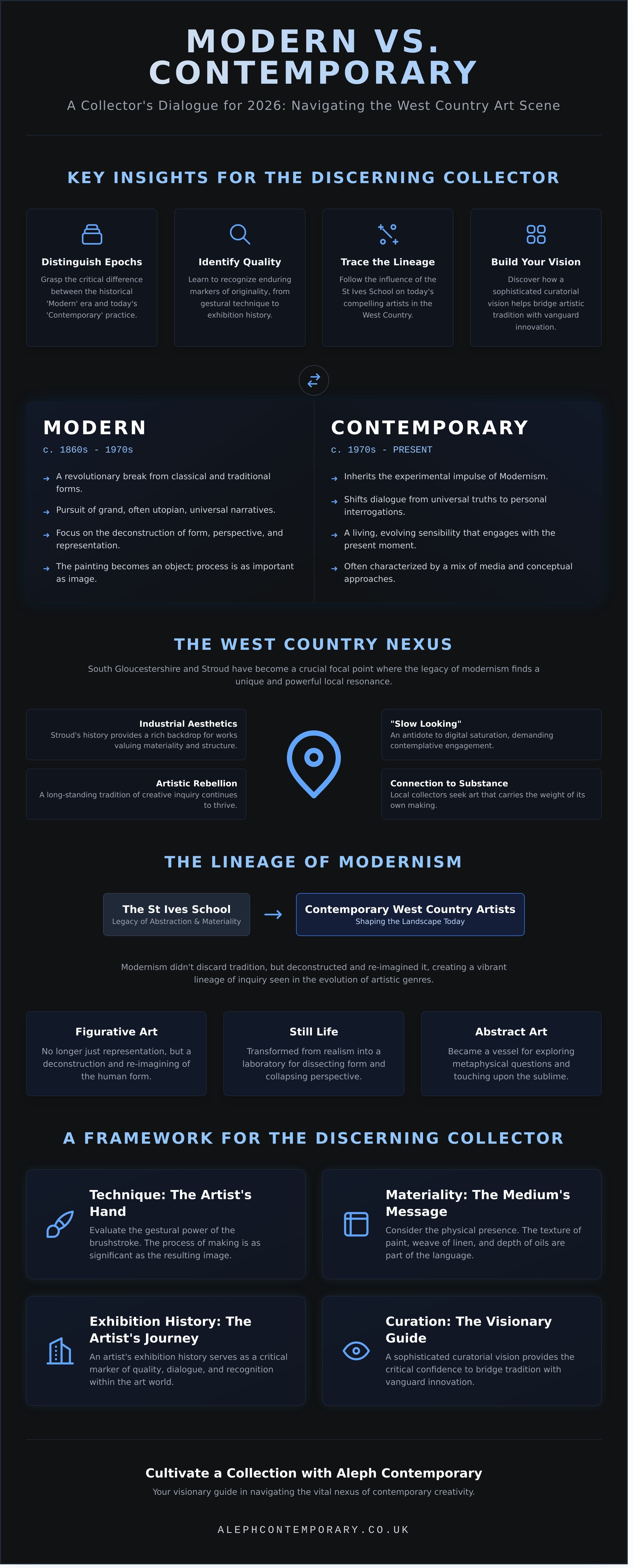
- Grasp the critical distinction between the historical "Modern" epoch and today's "Contemporary" practice to better navigate current artistic discourse.
- Learn to identify the enduring markers of quality and originality, from an artist’s gestural technique to their exhibition history, when evaluating new works.
- Trace the profound influence of the British Modernist legacy, particularly the St Ives School, on the compelling modern artists shaping the West Country landscape today.
- Discover how a sophisticated curatorial vision can guide you in cultivating a collection that bridges artistic tradition with vanguard innovation.
Defining Modern Artists: A Dialogue Between History and Presence in Stroud
To speak of modern artists today is to enter a complex and rewarding dialogue, one that navigates the liminal space between a defined historical epoch and a persistent, living sensibility. This discourse is not confined to the great metropolitan centres; rather, it has found a particularly fertile ground here in Stroud, where the legacy of industrial form meets a vibrant contemporary scene. Within this unique context, the gallery serves a critical function: it is the interlocutor, the bridge that connects the private, gestural world of the artist’s studio with the discerning eye of the collector, fostering a conversation that is both historically informed and urgently present. As we find ourselves in 2026, Stroud has undeniably become a crucial focal point for this interrogation of what it means to be modern in our time.
Modernism vs. Contemporary Practice
The term 'Modernism' itself refers to a revolutionary period of artistic production, broadly spanning from the 1860s to the 1970s, which sought to break from classical and traditional forms. While the historical parameters are well-documented-with resources like Wikipedia offering a comprehensive overview for Defining Modern Art-its spirit of radical inquiry endures. Where the great Modernists pursued grand, often utopian, narratives through the deconstruction of form, today’s practitioners have inherited this experimental impulse, turning it inward. The dialogue has shifted from universal truths to more personal interrogations of the human condition.
The Local Resonance in South Gloucestershire
This enduring modernist sensibility, so central to the work of pioneering modern artists, finds a unique resonance in the landscape of South Gloucestershire. Stroud’s own history, etched with the aesthetics of industry and a long-standing tradition of artistic rebellion, provides a rich backdrop for works that value materiality and structure. It is this profound connection to substance that draws local collectors, who increasingly seek an antidote to the ephemeral nature of digital saturation. They are drawn to the practice of "slow looking"-the deep, contemplative engagement required by art that carries the weight of its own making.
The Lineage of Modernism: Materiality and Gesture in Contemporary Practice
The great rupture of modernism was, at its core, a profound interrogation of the canvas itself. No longer merely a window onto a world, the painting became an object with its own physical presence, a site where the very act of creation was laid bare. This turn towards materiality-the texture of the paint, the weave of the linen, the visible trace of the artist’s hand-gave rise to a new visual language. The gestural power of the brushstroke, a signature of mid-20th-century abstraction, continues to inform contemporary practice, asserting that the process of making is as significant as the resulting image. It is within this discourse that modern artists challenged the centuries-old boundaries between representation and pure form, creating a lineage of inquiry that remains vibrant today. This legacy finds its place not only in galleries but in the considered home, where the intellectual and sensory depth of abstract paintings offers a perpetual source of dialogue and contemplation.
Interrogating the Abstract and the Figurative
The tension between tradition and radical innovation is powerfully expressed in the evolution of figurative art, which modernism did not discard but rather deconstructed and re-imagined. Simultaneously, abstraction became a vessel for exploring metaphysical questions, moving beyond earthly representation to touch upon the sublime. This is perhaps best observed in the transformation of still life; what was once a genre dedicated to meticulous realism became, through the modernist lens, a laboratory for dissecting form, collapsing perspective, and questioning the very nature of perception.
The Poetics of Technique
The medium is an intrinsic part of the message in modern and contemporary art. The specific language of oil paint works, with their capacity for luminous layering and slow, temporal depth, allows for a richness and complexity that speaks to a history of mark-making. Many contemporary modern artists expand this vocabulary by incorporating mixed media, challenging the pristine status of the art "object" and infusing it with materials from the everyday world. This exploration of boundaries is particularly potent in contemporary landscapes, which often evoke a sense of "liminality"-the threshold between states. This tradition has deep roots in British art, where painters of the St Ives School, for instance, translated the raw energy of the Cornish coast into a powerful abstract vernacular, capturing not just a place, but the experience of being within it.
The Modern British Legacy: From St Ives to the South Gloucestershire Landscape
While the epicentres of Modernism are often located in Paris or New York, the British contribution to this global discourse possesses a unique and compelling character, one deeply enmeshed with the materiality of its own ancient terrain. This legacy is not one of simple imitation but of translation, a constant dialogue between international avant-garde principles and the specificities of the British landscape. From the elemental force of the Cornish coast to the industrial grit of the North, British modernism charts a course through the nation’s soul, exploring the liminal space between pastoral memory and a rapidly changing urban reality.
Icons of British Modernism
The interrogation of form and space reached its zenith with figures like Barbara Hepworth and Henry Moore, whose pioneering work fundamentally reshaped the possibilities of contemporary sculpture. Their abstract forms, pierced and hollowed, do not merely occupy space but engage with it, drawing the surrounding landscape into their very being. This sensitivity to place also informs the "Northern Art" tradition, where the stark industrial environments gave rise to a powerful social realism that continues to influence modern perspectives on urban art. Simultaneously, institutions like the Royal Academy, while historically bastions of tradition, provided a crucial stage where these new, challenging ideas could enter into a dialogue with the establishment, fostering generations of British talent.
Modernism in the Cotswolds
This rich national heritage finds a vibrant, continuing expression in the Stroud valleys of South Gloucestershire. Here, a lineage stretching back to the Arts and Crafts movement has cultivated a profound respect for materiality and process, which continues to inspire a new generation of modern artists. The region's unique topography and the ethereal quality of its light infuse local creative practice, influencing palettes and compositions in ways that are both subtle and profound. This community of creators engages with the core tenets of the movement-an interrogation of form, a break with academic tradition, and a new subjectivity-that are central to Defining Modern Art, yet they filter these global ideas through the specific prism of their immediate environment, creating work that is at once universal and deeply rooted in place.
Discerning Quality: An Interrogation of Technique for the Discerning Collector
For the discerning collector, acquiring a work of modern art is not merely a transaction but an intellectual and aesthetic commitment. The challenge lies in moving beyond subjective preference to identify the markers of genuine originality and enduring quality-qualities that distinguish a fleeting trend from a lasting contribution to the artistic discourse. This requires a cultivated eye, one attuned to the subtle dialogues within a composition and the profound narrative embedded in an artist's career. The biographical trajectory of an artist, including their exhibition history and critical reception, provides an essential framework, offering testament to a sustained and rigorous practice. Without this context, a work risks being seen in a vacuum, its true significance obscured.
Understanding the medium is equally critical, as the artist's choice of materials is an integral part of their conceptual statement. The delicate, luminous layers of watercolour & gouache can convey a sense of immediacy and fragility, while the foundational honesty of a simple pencil drawing can reveal the genesis of a powerful idea. Each medium carries its own history and potential, and appreciating these nuances is key to building a cohesive collection that truly honours the modernist spirit of innovation and material exploration.
The Collector’s Eye: What to Look For
A truly compelling work often holds the viewer in a state of dynamic equilibrium, where compositional balance and conceptual tension create a vibrant, unresolved dialogue. Look for this interplay of forces. Furthermore, the materiality of the work-the texture of the canvas, the viscosity of the paint, the grain of the paper-is not incidental; it is a deliberate choice that determines the work’s physical longevity and its immediate sensory impact. It is often the role of the curator to articulate this significance, identifying works by modern artists that possess the intellectual and material integrity to resonate for generations.
Navigating the Art Market in 2026
The contemporary art market is in a state of dynamic flux. While London remains a central hub, the rise of influential regional galleries across the UK has decentralised high-level artistic discourse, offering collectors new avenues for discovery beyond the capital. Simultaneously, the digital sphere has matured into a vital resource. Leveraging sophisticated online platforms allows one to discover original paintings online with unprecedented access to artist information and curatorial insight. This new landscape invites a thoughtful approach, where the ethics and aesthetics of collecting are intertwined, encouraging acquisitions that are not only financially astute but also culturally responsible.
Cultivating a Collection: Aleph Contemporary as Your Visionary Guide in Stroud
In the vibrant cultural landscape of South Gloucestershire, Aleph Contemporary establishes itself not merely as a gallery, but as a sophisticated cultural interlocutor-a dedicated space where artistic legacy enters into a profound and continuous dialogue with the present. Our gallery, nestled in the heart of Stroud, transcends the function of a simple repository for objects; it is a carefully calibrated sensory environment, meticulously designed to facilitate a deep, contemplative connection between the viewer and the artwork’s inherent materiality. We hold the conviction that collecting is a deeply personal, intellectual, and emotional pursuit, a journey of discovery for which we are uniquely positioned to serve as your visionary guide.
A Curated Exploration of Form
The Aleph collection is defined by a distinct and rigorous language, one articulated through an unwavering commitment to quality, originality, and profound conceptual depth. We champion a carefully selected roster of emerging and established artists whose practices inhabit the liminal space between reverence for tradition and a radical push for innovation. These are creators who grapple with the complexities of the painted surface and the gestural mark, continuing the critical discourse initiated by the most influential modern artists of the twentieth century. Each exhibition at Aleph is therefore conceived not as a static display, but as an active interrogation of contemporary themes, inviting our patrons to engage with works that possess not only immediate aesthetic power but also an enduring, resonant cultural significance.
Starting Your Journey with Aleph
For the seasoned collector refining a vision or the new enthusiast beginning to navigate the international art world, we provide personalised consultancy tailored to your specific interests and ambitions. Our holdings are deliberately diverse yet thematically coherent, encompassing compelling explorations in genres from evocative portraiture that probes the depths of the human condition to visceral works of animal art that examine our primal relationship with the natural world. We extend a formal invitation for you to visit our Stroud gallery, to immerse yourself in this high-level conversation, and to discover how a truly transformative work of art can both anchor a space and elevate the spirit. Begin your exploration with us at alephcontemporary.co.uk.
Commencing Your Dialogue with Contemporary Modernism
As our exploration has revealed, to engage with the vibrant artistic landscape of South Gloucestershire is to enter into a profound dialogue-one that traverses the historical lineage of Modern British art and interrogates the very materiality and gestural language of contemporary practice. For the discerning collector, discerning quality is not merely an act of acquisition but an embrace of this ongoing conversation, recognising that enduring value resides in the intricate fusion of technical mastery and conceptual depth.
This journey of cultivation finds its physical and intellectual home here in the cultural heart of Stroud. As your visionary guide, Aleph Contemporary presents a meticulously curated roster of emerging and established modern artists who represent the vanguard of this vital tradition. We invite you to deepen your engagement and begin shaping a collection of enduring significance. With complimentary UK delivery on all original artworks, the process of acquisition is as considered and seamless as the art itself. Discover our curated selection of modern artists and begin your own dialogue with the extraordinary.
Frequently Asked Questions
What is the difference between a modern artist and a contemporary artist?
The distinction, while often debated, is fundamentally temporal. Modern Art refers to a specific historical period, roughly from the 1860s to the 1970s, defined by its radical break with academic tradition and its interrogation of form. Contemporary Art, conversely, describes the art of our present moment, beginning where Modernism concluded. This is more than a simple timeline; it signifies a paradigm shift in artistic discourse, moving from the self-referential explorations of Modernism to the pluralistic, globally-conscious concerns of today's practitioners.
Why is Stroud considered a hub for modern artists in South Gloucestershire?
Stroud's reputation as an artistic enclave is rooted in a rich cultural ecosystem that has long attracted creative practitioners. Its position within the sublime landscape of the Cotswolds, combined with a legacy of affordable studio spaces and a robust network of galleries and festivals, fosters a unique environment for artistic production. This setting facilitates a vibrant dialogue among artists, creating a supportive yet critically engaged community that continues to draw significant talent, making it a key centre for artistic inquiry in the region.
How can I tell if a modern painting is an investment-worthy piece?
Ascertaining the investment potential of a modern painting requires a discerning eye for markers of enduring cultural significance. Key considerations include the artist's exhibition history, particularly inclusion in museum shows, and the work's provenance-its documented history of ownership. One must also evaluate the piece's condition and its position within the artist’s oeuvre and the broader critical discourse of its time. These factors, more than fleeting market trends, signal an artwork's potential to retain and accrue value.
What are the key characteristics of the Modern British art movement?
Modern British art is characterised by a compelling synthesis of international modernist principles and a distinctly British sensibility. Artists like Henry Moore and Barbara Hepworth engaged in a profound dialogue with European abstraction, yet their work remained deeply connected to the British landscape. The movement often exhibits a tension between the avant-garde and a lyrical, sometimes melancholic, attachment to place and the human figure, a quality evident from the gestural intensity of the London School to the pastoral abstractions of St Ives.
Do modern artists still use traditional techniques like oil and gouache?
Indeed, many contemporary modern artists continue to engage deeply with traditional media such as oil and gouache, not as an act of nostalgia, but as a deliberate interrogation of their material possibilities. The historical weight and physical properties of these pigments offer a rich ground for new explorations of texture, light, and form. For these artists, employing a traditional medium is a way to enter into a dialogue with art history, re-contextualising established techniques within a contemporary conceptual framework.
How do I start an art collection on a modest budget in the UK?
Commencing an art collection on a modest budget is an entirely achievable intellectual and aesthetic journey. A discerning approach is to focus on limited edition prints by established artists or original works by promising emerging practitioners, which offer an accessible entry point. In the UK, schemes like Own Art provide interest-free loans of up to £2,500 to facilitate the acquisition of contemporary work, transforming a significant purchase into manageable instalments and supporting the artists and galleries that comprise our cultural landscape.
Can I buy original modern artworks online from Aleph Contemporary?
Yes, Aleph Contemporary provides a seamless and curated experience for acquiring original modern and contemporary artworks through our online platform. We act as a dedicated interlocutor between the artist's studio and the discerning collector, ensuring each piece is presented with the intellectual rigour and detailed context it deserves. Our digital gallery is designed to facilitate a deep engagement with the work, allowing you to explore and acquire pieces of enduring significance with confidence from anywhere in the world.
What role does materiality play in modern and contemporary art?
Materiality is a central concern within the discourse of modern and contemporary art, signifying a shift from viewing the medium as a transparent vehicle for an image to understanding it as an active participant in the work's meaning. The physical substance-the texture of paint, the weight of a sculpture, the weave of a canvas-is not merely support but is integral to the artwork's conceptual and phenomenological impact. This focus invites a haptic, sensory engagement, deepening the dialogue between object and viewer.

