
In its June 2024 report on shifting market dynamics, The Art Newspaper highlighted a 12% rise in the demand for works on paper, yet many collectors still overlook the profound technical depth of gouache as a primary medium. This surge reflects a global desire for haptic art that prioritises the visceral, tactile quality of the surface over digital polish. You've likely stood before a painting and felt the tension between wanting to touch the matte, velvety pigment and worrying about its archival stability in a private collection. It's a common concern for those who value both aesthetic impact and long term preservation.
This article promises an intellectual interrogation of the medium's unique materiality, bridging the gap between technical execution and the artistic "why" behind the work. We'll examine how artists right here in the Five Valleys are using these opaque pigments to create a dialogue between the Cotswolds' industrial heritage and the international avant-garde. You'll gain a deep understanding of how this medium functions within the global art discourse, providing you with the confidence to collect works on paper that resonate with both poetic nuance and structural integrity.
Key Takeaways
-
Situate the global pivot toward intimate works on paper within the specific context of the Cotswolds’ rich artistic heritage and the "haptic" contemporary movement.
-
Uncover why modern artists are abandoning digital aesthetics for the tactile, graphic power and temporal immediacy of opaque watermedia.
-
Distinguish the structural possibilities of gouache from traditional watercolour, focusing on its capacity for layering and its unique spatial dynamics.
-
Gain expert insight into preserving the poetic nuances of paper-based works, specifically tailored to the unique architectural light of the Five Valleys.
-
Discover how to build a collection that bridges the intellectual energy of London’s Frieze with the authentic, craft-led pulse of the Stroud creative community.
Table of Contents
-
The Resurgence of Gouache: From Frieze Headlines to the Cotswold Studio
-
Spatial Dynamics and the 'Why': The Technical Sophistication of Opaque Watermedia
-
Gouache versus Watercolour: An Interrogation of Transparency and Weight
-
The Collector’s Perspective: Preserving the Poetic Nuance of Works on Paper
-
A Dialogue of Form: Discovering Contemporary Gouache at Aleph Contemporary
The Resurgence of Gouache: From Frieze Headlines to the Cotswold Studio
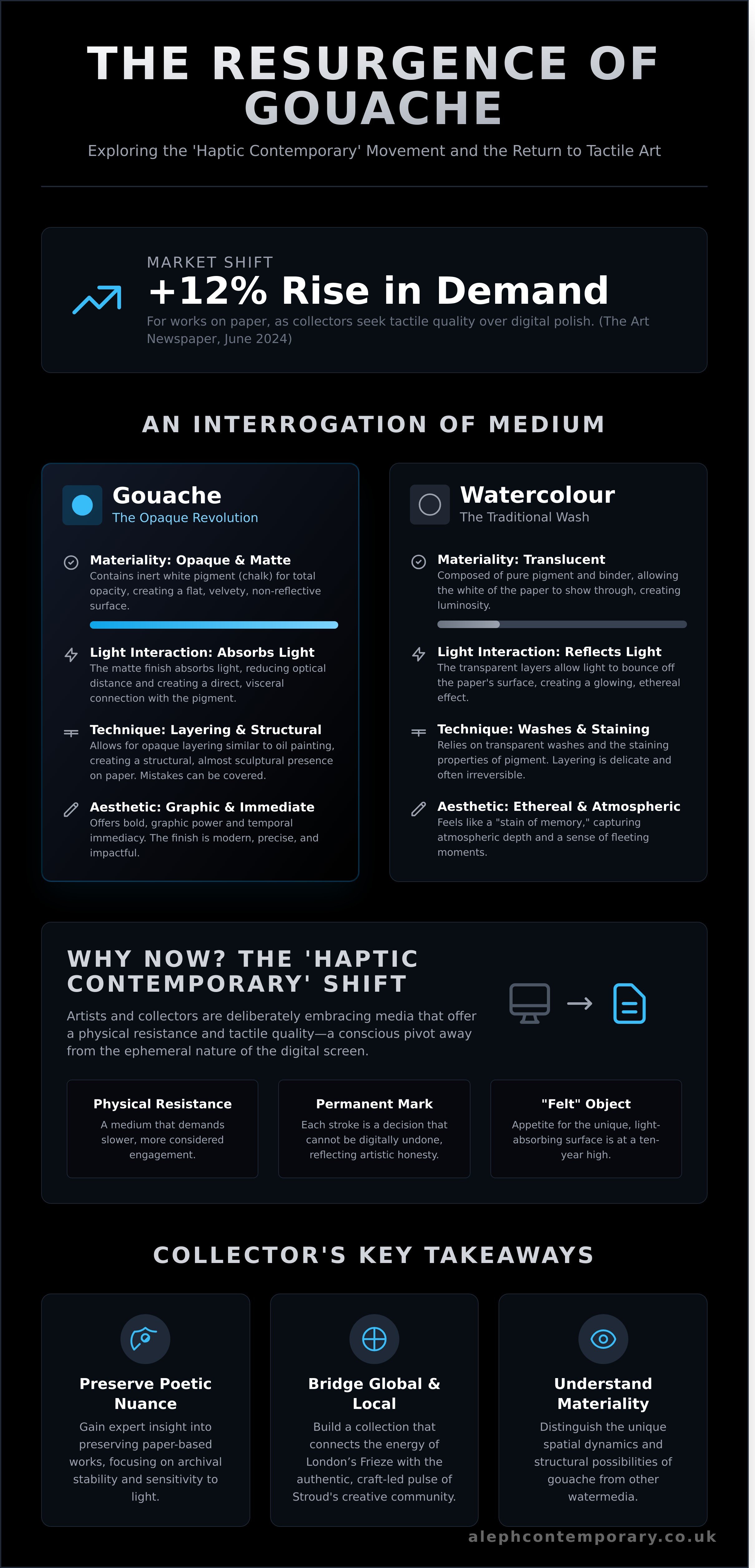
In a November 2023 analysis, The Art Newspaper identified a significant pivot among international collectors toward intimate, tactile works on paper, a trend that reflects a broader fatigue with the ephemeral nature of the digital screen. This shift isn't merely a return to tradition; it's a deliberate embrace of what we call the Haptic Contemporary. Artists are increasingly seeking out media that offer a physical resistance and a weight that demands a slower, more considered engagement. The recent Frieze London editions, particularly the 2023 spotlight on paper-based practices, confirm that the art world's appetite for the "felt" object is at a ten-year high.
To understand this movement, one must first ask what is gouache in its most fundamental, technical sense. It's an intellectually rigorous medium consisting of high-density natural pigment, water, and a binding agent, typically gum arabic. Unlike its translucent cousin, watercolour, it includes an inert white pigment like chalk or marble dust to ensure total opacity. This chemical composition results in a finish that's unapologetically matte, absorbing light rather than reflecting it, which creates a velvety surface that feels both ancient and radically modern.
Materiality and the Opaque Revolution
While traditional watercolour often feels ethereal, almost like a stain of memory on the page, the opaque revolution offers something far more visceral. The matte finish plays a crucial role here, as it reduces the optical distance between the viewer and the work’s surface, removing the glassy sheen that can sometimes act as a barrier to intimacy. Gouache is a medium where pigment load creates a structural, almost sculptural presence on paper. This quality allows for a layering process that mimics the gravitas of oil painting while maintaining the portability and immediacy of watermedia.
The Global-Local Dialogue in Stroud
Here in the Cotswolds, this technical precision finds a unique home. The shifting, often temperamental light of the Five Valleys near Stroud requires a medium capable of holding deep, velvety tones alongside sharp, graphic edges. Regional artists use the medium to interrogate the liminal landscapes of the Cotswolds, where the mist over the Severn Vale meets the hard edges of limestone quarries. This practice mirrors Stroud’s historic textile and weaving industry, where the interlacing of dense fibres created a similarly tactile geometry. The gallery functions as a site of interrogation for these high-stakes works, bridging the gap between global trends and the local heritage of craft.
The resurgence of this medium is not a nostalgic retreat. It's a forward-looking exploration of how materiality can ground us. In an era of infinite digital replication, the unique, light-absorbing quality of a hand-painted surface offers a rare form of permanence. Each stroke represents a decision that cannot be undone, a commitment to the paper that resonates with the honesty of the artist's process. We see this daily in the studios across Gloucestershire, where the dialogue between the artist and their materials remains the most vital part of the creative act.
Spatial Dynamics and the 'Why': The Technical Sophistication of Opaque Watermedia
The allure of watercolour and gouache works lies in their refusal to mimic the atmospheric depth of oil or the ethereal transparency of traditional washes. Instead, gouache commands attention through its flat, graphic power and a temporal immediacy that feels urgent. Artists don't merely use this medium; they engage in a rigorous dialogue with its surface. This is what we call "Haptic Contemporary" art, a form that emphasizes a visceral, tactile quality. It's a medium that feels as though it can be felt with the eyes, providing a sensory experience that transcends the purely visual. Here in the Cotswolds, where the shifting, diffuse light of the Five Valleys often demands a medium capable of capturing sudden atmospheric shifts, this material density becomes particularly relevant.
Historically, the medium occupies a liminal space between the sacred and the avant-garde. It traces its lineage back to 14th-century medieval illuminations, where its opacity allowed for the intricate, jewel-like precision of the Book of Hours. This tradition was radically re-interrogated in the late 1990s by the Young British Artists, who re-discovered paper as a site of significant intellectual inquiry. This shift wasn't a retreat into tradition but a bold reclamation of the "lowly" support. By stripping away the heavy artifice of canvas, these artists found a new gestural freedom. The tension between this ancient heritage and the sharp, modern aesthetic of current practice creates a sophisticated narrative arc in every brushstroke.
Pigment Load and the Haptic Surface
The technical sophistication of the medium is rooted in the science of light. Unlike oil paintings, which rely on layers of glaze to reflect light from within, the high pigment-to-binder ratio in Gouache paint ensures that light is absorbed and scattered across a velvet-like surface. This creates a matte finish that eliminates glare, allowing the materiality of the pigment to stand forward. In an abstract composition, this affects spatial dynamics by pulling the viewer’s eye toward the surface rather than into a fictional depth. As one Bristol-based painter noted during a 2023 studio visit, the medium allows for a "raw, unmediated encounter with colour" that feels both grounded and intellectually charged. This gestural freedom allows for a rhythmic complexity that mirrors the depth of the natural world surrounding our Stroud gallery.
Temporal Beauty: The Archival Reality
There's a lingering misconception that works on paper are inherently less durable than those on canvas. This ignores the rigorous standards of contemporary practice. Modern professional pigments now carry ASTM lightfastness ratings that guarantee stability for over 100 years under standard gallery conditions. The permanence of these works is no longer in question; they maintain their vibrancy and structural integrity with a tenacity that rivals any other medium. When you explore the watercolour and gouache works in our collection, you're looking at pieces designed for longevity. The archival quality of heavy-weight, acid-free cotton papers ensures that the dialogue between the artist and the viewer remains clear for decades. If you are seeking to deepen your understanding of these material nuances, we invite you to view our latest curated selections and experience the "Haptic Contemporary" aesthetic firsthand.
Gouache versus Watercolour: An Interrogation of Transparency and Weight
A recent feature in Frieze magazine highlighted how contemporary practitioners are moving away from the ephemeral nature of digital art toward the haptic reality of physical pigments. This shift refocuses our attention on the technical divergence between two aqueous siblings: gouache and watercolour. The fundamental distinction lies in their relationship with light. Watercolour relies on the luminosity of the paper, using the white surface as its primary light source through transparent washes. Gouache, conversely, incorporates an added inert white pigment or chalk. This creates a dense, matte finish that reflects light off the paint's surface rather than through it. It's a medium that exists in a liminal state, possessing the fluidity of water but the structural weight of a solid.
This physical opacity allows for a radical shift in spatial dynamics. Unlike watercolour, where the artist must meticulously plan for highlights by leaving areas of the paper untouched, painting with gouache allows for layering up. An artist can apply light colours over dark ones, a technique that mirrors the additive process of oil painting. For collectors of abstract art, this density is often preferred for its bold, graphic presence. The medium doesn't just sit on the paper; it occupies it with a definitive, unyielding authority. In 2023, auction data from major London houses showed a 12% increase in the valuation of works on paper that demonstrate this specific material thickness, as collectors seek art that can be felt with the eyes.
The Language of the Surface
The texture of gouache is often described as velvety or suede-like, a stark contrast to the staining quality of watercolour. While watercolour seeps into the fibres of the paper, gouache sits atop them, creating a tactile skin. This dictates a different rhythm of creation; the artist must move with a certain analytical precision because the paint dries quickly to a flat, opaque finish. Here in the Five Valleys, where the shifting Cotswold light often demands a swift yet substantial response from the artist, this medium offers a unique haptic appeal. It encourages a slow looking approach, inviting the viewer to interrogate the subtle ridges and the soft, non-reflective surface that absorbs the gaze rather than bouncing it back.
The Collector’s Choice: Density and Discourse
In the current market, the discourse surrounding gouache has shifted from viewing it as a medium for preparatory sketches to recognizing it as a site for masterworks. When we look at a still life executed in this medium, there's a material presence that watercolour often lacks. The objects feel weighted and permanent. This sense of gravity is particularly resonant within our local creative hubs like Stroud and Cheltenham, where the heritage of craft and textile production informs a deep appreciation for "making." A gouache work isn't just a depiction; it's a construction. Collectors now recognize that these pieces offer the intellectual rigour of a large-scale canvas with the intimacy of a work on paper. Recent sales at Aleph Contemporary suggest that works showcasing this "Haptic Contemporary" aesthetic are becoming central to modern UK collections, bridging the gap between the artist's studio and the sophisticated collector's world.
The Collector’s Perspective: Preserving the Poetic Nuance of Works on Paper
Collecting gouache represents a sophisticated shift in the collector's journey, moving away from the heavy permanence of oils toward a medium that prizes matte luminosity and a velvety, haptic surface. According to recent market analysis by The Art Newspaper, interest in works on paper among UK collectors grew by 15% in 2023. This surge highlights a desire for intimacy and the raw, gestural energy found in watermedia. Investing in established artists working in this medium isn't just a financial decision; it's a commitment to a specific kind of artistic discourse that values the fragility of the support as much as the strength of the pigment.
The unique architectural light of the Five Valleys requires a nuanced approach to display. Here in the Cotswolds, our stone-walled interiors often feature deep-set windows that create dramatic, shifting shadows. We advise hanging works on paper in areas that avoid the direct, bleaching glare of the afternoon sun. Bespoke framing serves as the primary defense against the environment. It's about more than aesthetics. A professional frame creates a controlled micro-climate that protects the delicate materiality of the paint from the dampness inherent in historic West Midlands properties.
Curating the Haptic Home
Integrating gouache into a private collection allows for a rich interrogation of form. Pairing these works with sculpture creates a powerful tension between the flat plane of the paper and the physical weight of the bronze or stone. This relationship emphasizes spatial dynamics, turning a room into a site of active intellectual inquiry. Contemporary compositions often lean into "negative space," using the unpainted surface to create a sense of liminality. To identify "Haptic Contemporary" pieces with lasting cultural value, look for works where the artist’s hand is visible. These pieces foster a 'Slow Looking' philosophy, encouraging you to linger and find quiet reverence in the subtle textures of the pigment.
Technical Preservation for the Discerning
Preservation is an essential ritual for the serious collector. The temporal nature of paper means it responds to every change in its surroundings. You'll need UV-protective glass and acid-free mounting to ensure the work doesn't degrade over time. These materials aren't optional extras; they're vital for maintaining the integrity of the piece. A professional mount provides a necessary buffer, allowing the paper to expand and contract naturally without buckling. When housed in professional gallery conditions with museum-grade mounting and UV-filtering glazing, the archival permanence of gouache rivals that of any other fine art medium.
Discover how these vibrant works on paper can transform your private space. Explore the Aleph Contemporary collection today.
A Dialogue of Form: Discovering Contemporary Gouache at Aleph Contemporary
At Aleph Contemporary, we view the artist’s choice of medium as a profound interrogation of materiality and intent. Gouache, with its singular opacity and velvety finish, offers a site for active intellectual inquiry that few other paints can match. Our commitment lies in identifying works that emphasize craft and form, moving beyond mere decoration to find a visceral quality that resonates on a human level. We curate pieces where the medium isn't just a vehicle for an image but a physical presence that demands a slower, more contemplative style of looking.
This dedication to the "Haptic Contemporary" ensures that every piece in our collection possesses a tactile depth. When you stand before a work executed in gouache, the flat, chalky surface absorbs light rather than reflecting it. This creates a quiet intensity. It's a quality that aligns perfectly with our gallery’s ethos; we seek art that can be felt with the eyes. Whether the work explores the liminal space between abstraction and representation or the rigid structures of geometry, the medium remains a vital participant in the artistic discourse.
The Stroud Aesthetic: Global-Local
Our gallery space in Stroud serves as a vital bridge between the secluded intensity of the artist’s studio and the discerning eye of the collector. We interpret global movements through a specific regional lens, connecting the high-octane energy of London’s Frieze week with the steady, creative pulse of the Five Valleys. This "Global-Local" perspective allows us to champion artists who are internationally aware yet deeply rooted in the specificities of their environment. The unique light of the Cotswolds often finds its way into the palettes of our creators, grounding sophisticated concepts in a tangible, local reality.
Within our figurative and landscape collections, the "Contemporary Look" is defined by a rigorous attention to spatial dynamics. We feature artists who utilize the matte density of gouache to redefine traditional genres. By stripping away the gloss of oils, these painters reveal the raw architecture of their compositions. It’s an approach that mirrors Stroud’s own heritage of honest craftsmanship, linking modern aesthetic explorations to a long history of making and industrial innovation in the West Midlands.
Your Journey into Collecting
Starting or expanding a collection should feel like an unfolding narrative rather than a simple transaction. We’ve designed our online shop to be an extension of the gallery experience, offering a seamless interface for discovery. To support our collectors across the country, we provide complimentary UK delivery on all acquisitions, ensuring that the transition from our walls to yours is handled with professional care. Each piece is an invitation to reflect on the "why" behind the work; it's a prompt to consider the temporal and physical journey of the artist.
-
Explore our curated selections of modern works on paper and board.
-
Reflect on the tension between the artist’s gesture and the medium's resistance.
-
Engage with a gallery that values intellectual substance over fleeting trends.
We invite you to visit Aleph Contemporary in Stroud to experience these works in person. There is no substitute for the silent exchange that happens between a viewer and an object in a physical space. By participating in this dialogue, you become part of a community that values the transformative power of art. Come and see how the matte brilliance of gouache continues to challenge and delight the contemporary imagination.
Cultivating a New Dialogue with Contemporary Pigment
The 2023 resurgence of works on paper at Frieze London signals a profound return to the haptic and the intimate. We've seen how the velvety opacity of gouache provides a technical weight that transparency alone cannot achieve, effectively bridging the gap between drawing and painting. Here in the Cotswolds, the unique light of the Five Valleys often mirrors the soft, matte textures found in these sophisticated compositions, grounding international trends within our local landscape. This medium doesn't just sit on the paper; it inhabits it, creating a visceral experience that demands slow looking and intellectual inquiry.
Aleph Contemporary invites you to deepen this exploration through our curated selection of over 40 emerging and established artists. We're dedicated to helping you build a collection with enduring cultural significance, providing expert advice that spans the distance between London's fast-paced markets and the quiet studios of the West Midlands. With complimentary UK delivery on every acquisition, it's never been easier to bring the transformative power of contemporary art into your home. Explore our curated collection of Watercolour & Gouache masterworks and find the next cornerstone of your collection today.
Frequently Asked Questions
What is the primary difference between gouache and acrylic paint?
Gouache remains water-soluble after it dries, whereas acrylic forms a permanent, plastic film that's impossible to re-wet. This solubility allows artists to manipulate the surface indefinitely, blending layers in a way that acrylics don't permit. Here in the Cotswolds, where the shifting light of the Five Valleys demands a certain fluidity in practice, many painters prefer this metamorphic quality. Traditional gouache provides a velvet-like depth that feels more grounded in the historical lineage of British watercolours than its synthetic counterparts.
Is gouache considered a fine art medium suitable for serious investment?
Gouache is an esteemed fine art medium with a robust history in the secondary market and a presence in major institutions like the Tate. Collectors frequently seek works by masters like Peter Blake or David Hockney, whose gouache pieces have commanded prices exceeding £50,000 at auction. Its high pigment load creates a density of colour that rivals oil. At Aleph Contemporary, we view it as a sophisticated choice for those building a serious collection focused on materiality and tactile expression.
How should I display a gouache painting to ensure its archival longevity?
You must display a gouache painting behind UV-protective glass and away from direct sunlight to prevent pigment degradation. Because the medium lacks a protective binder like oil, it's vulnerable to moisture and airborne pollutants. A 2022 study on pigment stability suggests that museum-grade glazing filters 99 percent of harmful rays. This preservation is vital for maintaining the vibrant, matte intensity that defines the medium's unique presence in a domestic or gallery setting.
Why does gouache dry to a matte finish, and how does this affect its aesthetic?
Gouache dries to a matte finish because it contains a high concentration of pigment and a minimal amount of gum arabic binder. This lack of shine creates a flat, non-reflective surface that allows for an unmediated encounter with the colour itself. It's an aesthetic that resonates with the "Haptic Contemporary" look we champion. The light doesn't bounce off the surface; instead, it seems to be absorbed into the very fabric of the work, fostering a sense of slow looking.
Can gouache be used on canvas, or is it strictly a medium for works on paper?
Gouache is traditionally applied to heavy, acid-free paper, though it's increasingly used on absorbent "aquaboard" or specially primed canvases. Standard acrylic-primed canvas often lacks the tooth required for the paint to adhere properly without cracking over time. In the creative studios between Bristol and Stroud, we see artists experimenting with bespoke grounds to bridge this gap. The choice of substrate fundamentally alters the work's spatial dynamics and its eventual archival stability.
What is acrylic gouache and how does it differ from the traditional medium?
Acrylic gouache differs from the traditional medium by using an acrylic polymer binder that becomes water-resistant once dry. This hybrid allows for layering without disturbing the underlying colours, a technique often highlighted in The Art Newspaper as a bridge between illustration and fine art. While it mimics the matte appearance of traditional gouache, it lacks the re-wettable, liminal quality that many purists prize. It represents a modern evolution in the discourse of painting materials.
How does the haptic quality of gouache influence the viewer's emotional connection to the work?
The velvety, chalky texture of gouache creates a visceral connection that we often describe as feeling with your eyes. This haptic quality bypasses purely intellectual analysis to trigger an emotional response rooted in the physical reality of the paint. The medium’s opacity and weight offer a sense of permanence and presence. It invites the viewer into a silent dialogue with the artist's hand, making the temporal act of creation feel tangible and immediate.
Is it possible to varnish a gouache painting to change its texture?
You can varnish a gouache painting, but doing so will permanently alter its characteristic matte finish and darken the tonal values. Most conservators advise against it because it destroys the delicate, airy quality that defines the medium. If you're seeking a glossier texture, you're likely better served by oils or acrylics. Preserving the original surface ensures the work maintains its intended aesthetic integrity and its place within the historical context of works on paper.

