
In a region where the pastoral tradition so often informs the aesthetic discourse, the task of identifying the next generation of significant artistic voices presents a complex, yet thrilling, challenge for the discerning collector. Navigating this evolving landscape-a liminal space between idyllic history and a dynamic contemporary pulse-requires more than a passive appreciation for beauty; it demands a curator’s insight into the practices and conceptual frameworks that signal enduring cultural relevance. It is this very interrogation that forms the foundation of our annual guide, a definitive answer for those seeking to understand the Cotswolds artists to watch 2026.
Within this curated exploration, we move beyond the picturesque to reveal the practitioners whose command of materiality, gestural innovation, and critical inquiry is already shaping the future of British art. This is your invitation to engage with the region’s most compelling talent before they enter the wider consciousness. We offer an insider’s perspective on the movements taking shape and the creators defining them, empowering you to collect with confidence and intellectual conviction.
Key Takeaways
- Understand the unique cultural and historical conditions that position the Cotswolds as a crucible for significant contemporary artistic production, moving beyond its idyllic reputation.
- Discover our curated selection of the essential Cotswolds artists to watch 2026, a vanguard of painters, sculptors, and printmakers defining the region's aesthetic discourse.
- Explore the diverse materiality of the Cotswolds' art scene, from gestural painting and innovative sculpture to the often-overlooked mastery of contemporary works on paper.
- Gain actionable strategies for engaging with and collecting from the Cotswolds' most promising talents, empowering you to build a collection of enduring cultural significance.
The Cultural Climate: Why the Cotswolds is a Crucible for Contemporary Art
To perceive the Cotswolds merely through the lens of its pastoral clichés-of honey-stone villages and rolling bucolic landscapes-is to overlook a profound and accelerating cultural metamorphosis. For centuries, this region has served not just as an escape, but as a crucible for artistic inquiry, a place where the temporal rhythms of nature have informed a deep-seated creative discourse. This unique confluence of historical weight and contemporary dynamism makes the Cotswolds one of the most compelling regions for art in the United Kingdom today. At Aleph Contemporary, we offer a discerning eye, navigating this evolving scene to illuminate the voices that matter.
A Dialogue Between Tradition and Modernity
The contemporary artistic identity of the Cotswolds is forged in a dynamic dialogue between its storied past and a decidedly forward-looking present. This is a landscape imbued with the legacy of the Cotswolds Arts and Crafts movement, a history that championed materiality and authentic craftsmanship, and whose principles still resonate within the studios scattered across its valleys. Yet, today’s practitioners are not simply custodians of this tradition; they are interrogators of it. We witness a compelling tension where the established language of landscape painting is being deconstructed, its motifs abstracted into gestural explorations of colour and form, reflecting an influx of new creative energy that challenges and enriches the region's artistic soil.
Stroud's Growing Reputation as an Artistic Hub
Nowhere is this creative ferment more palpable than in Stroud, a town that has firmly established itself as a nexus for the arts in the South West. Its reputation is built upon a robust infrastructure of artist-led studios, collaborative spaces, and a community that actively fosters experimental practice. This environment acts as an incubator, providing the necessary conditions for emerging talent to develop a rigorous and authentic voice, free from the commercial pressures of the metropolitan centre. It is from this fertile ground that many of the most compelling Cotswolds artists to watch 2026 are emerging, their work offering a vital commentary on the enduring power of place in a globalised art world.
The New Vanguard: Painters Engaging with Materiality and Place
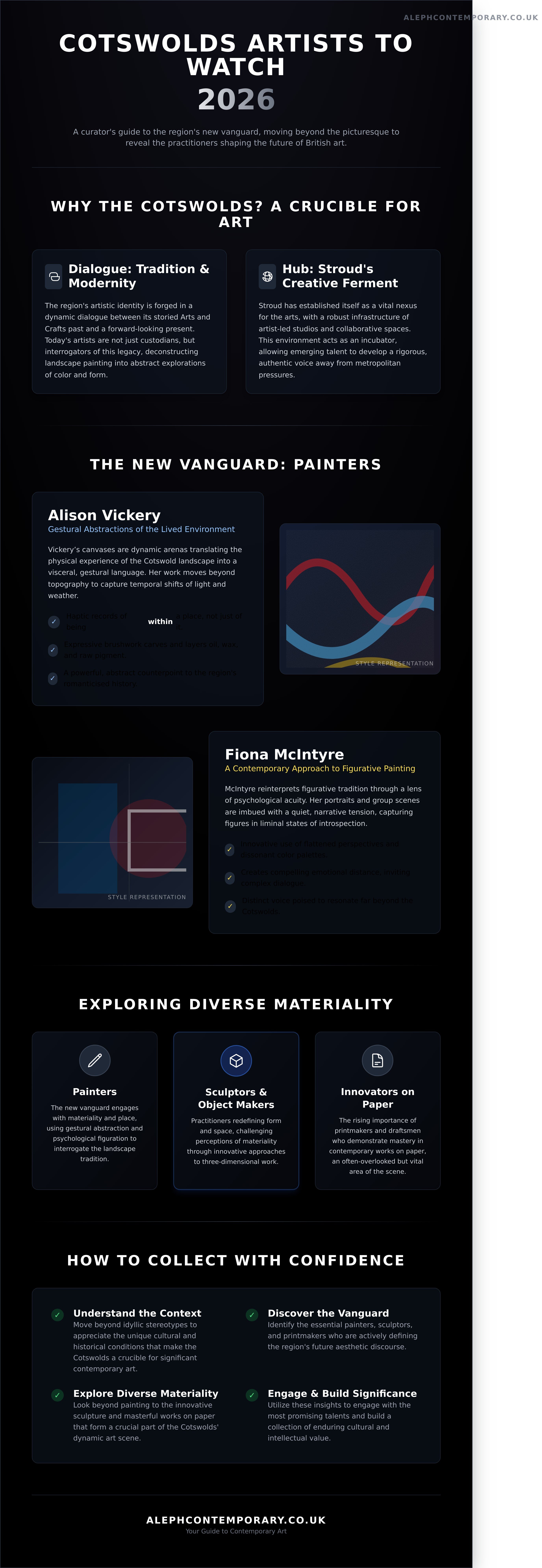
Within the enduring pastoralism of the Cotswolds, a new vanguard of painters is forging a compelling discourse between landscape and psyche, tradition and innovation. These are not artists content with mere representation; rather, they engage in a profound interrogation of place, using the very materiality of their medium to excavate deeper truths. This burgeoning scene, supported by initiatives like the Creative Cotswolds partnership, is nurturing a generation of practitioners whose technical rigour and conceptual depth position them as essential Cotswolds artists to watch 2026. Two painters, in particular, exemplify this movement through their distinct yet complementary explorations of abstraction and figuration.
Alison Vickery: Gestural Abstractions of the Lived Environment
Alison Vickery’s canvases are dynamic arenas where the physical experience of the Cotswold landscape is translated into a visceral, gestural language. Her expressive brushwork, which carves and layers oil, wax, and raw pigment, moves beyond topographical accuracy to capture the temporal shifts of light and weather. These are not pictures of a place, but haptic records of being within it. Following her acclaimed solo shows at local galleries and growing critical attention, Vickery’s practice is gaining significant momentum, her works offering a powerful, abstract counterpoint to the region's romanticised visual history.
Fiona McIntyre: A Contemporary Approach to Figurative Painting
Turning the gaze inward, Fiona McIntyre reinterprets the tradition of figurative painting through a lens of psychological acuity. Her portraits and group scenes are imbued with a quiet, narrative tension, capturing figures in liminal states of introspection or ambiguous interaction. McIntyre’s innovative use of flattened perspectives and a subtly dissonant colour palette creates a compelling emotional distance, inviting the viewer into a complex dialogue about identity and human connection. With a series of new works slated for exhibition in London next year, her distinct voice is poised to resonate far beyond the Cotswolds, marking her as a key artist to follow.
Sculptors and Object Makers: Redefining Form and Space
Moving beyond the plane of the canvas, the Cotswolds landscape also fosters a profound and evolving discourse in three-dimensional form, where the interrogation of materiality and space becomes paramount. The region’s sculptors are engaged in a dynamic conversation with their environment, creating works that are not merely placed within the landscape but are born of its very substance and spirit. This dialogue, actively encouraged by initiatives like the Cotswolds National Landscape’s Art in the Landscape program, sees artists translating the area's geological and botanical identities into powerful sculptural statements. The following creators represent some of the most compelling Cotswolds artists to watch 2026, each redefining the relationship between object, maker, and place.
Natasha Houseago: Exploring Organic Forms and Natural Materials
Natasha Houseago’s practice is a visceral dialogue with her primary material: wood. Working directly and intuitively with a chainsaw on large sections of oak, cedar, and other locally sourced timbers, she carves monumental forms that feel both ancient and urgently contemporary. Her sculptures, with their raw, gestural surfaces and abstracted figural qualities, evoke the enduring presence of Neolithic standing stones or the sinuous growth of ancient trees. Rather than imposing a form upon the material, Houseago’s process is one of revelation, uncovering the spirit inherent within the wood itself. Her significant presence at leading UK sculpture parks and recent public commissions have solidified her reputation as a powerful voice exploring the elemental connection between humanity and the natural world.
Ann-Margreth Bohl: Conceptual Objects and Material Investigations
Operating at the intersection of craft, sculpture, and conceptual art, Ann-Margreth Bohl’s ceramic works are quiet yet potent investigations into memory, fragility, and containment. Her practice deconstructs the traditional vessel, transforming it into a signifier for the human condition-a container of experiences, vulnerable to time and circumstance. Working primarily with porcelain, she pushes the material to its physical limits, creating objects that appear weathered, fragmented, or collapsed, their delicate surfaces bearing the trace of intense process. Bohl’s inclusion in prestigious exhibitions like Ceramic Art London highlights the intellectual rigour of her approach, which moves beyond pure aesthetics to ask profound questions about what we choose to hold and what is inevitably lost. It is this philosophical depth that makes her one of the key Cotswolds artists to watch 2026.
Innovators on Paper: The Rise of Cotswolds Printmakers and Draftsmen
While the monumental presence of painting and sculpture often commands the discourse, the more intimate medium of paper reveals a different, yet equally profound, dimension of artistic inquiry. Works on paper-be they drawings, prints, or mixed-media compositions-offer a direct conduit to the artist's hand and mind, capturing the immediacy of a gestural mark or the meticulous precision of a carefully worked plate. This medium, with its inherent tactility and intellectual rigour, not only provides an accessible entry point for new and discerning collectors but also serves as a vibrant arena for technical innovation. The practitioners emerging from this region are redefining the possibilities of the medium, making them essential names among the Cotswolds artists to watch 2026.
Victoria Browne: Pushing the Boundaries of Etching and Lithography
Victoria Browne’s practice is an exercise in austere beauty and conceptual depth, interrogating the language of printmaking itself. Working from her Stroud studio, she employs traditional techniques like etching and stone lithography not merely as methods of reproduction, but as tools for a philosophical exploration of space, absence, and architectural form. Her editions are characterised by their minimalist precision, where crisp lines and subtle tonal gradations articulate the poetics of liminal structures. Browne, who has undertaken prestigious residencies including at the Frans Masereel Centrum in Belgium, creates work that resonates with collectors who appreciate a quiet yet powerful intellectualism. Her prints are not just images; they are meditations on materiality and perception, gaining traction for their sophisticated and enduring vision.
Day Bowman: Layered Narratives on Paper
In the layered works of Day Bowman, paper becomes a palimpsest of memory and place. Her process is one of accumulation and excavation, combining vigorous, gestural drawing with fragments of collage and swathes of paint to construct complex visual topographies. These compositions often evoke the post-industrial landscapes and eroding coastlines of Britain, telling stories of transience, decay, and resilience. Represented by respected galleries, Bowman’s artworks function as fragmented narratives, where the materiality of the paper-torn, layered, and worked-is integral to their meaning. They invite a slow, contemplative reading, rewarding the viewer with a rich dialogue between abstraction and figuration. For those interested in how contemporary artists are channelling complex histories through this versatile medium, one can explore original works on paper from a curated selection.
How to Collect and Engage with the Cotswolds Art Scene in 2026
To truly engage with the vibrant cultural landscape of the region, one must move beyond passive appreciation into a more active, sustained dialogue. Identifying the most compelling Cotswolds artists to watch 2026 is the first step; the journey of collecting, however, offers a far deeper immersion into the artistic discourse that defines our time. This guide provides a framework for both nascent and established collectors to navigate this terrain with intellectual rigour and personal conviction.
Navigating Galleries and Exhibitions
The curated gallery space remains the primary site for critical engagement. A visit to a destination like Aleph Contemporary in Stroud is not merely an opportunity to view finished works, but to understand them within a meticulously constructed context. We encourage you to follow gallery exhibition schedules closely and, most importantly, to cultivate a relationship with a gallerist. This individual is more than a sales advisor; they are a crucial interlocutor, offering invaluable insights into an artist’s practice, materiality, and position within the broader art historical narrative.
Beyond the Gallery: Open Studios and Art Fairs
To witness the genesis of creation, one must venture into the artist's own environment. Annual events like Cotswold Open Studios offer an unfiltered glimpse into the studio, a liminal space where concept and material converge. Here, the dialogue is direct and unmediated. Similarly, regional art fairs, such as the esteemed Fresh: Art Fair at Cheltenham Racecourse, provide a concentrated survey of the contemporary scene, allowing collectors to assess a wide spectrum of work and engage with artists and gallerists in a dynamic setting.
Building Your Collection with Confidence
Acquiring art should be a considered, deliberate act. When considering the work of the leading Cotswolds artists to watch in 2026, take the time to research an artist’s career trajectory-their exhibition history, their academic background, and the critical discourse surrounding their work. For those beginning their journey, starting with smaller works can be an intelligent strategy.
- Begin with accessible pieces: Drawings, studies on paper, or limited edition prints often provide a more accessible entry point, with exceptional pieces available from a few hundred pounds.
- Trust your intellectual and aesthetic response: While an artist’s provenance is significant, the most enduring collections are built on a foundation of profound, personal resonance. Acquire the work that challenges, moves, and stays with you.
Charting the Future: The Cotswolds' Artistic Vanguard
As we have explored, the Cotswolds has unequivocally established itself as a fertile ground for contemporary artistic inquiry-a landscape where a new vanguard of painters is profoundly engaging with materiality and place, while sculptors and printmakers courageously redefine the parameters of their forms. This burgeoning scene, a dynamic dialogue between tradition and innovation, provides the essential context for identifying the definitive Cotswolds artists to watch 2026. To engage with this work is to witness a cultural future in formation.
Navigating this evolving landscape requires a discerning eye. As an authoritative voice in the Cotswolds contemporary art scene, Aleph Contemporary offers precisely that. Through the expert curation of our leading Stroud-based gallery, we provide direct access to original works by the most compelling emerging and established artists, inviting you to move beyond observation and into the dialogue. The opportunity to connect with these seminal works is immediate and profound.
Discover the artists shaping the future of contemporary art. Explore our collection.
Frequently Asked Questions
How do I determine if an emerging Cotswolds artist is a sound investment?
Determining an artist's investment potential transcends market trends; it involves an interrogation of their practice. Assess the artist's developmental trajectory, the consistency of their conceptual inquiry, and the quality of material execution. For the discerning collector evaluating Cotswolds artists to watch 2026, a robust dialogue with a gallerist can provide invaluable insight into an artist’s long-term significance, exhibition history, and the integrity of their provenance before you commit to an acquisition.
What are the key art fairs or annual events in the Cotswolds for discovering new talent?
The region offers a curated calendar of events for discovering emergent talent. Fresh: Art Fair at Cheltenham Racecourse presents a significant commercial platform, while the annual Cotswold Open Studios provides a more intimate, direct engagement with artists in their creative sanctums. For those with a focus on sculpture, the evolving exhibitions at the Cotswold Sculpture Park offer a profound dialogue between form and landscape, often revealing practitioners on the cusp of wider recognition.
What is the typical price range for original works by up-and-coming artists in the region?
For original works by emerging practitioners in the Cotswolds, one might anticipate an entry point of approximately £800 to £2,500. This range typically encompasses small to medium-scale paintings on canvas or unique works on paper. Limited edition prints from these same artists offer a more accessible entry into collecting, often priced between £250 and £600, allowing for the acquisition of a significant work from a developing oeuvre without the commitment of a major canvas.
How does the Cotswolds art scene compare to larger hubs like London or Bristol?
The Cotswolds art scene operates in a distinct register from the high-velocity markets of London or Bristol's avant-garde. It is characterised by a profound engagement with landscape, materiality, and a legacy of pastoral modernism. This creates a more contemplative and intimate discourse, where the dialogue between tradition and contemporary practice is palpable. While London offers unparalleled global access, the Cotswolds provides a unique opportunity for deeper, more sustained relationships with artists and their specific contexts.
What are the first steps to take when starting a contemporary art collection?
Embarking on a collection is an intellectual and aesthetic journey. The initial step is not acquisition but immersion: visit galleries, attend degree shows, and read voraciously to refine your eye and articulate your unique perspective. Begin a dialogue with gallerists who can act as trusted guides. Rather than pursuing disparate pieces, consider a unifying conceptual thread-be it a medium or a philosophical inquiry-that will lend your collection coherence and personal resonance.
Are there any specific art schools in the area known for producing notable graduates?
The primary institution of note is the University of Gloucestershire, which absorbed the historic Cheltenham School of Art, a foundation with a distinguished legacy. Its Fine Art programme consistently produces graduates whose practices are both technically accomplished and conceptually rigorous. Discerning collectors often pay close attention to its annual degree show, which frequently serves as the first public platform for artists who will go on to shape the region's artistic discourse and gain national attention.

