
You might assume that a grand oil on canvas is the only way to anchor a serious art collection. However, a work on paper often represents the most vital and immediate moment of an artist's vision, capturing a level of intimacy that larger formats can sometimes lose. At Aleph Contemporary, we love how these pieces look against the white walls of our light-filled gallery in Stroud. The way the sharp spotlights catch the texture of hand-deckled paper or the subtle sheen of a gouache wash is truly special, offering a glimpse into the artist's private world.
We know that choosing your first original piece can feel daunting. It's natural to worry about whether a drawing feels "finished" or how to handle the nuances of conservation and framing. We want to put those anxieties to rest. This guide explores why these pieces are the most accessible entry point for sophisticated collecting in 2026. We'll walk you through the different mediums we champion, explain how these works fit perfectly into the scale of modern homes, and share our secrets for adding a quietly confident work to your space that will hold its beauty for years to come.
Key Takeaways
- Understand why a work on paper is a primary, finished expression of an artist’s vision rather than a mere preparatory sketch.
- Learn to distinguish between the luminous quality of watercolours and the bold, matte finish of gouache to find a style that resonates with your space.
- Discover how the intimate scale of these pieces makes them perfectly suited for modern interiors and "easy to live with" collections.
- Gain expert advice on conservation techniques, from archival mounting to UV protection, to ensure your original art remains vibrant for generations.
- Explore how to select "quietly confident" pieces that create a sophisticated dialogue within your home.
Defining the Medium: Why Work on Paper is a Primary Expression
Many collectors arrive at our light-filled gallery in Stroud with the misconception that paper is merely a rehearsal space for "real" painting. We enjoy dispelling this myth. A work on paper is not a secondary medium or a preparatory sketch; it is a primary expression that captures an artist's vision with a unique, breathless immediacy. Nicholas Wells curated our collection to highlight pieces that function as powerful, independent statements. These aren't just ideas for larger works. They're complete, expressive originals that possess a distinct gravity of their own.
From our London roots, we've observed a shift in how international collectors view these pieces. There's a growing appreciation for the "London eye" perspective, which is a discerning focus on the raw, unmediated dialogue between the artist and their materials. In 2026, the global art market is seeing a renewed focus on craftsmanship. Collectors are moving away from the mass-produced and toward the authentic. A unique work on paper offers exactly that. It's an intimate entry point into an artist’s practice that feels both prestigious and deeply personal.
The Dialogue Between Artist and Support
The magic of this medium lies in the tactile exchange between the artist’s hand and the paper's surface. Unlike the rigid resistance of a canvas, paper is absorbent and alive. It reacts to every drop of pigment and every gestural stroke. This sensitivity reveals the most authentic version of an artist's practice. We love how the white walls of our Stroud space provide a neutral backdrop that lets these textures speak. When the sharp spotlights catch the grain of a heavy rag paper, you can see the history of the work's creation. It's a quietly confident work, offering a poetic depth that invites you to look closer and stay longer.
Originals vs. Prints: Understanding the Value
It's helpful to distinguish between different types of paper-based art. While Printmaking techniques such as etchings or silk screens produce wonderful editions, the term "work on paper" in our gallery typically refers to unique, one-of-a-kind originals. Whether it's a mixed media piece or a delicate pencil and graphite drawing, these are singular objects. There is only one. This uniqueness creates a direct, silent exchange between the viewer and the object. An original piece carries the literal energy of the artist’s touch in a way that a print cannot replicate, making it a cornerstone for any thoughtful contemporary collection.
Materiality and Technique: Choosing Between Watercolour, Gouache, and Mixed Media
When you select a work on paper, you aren't just buying an image. You're acquiring a specific physical interaction between pigment and fibre. As noted in this Christie's collecting guide to works on paper, understanding these technical nuances is key to building a collection with longevity. In our Stroud space, we often see how the materiality of these pieces changes throughout the day as the sun moves across our floor-to-ceiling windows. The paper's surface acts as a silent participant in the work, either absorbing the medium or letting it sit proudly on top.
The Luminous Depth of Watercolour and Gouache
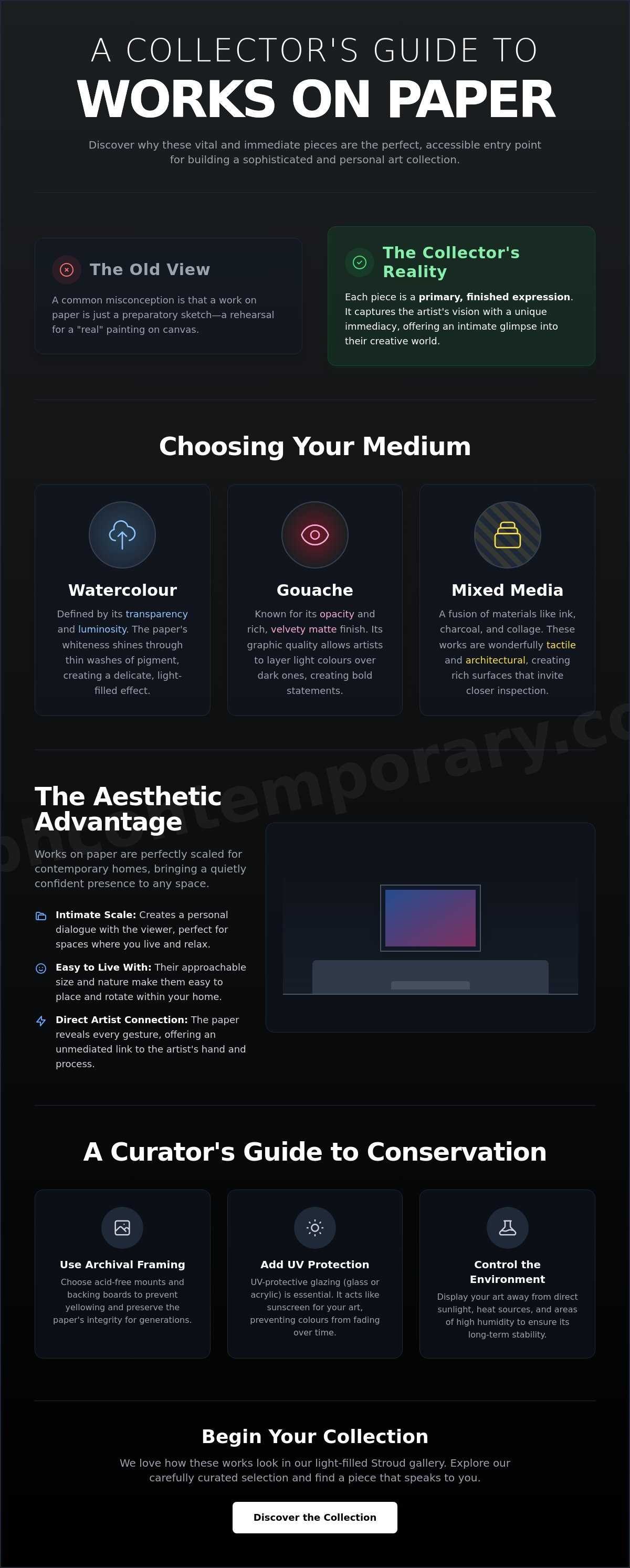
The choice between watercolour and gouache is essentially a choice between transparency and opacity. Watercolour relies on the light reflecting off the white paper through thin washes of pigment. It's a medium of luminosity. Visitors often notice how the natural light in our light-filled gallery makes these works feel almost holographic. In contrast, gouache offers a matte, velvety finish. It's opaque and graphic, allowing artists to layer light colours over dark ones. You can explore our curated selection of watercolour and gouache works to see this tension between light and weight in person. Both mediums respond beautifully to the sharp spotlights we use to highlight their specific textures.
Mixed media works take this a step further. We love how artists layer ink, collage, and charcoal to create rich, tactile surfaces that defy simple categorisation. These pieces often feel more architectural. The addition of collage adds a physical relief to the work on paper, while charcoal provides a gritty, earthy contrast to fluid ink. It's a sophisticated way to experience the artist's hand in its most experimental form.
Pencil, Graphite, and the Power of Line
There is a profound, gestural beauty in minimalist drawing. Pencil and graphite works rely on the purity of the line to convey emotion and form. These pieces possess a "quietly confident" presence. They don't need bold colours to command a room. Instead, they invite a slower, more contemplative kind of looking. You can discover the precision of pencil and graphite works in our current collection, where each mark tells a story of the artist's intent. For those looking to dive deeper into this specific medium, our sibling article, Contemporary Fine Art Drawings: A Collector's Guide, offers further insight into why these works are so prized by modern connoisseurs. If you're nearby, we'd love to show you how these delicate lines interact with the Cotswolds sun in our Stroud gallery.
The Aesthetic Advantage: Why Paper Works are Perfect for Contemporary Homes
One of the most frequent conversations I have in our Stroud gallery involves how a delicate work on paper can truly hold its own in a modern interior. While a large oil on canvas has its place, the unique scale and versatility of paper works offer an aesthetic advantage that is hard to replicate. In our light-filled space, visitors often notice how the white walls and sharp spotlights bring out the subtle textures of the materials. It's a "quietly confident" look that feels sophisticated yet approachable, embodying that sense of Cotswolds warmth we cherish. These pieces are "easy to live with" because they don't demand the same architectural volume as heavy sculptures or massive canvases. They invite you to lean in. When you're thinking about your own walls, it's helpful to look at a conservation guide for artworks on paper to understand how light and placement affect these materials over time.
Scaling Art for Modern Living
Modern British homes often feature intimate spaces where a massive painting would feel overwhelming. A work on paper is often perfectly scaled for a study, a bedroom, or a quiet hallway. We love how grouping smaller pieces creates a curated dialogue across a single wall. This "gallery wall" approach allows you to tell a broader story about your taste through different artists and techniques. Alternatively, a single, large-scale piece on paper can act as a stunning focal point. It offers a sense of airy lightness and spontaneity that a canvas of the same size might lack, making the room feel open rather than crowded.
Collecting Within a Budget
For those just beginning their journey, paper is a strategic choice. It allows you to acquire an original piece by an established or emerging artist at a much more approachable price point. You can find original contemporary art under £1, 000 that carries the same prestige and intellectual weight as a five-figure investment. Nicholas Wells curated our collection to ensure that every "carefully curated" piece, regardless of price, represents a significant contribution to contemporary practice. This accessibility doesn't diminish the art's value. Instead, it invites a wider audience into the rewarding world of serious collecting, providing a prestigious entry point that grows with you over the years.
A Curator’s Guide to Framing and Displaying Works on Paper
Once you have selected a work on paper that resonates with you, the final step in the collecting journey is ensuring it is presented and protected with the same care the artist took in its creation. Framing is more than a decorative boundary. It is a protective vessel that preserves the delicate materiality of the piece for decades. At Aleph Contemporary, we view the frame as a bridge between the intimate world of the artist’s studio and the specific atmosphere of your home. A thoughtful choice in presentation ensures that the work remains a "quietly confident" presence on your wall, allowing the textures and gestures to speak without distraction.
Protecting Your Investment
The most critical aspect of displaying paper is protection from environmental degradation. We always recommend archival mounting using acid-free materials. This prevents "acid-burning," a process where inferior boards transfer acidity to the paper, causing yellowing and brittleness over time. Professional standards, such as ISO 9706 for permanent paper, highlight the importance of these stable environments. Visitors often notice the clarity of our displays in Stroud. This is achieved by using museum-quality glass that offers high UV protection. In a light-filled gallery or a modern home with floor-to-ceiling windows, this is essential to prevent pigments from fading in the Cotswold sunlight. One common mistake to avoid is letting the paper touch the glass directly; always use a spacer or a mount to allow the paper to breathe and prevent moisture from becoming trapped against the surface.
The Gallery Experience at Home
In our Stroud space, we use white walls and sharp spotlights to create a focused environment for slow looking. You can replicate this "intimate exhibition" feeling at home by considering how natural light interacts with the piece throughout the day. We are particularly fond of the "float mount" style. This contemporary technique suspends the artwork above the backing board, revealing the raw, deckled edges of the paper. It celebrates the objecthood of the work, making the edges part of the artistic dialogue. Nicholas Wells curated our display methods to be simple and elegant. A slender, understated frame in natural wood or a neutral tone ensures that the focus remains entirely on the artist's hand. By mimicking the gallery’s use of directional lighting, you can highlight the subtle, "gestural" marks and tactile qualities that make these pieces so captivating.
If you are ready to find a piece that brings this sophisticated aesthetic into your own space, we invite you to view our latest collection of original works and discover an artwork that is truly easy to live with.
Standout Selections: Curated Highlights from the Aleph Contemporary Collection
Since our relocation to Stroud in late 2023, the way we experience art has fundamentally evolved. The floor-to-ceiling windows of our new home invite the shifting Cotswolds light to play across the surfaces of every work on paper we exhibit. This environment has naturally influenced our curation, leading us toward pieces that possess a lighter, more atmospheric quality. These are works that don't just sit on a wall; they breathe with the room. We've focused on artists who push the boundaries of the medium, ensuring each selection embodies the "quietly confident" aesthetic that defines Aleph Contemporary. It's a blend of our London eye for prestige and the inviting warmth of our rural setting.
Abstract and Figurative Dialogues
Our collection often explores the liminal space where abstraction meets figuration. Visitors often notice a particular sense of spontaneity in these pieces, a feeling that the artist’s gesture was captured only moments ago. This is especially evident in our mixed media works, where layers of ink, graphite, and charcoal create a rich, tactile dialogue. Whether it's a gestural abstract or a delicate landscape, these pieces offer a sensory impact that is best appreciated in person. You can browse our full Work on Paper collection online to see how these diverse styles coexist within our carefully curated vision. Each piece is selected for its ability to function as a powerful independent statement.
Visit Us in the Cotswolds
There is no substitute for standing before an original work. In our light-filled gallery, the interaction between natural light and the artist's materials becomes a central part of the viewing experience. We love how the sharp spotlights catch the specific grain of the paper, revealing details and textures that a digital screen simply cannot convey. Nicholas Wells takes a personal, curator-led approach to every visitor, helping you find the specific piece that resonates with your home and your history. It’s about more than acquisition; it’s about discovery. We invite you to view the collection online or book a visit to Stroud to experience these works for yourself. Our white walls and open spaces are ready to welcome you into a high-level conversation about the transformative power of contemporary painting. It's an intimate experience designed for the discerning collector.
Finding Your Next Original Statement
Choosing a work on paper is an invitation into the most intimate corner of an artist's studio. We've explored how these pieces offer a primary, unmediated expression of creativity, providing a prestigious entry point for any collector. Whether you're drawn to the luminous washes of watercolour or the bold, matte presence of gouache, these "quietly confident" works are perfectly scaled to bring a sense of Cotswolds warmth to your interiors. Proper archival framing ensures that the artist's immediate, gestural marks are preserved for generations.
Every piece in our gallery is carefully curated by Nicholas Wells to ensure it carries enduring cultural significance. We want to make the process of acquiring art as seamless as the works are easy to live with. That's why we offer complimentary UK delivery on all our original pieces. We'd love for you to visit our light-filled Stroud gallery to see how the natural light interacts with these tactile surfaces in person. Ready to discover a piece that resonates with you? You can explore our carefully curated collection of 200+ original Works on Paper today and find an artwork that inspires a profound connection every time you walk into the room.
Frequently Asked Questions
What exactly counts as a 'work on paper' in contemporary art?
A work on paper encompasses any original artwork where paper serves as the primary support rather than canvas or board. This includes a wide range of mediums we champion in our Stroud gallery, such as watercolour, gouache, pencil, and mixed media works. It's a broad category that celebrates the unique texture and absorbency of the material, allowing for diverse artistic expressions ranging from minimalist abstracts to detailed figurative studies.
Are works on paper as durable as paintings on canvas?
Yes, they're remarkably durable when treated with the correct archival care and professional framing. While paper is a more delicate material than canvas, using acid-free mounting and UV-protective glass ensures these pieces last for generations. We follow international standards like ISO 9706 for permanent paper to guarantee that the materiality of the work remains stable. With the right conservation approach, your original piece will maintain its vibrancy and structural integrity indefinitely.
Why are works on paper often more affordable for collectors?
These works are often more approachable because the material costs are lower than large-scale canvases and the scale is typically more intimate. This makes them a strategic entry point for those looking to find prestigious original art without a five-figure investment. We love how this accessibility allows new collectors to acquire "quietly confident" pieces by established artists, building a serious collection at a pace that feels comfortable and sustainable.
How should I frame an original work on paper to keep it safe?
You should always use archival-quality, acid-free materials for mounting and backing to prevent chemical damage over time. We often recommend a "float mount" for the pieces in our collection, which allows the raw, deckled edges of the paper to be seen while keeping the work away from the glass. This creates a protective air pocket and highlights the physical objecthood of the work, ensuring it stays safe while looking its absolute best on your wall.
Can I hang a work on paper in a room with lots of natural light?
You certainly can, provided you use museum-quality glass with high UV protection to shield the pigments from fading. Our light-filled gallery in Stroud features floor-to-ceiling windows, and we use specialized glass to ensure the art remains protected while interacting beautifully with the natural light. It's always best to avoid placing the work in direct, harsh sunlight for extended periods, but modern conservation techniques make most modern interiors perfectly suitable for these pieces.
Is a work on paper considered a 'finished' piece of art or just a study?
In contemporary practice, a work on paper is absolutely a finished, primary expression of an artist's vision. While artists do use paper for sketches, the pieces Nicholas Wells curated for our collection are intended as complete and independent statements. They capture a sense of immediacy and spontaneity that's a hallmark of the medium. Visitors often notice that these works reveal a more intimate and authentic version of the artist’s practice than their larger canvases.
What is the difference between an original work on paper and a print?
The primary difference lies in uniqueness; an original work is a one-of-a-kind object created directly by the artist's hand. While prints are part of a limited edition or multiple, an original mixed media or watercolour piece is singular. There's only one in existence. Owning an original means you possess the literal energy of the artist’s touch and their immediate marks, making it a more prestigious and personal addition to a collection.
How do I start an art collection with a focus on paper works?
Begin by exploring different mediums to see what resonates with your personal taste, whether it's the luminosity of watercolour or the precision of graphite. We suggest visiting our Stroud space to see how these works look under sharp spotlights against our white walls. Nicholas Wells curated our collection to offer a focused environment for discovery. Starting with "easy to live with" pieces that fit your home's scale is a wonderful way to build a meaningful, long-term collection.

