
In an era where the contemporary art world often feels like a relentless cacophony of visual noise, the search for genuine stillness has become an act of quiet rebellion. For many, the minimalist "black square" remains an impenetrable cipher—a conceptual barrier that frequently invites confusion rather than the intended serenity. However, within the singular, creative topography of the Five Valleys, a profound shift is occurring through the lens of a Clay Sinclair's art. Here, the artist’s 'Still Art' series transcends mere abstraction, utilising the radical materiality of Musou black—a velvet fabric of such profound depth it absorbs nearly all light—to create a void that demands engagement from the viewer.
This article invites you to navigate the philosophical evolution of Sinclair’s practice, moving beyond his celebrated satirical narratives toward a discourse on the sublime. You will discover how these works function as resonant vessels for contemplation, offering a structured methodology for engaging with the void as a meditative tool.
Table of Contents
-
The Materiality of Nothingness: Musou Black and the 99.9% Void
-
Experiencing 'Still Art' in Stroud: A Guide to Guided Meditation
-
Sinclair’s Evolution: From Pop Provocateur to Curatorial Anchor
What is 'Still Art'?
In a recent editorial, The Art Newspaper highlighted the burgeoning global ascent of ‘Slow Looking,’ a movement that encourages viewers to bypass the frenetic consumption of imagery in favour of a prolonged, visceral engagement. In the heart of Stroud, this trend finds its most profound manifestation through Clay Sinclair. This practice is not merely an exhibition but a curated encounter with his ‘Still Art’ series—a collection of contemplative works that demand a radical departure from the superficial, inviting dialogue between the observer and the resonant silence of the void.
For Aleph Contemporary, Sinclair’s evolution represents a critical interrogation of spatial dynamics. By stripping away the representational, he transforms the gallery space where the materiality of the object becomes a gateway to the metaphysical.
Pop Expressionism vs. Radical Reduction
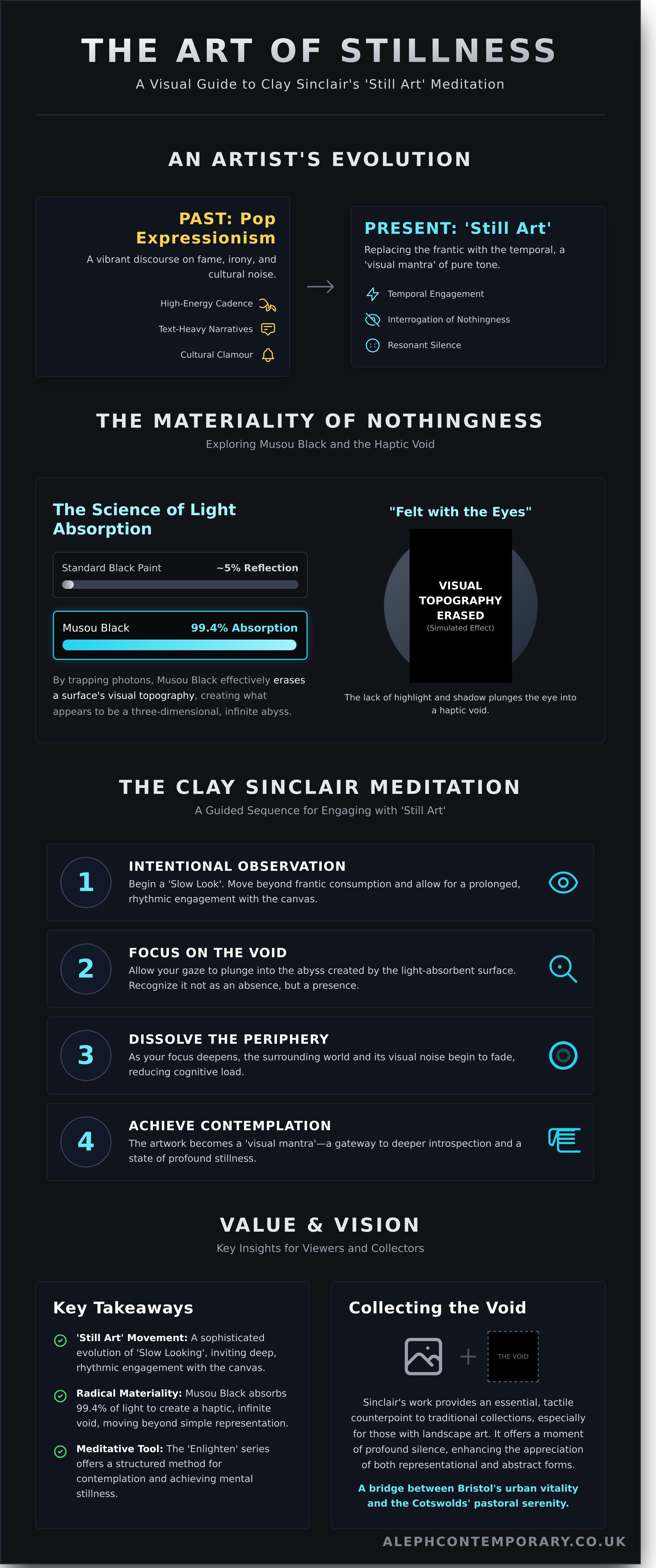
Sinclair’s earlier career was defined by the high-energy, text-heavy cadences of Pop Expressionism—a vibrant discourse on fame, identity, and contemporary culture. His current shift toward radical reduction is a logical interrogation of that clamour, replacing the frantic with stillness. By utilising some of the world's blackest material, Sinclair achieves a 'visual mantra' of pure tone. It is a transition that has found significant resonance among collectors of abstract art, who increasingly seek works that offer not just aesthetic pleasure.
The Materiality of Nothingness: Musou Black and the 99.9% Void
In this series, Sinclair employs Musou Black, a high-tech velvet fabric that absorbs approximately 99.9% of visible light. Unlike traditional pigments that reflect a portion of the spectrum to reveal their texture, Musou Black functions as a structural trap for photons, effectively erasing the surface's topography. This creates a visual phenomenon where the eye, deprived of its usual landmarks of highlight and shadow, plunges into what appears to be an infinite, three-dimensional abyss. This radical materiality moves the Still Art beyond mere visual representation into a profound interrogation of presence and absence.
While the international art discourse—frequently documented in publications like Frieze and e-flux—has been dominated by the proprietary controversies surrounding Vantablack, Sinclair’s use of Musou Black democratises this "non-colour" while maintaining its ontological weight. It is not merely an aesthetic choice but a philosophical anchor, inviting a dialogue between the viewer and the void that is as much about physics as it is about metaphysics.
Musou Fabric: More Than Just a Medium
The science of light absorption has a documented psychological impact; by removing visual "noise," the work encourages a state akin to mindfulness-based art therapy, where the viewer's cognitive load is reduced, allowing for deeper introspection. Sinclair manipulates the fabric to create spatial illusions that feel "felt with the eyes," a haptic experience where the fragility of the surface—velvety and absorbent—demands an intimate, physical proximity. Key characteristics include:
-
Total Light Extinction: The elimination of specular reflection, creating a "black hole" effect on the gallery wall.
-
Spatial Disorientation: The struggle of the human eye to find a focal plane, resulting in a sense of infinite depth.
-
Tactile Fragility: A surface so delicate that its very existence feels ephemeral, heightening the viewer's sense of care and presence.
Symmetry and the Visual Mantra
The architecture of these works relies on a perfectly balanced black core, a focal point that serves as a visual mantra. Surrounding this void are radiating tonal bands that suggest a rhythmic pulse, mirroring the slow, deliberate breath of a practitioner. This symmetry creates a direct relationship between the work’s physical centre and the viewer’s internal stillness, anchoring the works in a shared moment of temporal suspension. The layering of these bands creates a "halo" effect, transitioning the viewer from the chaotic light of the exterior world into the hushed, hallowed silence of the core.
'Still Art' in Stroud: A Guide to Guided Meditation
To engage with Clay Sinclair is to embark on a journey of radical stillness. This method of engagement serves as more than a mere artistic exercise; it aligns with the psychological understanding of mindfulness as a research-proven way to reduce stress, providing a sophisticated visual anchor for cognitive recalibration. To fully inhabit the work, one should follow a structured progression of observation:
-
Step 1: Arrive with the intention of 'slow looking', allowing the architectural weight of the space to ground your physical presence.
-
Step 2: Engage with the Musou core—the absolute, light-absorbing blackness at the work’s centre—until the peripheral world dissolves into insignificance.
-
Step 3: Follow the tonal bands outward, mirroring the expansion of consciousness as the eye moves from the dense void toward the liminal edges.
-
Step 4: Reflect on the absence of colour not as a vacuum, but as a generative presence of infinite possibility.
The St Laurence Church Sessions
In the hallowed nave of St Laurence Church, the Clay's Meditation experience found its most resonant home, blending historical sanctity with the contemporary void. During two-hour public exhibitions, the space hummed with a shared, silent inquiry, while intimate guided sessions allow for a deeper interrogation of the work's materiality. The unique acoustic properties of the Five Valleys' heritage spaces—where stone and timber dampen the external world—complement the visual silence of the works.
Sinclair’s Evolution: From Pop Provocateur to Curatorial Anchor
Sinclair’s artistic trajectory represents an interrogation of the UK art market's historical dichotomy between the overtly commercial and the deeply contemplative. Once recognized for his vibrant, socio-political pop provocations, his recent series marks a significant pivot toward a more visceral, material-led inquiry. This evolution effectively bridges the kinetic, urban energy with enduring stillness. His recent work serves as the distilled essence of this trajectory, occupying a liminal space where the artist’s past exuberance is not erased, but rather compressed into a singular silence.
Embracing the Liminal
By engaging with Clay's works, the viewer is invited into a liminal space where the void becomes a tangible presence, challenging our perceptions. This interrogation of nothingness, underscores Sinclair’s position on his art as an invitation to participate.

