
Recent reports in The Art Newspaper highlight a burgeoning global appetite for "haptic" forms-sculpture that demands a visceral, tactile engagement far beyond the sterile, clinical confines of the traditional "white cube" gallery. For the discerning collector, however, the transition from an international art fair to the private sphere often presents a daunting aesthetic challenge: how does one translate the radical materiality of a contemporary master into the historic, honey-coloured vernacular of a traditional stone dwelling? Navigating the nuances of modern sculpture for home Cotswolds requires more than an eye for beauty; it demands an interrogation of spatial dynamics and a profound appreciation for how global artistic movements can harmonise with our region’s rich, tactile heritage.
In this guide, we bridge the perceived distance between the avant-garde and the hearth, moving beyond the intimidating discourse of the metropolitan elite to offer sophisticated strategies for placement and acquisition. By exploring the "why" behind the form, we invite you to discover how abstract volumes can breathe new life into the unique light of the Five Valleys, ensuring your investment reflects both enduring cultural significance and a deeply personal connection to the haptic contemporary aesthetic.
Key Takeaways
- Explore how the 2026 Venice Biennale’s shift toward "slow materiality" informs the contemporary artistic discourse within the Five Valleys.
- Understand the concept of the "Haptic Contemporary" and how modern sculpture mirrors the tactile, craft-heavy heritage of Stroud’s historic textile industry.
- Learn to navigate the spatial dynamics of placing modern sculpture for home Cotswolds settings, balancing traditional honey-coloured stone with sophisticated abstract forms.
- Develop a discerning collector’s framework by evaluating an artist’s trajectory through the critical lens of global publications like *Frieze* and *e-flux*.
- Discover how to transition from mere aesthetic acquisition to a deeper dialogue with works that possess enduring cultural and philosophical significance.
The Global Resonance of Form: From International Biennales to the Five Valleys
In a definitive headline, The Art Newspaper recently heralded the 2026 Venice Biennale as a watershed moment for "Ecological Monumentality," signaling a global pivot toward what curators are calling 'slow materiality.' This movement represents a profound shift in the contemporary discourse, moving away from the ephemeral nature of the digital age in favour of sustainable casting, reclaimed mediums, and a rigorous interrogation of substance. Such international shifts find a resonant echo here in the West Midlands, where the pursuit of modern sculpture for home Cotswolds collections has become an exercise in balancing global avant-garde trends with the quiet, enduring spirit of our local landscape.
The unique, raking light of the Five Valleys serves as a natural curator, revealing the subtle nuances of abstract surfaces and the intricate history of modern sculpture that informs every contemporary bronze or mixed-media piece. At Aleph Contemporary, we view this through a "Global-Local" lens, recognizing that the artistic provocations seen in the galleries of London or New York are being reimagined and refined within the vernacular of our rural creative hubs, creating a sophisticated aesthetic that is both worldly and deeply rooted.
The Dialogue Between Tradition and Innovation
There is a compelling tension inherent in selecting modern sculpture for home Cotswolds settings-a dialogue between the ancient, honey-hued Oolitic limestone of our architecture and the futuristic, often liminal qualities of mixed-media works. To view a Stroud-based studio through the lens of a New York trend is to witness the "temporal" nature of rural practice. As one local sculptor recently noted: "To work in the Five Valleys is to negotiate with deep time; the stone remembers while the bronze anticipates." This interrogation of time and material transforms a simple acquisition into a visceral connection to the human condition.
Why Sculpture for the Home is Trending in 2026
As our daily lives become increasingly tethered to the two-dimensional flicker of digital screens, the three-dimensional object offers a necessary, haptic counterpoint. In 2026, sculpture functions as a "gestural" anchor within the modern interior, providing a sense of permanence and intellectual prestige that a flat canvas cannot always replicate.
- Spatial Dynamics: A well-placed sculpture commands the room’s energy, dictating the flow of movement and light.
- Haptic Contemporary: The move toward art that can be "felt with the eyes" satisfies a primal need for tactile engagement.
- Intellectual Prestige: Owning an original contemporary object represents a commitment to the ongoing narrative of craft and form, elevating the home into a site of active inquiry.
Materiality and the Haptic Contemporary: Why Texture Matters in Modern Sculpture
In the current discourse of the international art world, as frequently interrogated in publications such as Frieze or The Art Newspaper, there is a burgeoning reverence for the "Haptic Contemporary." This movement prioritizes works that demand an immediate sensory engagement-art that possesses a tactile quality so potent it can be "felt with the eyes." When selecting modern sculpture for home Cotswolds environments, the discerning collector looks beyond mere silhouette to the visceral narrative written into the surface of the object. Here in the Five Valleys, this focus on texture feels profoundly grounded; the experimental, interwoven forms of contemporary sculpture often mirror Stroud’s historic legacy in the textile and weaving industries, bridging the gap between our regional industrial heritage and global avant-garde expression.
Interrogating the Surface
The "Contemporary Look" favors works that unapologetically show the hand of the artist, rejecting the sterile perfection of mass production for the nuanced "liminal" space between rough-hewn textures and refined finishes. Materiality is the physical manifestation of an artist's conceptual discourse. Within the domestic sphere, the poetic nuances of mixed media works offer a profound sensory impact, inviting the viewer to explore the tension between disparate elements like found wood, resin, or plaster. This interplay is central to Tate's definition of sculpture, which emphasizes the transformative processes of carving, modelling, and constructing to imbue inert matter with a living, intellectual presence.
The Power of the Line in Space
The selection of modern sculpture for home Cotswolds interiors often necessitates a balance between the architectural weight of the stone-built environment and the ethereal quality of contemporary mark-making. We frequently contrast the grounded, historical resonance of oil-based patinas on bronze with the skeletal airiness of wire and graphite forms that seem to draw directly into the air.
- Gestural Mark-making: A sculptor’s visible touch creates a silent, intimate exchange with the viewer.
- Spatial Dynamics: The contrast between dense mass and "captured" air defines the visceral quality of contemporary British sculpture.
- Regional Light: The unique, shifting light of the Cotswolds emphasizes the relief and shadow of textured surfaces.
Interrogating Space: Placing Contemporary Sculpture within Cotswold Architecture
The most frequent hesitation we encounter when discussing modern sculpture for home Cotswolds settings is the fear of "monumentality"-the concern that a piece of significant presence will overwhelm the domestic intimacy of a period cottage or a converted barn. However, the curation of contemporary art is less about dominance and more about a rhythmic interrogation of space. In the unique architectural vernacular of South Gloucestershire, where honey-coloured limestone provides a warm, textured backdrop, the introduction of sharp abstract forms creates a sophisticated dialectic between heritage and the avant-garde.
By placing objects in liminal zones-the quiet transition of an entryway, a secluded library corner, or a window bay overlooking the wolds-we invite a silent exchange that thrives in the unhurried atmosphere of a rural retreat. This dialogue is not merely visual but spatial, requiring an understanding of how a three-dimensional object disrupts and defines the air around it.
The Architecture of Light
The shifting, often ethereal light of the Five Valleys acts as a secondary medium for the sculptor. As the sun moves across the Cotswold escarpment, the perception of shadow and form evolves, revealing the nuanced materiality in contemporary sculpture that a static gallery environment might obscure. Placing a piece to interact with expansive views ensures that the art participates in a temporal dance. We encourage "slow looking," allowing the collector to witness how a bronze patina or a polished surface responds to the gloaming, grounding the work in the local landscape and the specific atmospheric conditions of the West Midlands.
Scale and Proportion in the Five Valleys
To avoid a sterile "museum" feel, one must seek pieces that resonate with the human scale rather than simply filling a void. While a minimalist interior offers a clean slate, it can occasionally feel detached; integrating figurative sculpture can provide an essential emotional anchor, grounding the room in a sense of presence and history. Consider the following when balancing modern sculpture for home Cotswolds interiors:
- The Role of the Plinth: Elevating a work to eye level transforms it from furniture into a focal point, initiating a conversation with the room’s verticality.
- Negative Space: Ensure the sculpture has "room to breathe," allowing the viewer to navigate the object from multiple angles.
- Material Contrast: The juxtaposition of industrial steel or glass against traditional Cotswold stone heightens the tactile, haptic quality of both materials.
Ultimately, the objective is a harmonious proportion that honours both the artist’s gestural intent and the home’s architectural heritage, whether in a townhouse in Cheltenham or a creative studio in Stroud.
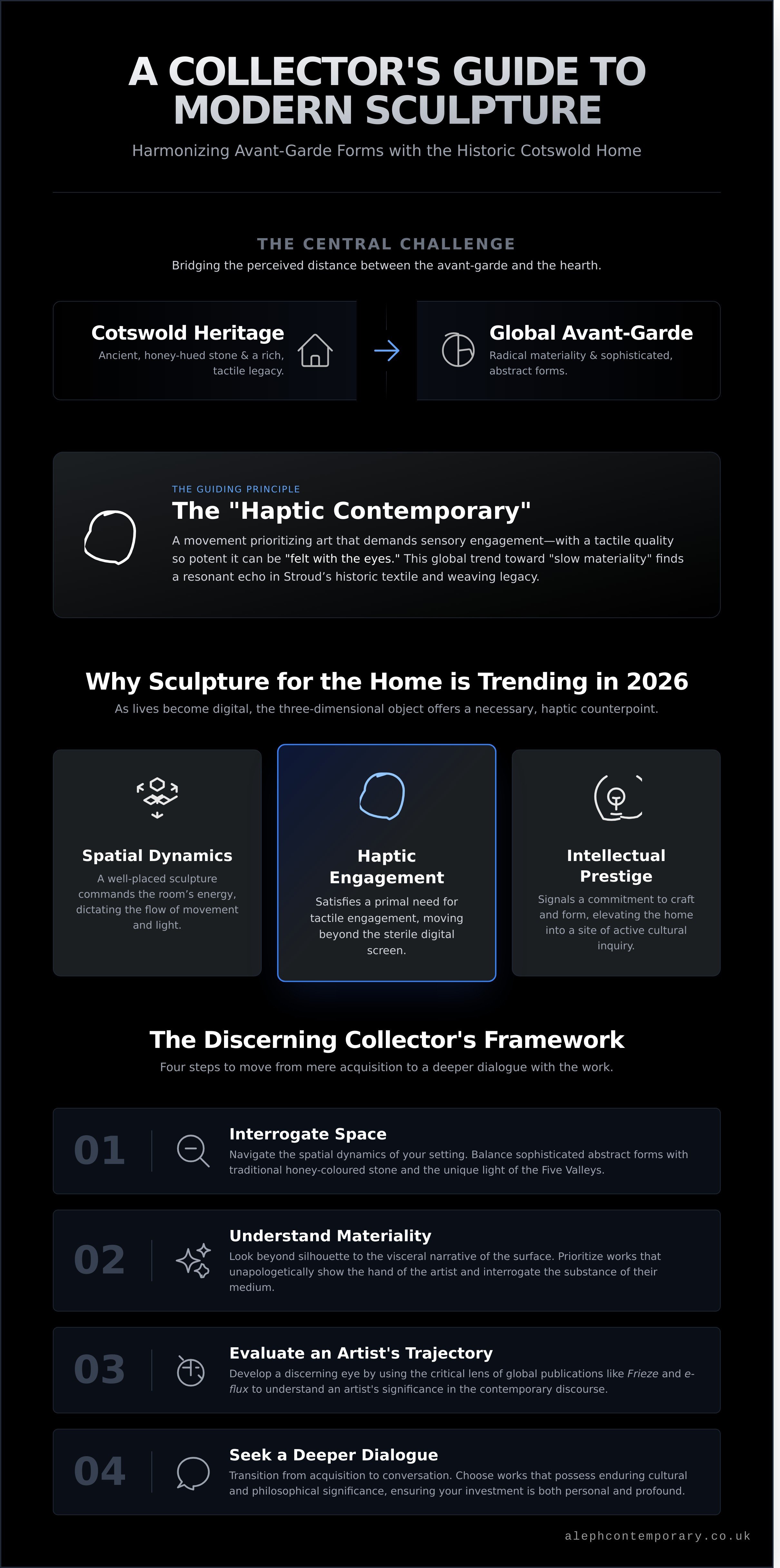
The Discerning Collector’s Framework: Navigating Modern Sculpture for the Home
To begin a sculpture collection is to engage in a silent dialogue between the object and the environment. While aesthetic appeal is often the initial catalyst, a truly curated space within the Five Valleys requires a deeper interrogation of "the why." Is the piece intended to anchor a room’s spatial dynamics, or does it serve to reflect the rugged materiality of the surrounding landscape? By following the critical discourse in publications like Frieze or e-flux, the collector can evaluate an artist’s trajectory within the broader contemporary canon, ensuring that selecting modern sculpture for home Cotswolds interiors is an investment in a living narrative rather than a mere decorative gesture.
Investment and Curation
For those initiating their journey, exploring curated collections between £1,000 and £2,500 offers a sophisticated entry point into the world of emerging talent. The significance of "originality" and "quality" cannot be overstated in long-term art investment; we are currently witnessing a global resurgence of British contemporary artists whose work emphasizes a "Haptic Contemporary" aesthetic-art that is felt with the eyes. This resurgence is driven by a renewed appreciation for craft and form that transcends fleeting trends, positioning British sculpture as a cornerstone of the international market.
The Technical Interrogation
The acquisition process necessitates a rigorous understanding of the work’s physical and conceptual provenance. Distinguishing between a "unique" work-a singular expression of materiality-and a "limited edition" cast is paramount for determining value and rarity. Beyond the object itself, researching an artist’s biographical narrative allows the collector to connect with the temporal and gestural history of the piece. Here, the gallery acts as a vital bridge, translating the raw energy of the studio into the refined context of the home.
The logistics of bringing a significant work into a West Midlands residence require precision and foresight:
- Specialized Delivery: Ensure the use of art-handling specialists familiar with the logistical nuances of rural Gloucestershire and the Cotswolds.
- Lighting: Consider how the shifting, liminal light of the region will interact with the sculpture’s surface, revealing different nuances from dawn to dusk.
- Insurance: Secure comprehensive coverage that reflects the work's current market valuation and historical importance.
At Aleph Contemporary, we invite you to explore these spatial possibilities further. Whether you are a seasoned collector or discovering your first piece, our role is to guide you through the transformative power of three-dimensional form. Discover our latest acquisitions and reflect on how a single piece might redefine your interior landscape at alephcontemporary.co.uk.
A Dialogue in Stroud: Discovering Modern Sculpture at Aleph Contemporary
In a recent discourse featured in The Art Newspaper regarding the "return to the object," critics have noted a significant shift toward works that prioritise tactile integrity over ephemeral digital trends. At Aleph Contemporary, we position ourselves as the visionary guide for this movement within the region, curating a selection that functions as a bridge between the international avant-garde and the sophisticated domesticity of the Five Valleys. Our commitment to "Haptic Contemporary" ensures that every piece we represent-whether cast in bronze or carved from stone-possesses a visceral quality that can be "felt with the eyes," making the search for modern sculpture for home Cotswolds an exercise in both intellectual and sensory discovery.
The Aleph Experience
Our gallery in Stroud serves as a site of active intellectual inquiry, where the unique light of the Cotswolds illuminates the complex materiality of our artists' work. We understand that acquiring a significant piece is a journey of stewardship; therefore, we offer complimentary UK delivery to ensure your sculpture arrives with the curatorial care it deserves. By bridging the gap between global practice and local heritage, we invite you to explore our latest sculpture collection, where the rhythmic complexity of modern form meets the enduring cultural significance of the West Midlands.
Your Next Step in Collecting
Selecting modern sculpture for home Cotswolds environments requires a nuanced understanding of how a three-dimensional form interrogates its surrounding space. We invite discerning collectors to book a private viewing or a bespoke consultation at our Stroud gallery to discuss the temporal and spatial dynamics of their interiors. Whether you are drawn to the gestural energy of a contemporary bronze or the liminal qualities of mixed-media assemblages, we are here to facilitate a profound connection between the viewer and the artwork.
The transformative power of bringing an original contemporary dialogue into your living space cannot be overstated. We encourage you to visit Aleph Contemporary to continue this conversation and discover how a singular, haptic form can redefine the architectural narrative of your home. To begin your exploration, please visit our website or contact the gallery directly to arrange a private appointment.
Cultivating a Dialogue: The Future of Form in the Five Valleys
Integrating a piece of contemporary form into one’s private sanctuary is more than an act of acquisition; it is a profound interrogation of space and a commitment to the haptic contemporary. As we have explored, the transition from the global stages of international biennales to the unique, ethereal light of the Five Valleys requires a discerning eye for materiality and a deep appreciation for the poetic dialogue between modern form and Cotswold architecture. Whether navigating the rhythmic complexity of bronze or the liminal grace of stone, the right work serves as a transformative bridge between the visceral and the cerebral, anchoring the home in a broader cultural narrative.
At Aleph Contemporary, we serve as a visionary guide for the collector, offering modern sculpture for home Cotswolds environments that is curated by seasoned aesthetes and regularly featured in major art discourse. We invite you to continue this exploration of texture and spatial dynamics within our Stroud gallery, located just a short journey from the creative hubs of Bath and Cheltenham. Explore our curated collection of Modern Sculpture in Stroud and benefit from our complimentary UK delivery. We look forward to helping you discover a work that resonates with both the global avant-garde and the enduring heritage of our region.
Frequently Asked Questions
What defines 'modern sculpture' for a Cotswold home versus a gallery?
In a gallery, sculpture often exists as a discrete object of interrogation; however, within the domestic sphere of a Cotswold home, it becomes a participant in a lived dialogue. Modern sculpture for the home prioritizes a haptic quality-a tactile resonance that complements the honeyed tones of local limestone-while maintaining the intellectual rigor one might find in a feature in The Art Newspaper. It is about finding a balance between monumental presence and the intimate scale of private reflection.
How do I care for bronze or mixed media sculptures in a domestic environment?
Bronze requires a rhythmic maintenance of microcrystalline wax to preserve its patina against the shifting humidity of the Five Valleys. For mixed media works, which often explore the liminal space between organic and synthetic materials, we advise avoiding direct sunlight from large mullioned windows. Caring for these pieces is an act of stewardship, ensuring that the materiality of the work remains as vibrant as the day it left the artist’s studio in London or Bristol.
Is it better to start with abstract or figurative sculpture for a new collection?
Choosing between the abstract and the figurative is less a matter of trend and more an exploration of how one wishes to inhabit a space. Figurative works offer a recognizable human discourse, whereas abstract pieces invite a more fluid, temporal engagement with form and shadow. For a new collection of modern sculpture for home Cotswolds, we often suggest beginning with a piece that emphasizes 'haptic' qualities-art that demands a visceral, sensory response regardless of its subject matter.
How does the lighting in a Cotswold stone house affect modern art placement?
The unique, porous texture of oolitic limestone absorbs and diffuses light in a way that can either flatten or dramatize a sculpture’s form. We recommend a layered lighting approach that mirrors the shifting diurnal cycles of the Gloucestershire landscape. Directional, soft-LED spots can highlight the gestural marks of a carved surface, while the natural, amber-hued light of a Stroud sunset creates a poetic interplay of shadows, enhancing the work's inherent spatial dynamics.
Can contemporary sculpture be an investment-worthy purchase for beginners?
Indeed, contemporary sculpture can be a profound investment when one looks beyond fleeting market trends toward works with enduring cultural significance. By identifying artists who engage deeply with materiality and historical discourse-often highlighted in publications like Frieze-beginners can acquire pieces that appreciate both intellectually and financially. At Aleph Contemporary, we champion artists whose work possesses a timeless quality, ensuring your acquisition remains a vital part of the global art conversation.
What is the difference between 'modern' and 'contemporary' sculpture?
'Modern' sculpture typically refers to the historical period from the late 19th century through the mid-20th, characterized by an interrogation of tradition and the birth of abstraction. In contrast, 'Contemporary' sculpture is the art of our present moment, often grappling with immediate global concerns and experimental media. While the terms are frequently conflated in casual discourse, understanding this temporal distinction is essential for any discerning collector navigating the international art world from a local perspective.
How do I know if a sculpture is the right scale for my living room?
Determining the correct scale requires an analytical look at the 'negative space' surrounding an object. A sculpture should neither overwhelm the room’s architectural heritage nor be swallowed by it. We often consider the work’s volume in relation to the ceiling height of your Cotswold residence. A piece achieves the 'right' scale when it establishes a harmonious tension with its environment, allowing the viewer room for the 'slow looking' and quiet contemplation we value.
Does Aleph Contemporary offer shipping and installation advice for Stroud residents?
Aleph Contemporary provides bespoke shipping and installation advice tailored to the specific logistical nuances of the West Midlands and the Five Valleys. Whether you are situated in a historic Stroud townhouse or a contemporary conversion in Cheltenham, we coordinate with specialized art handlers to ensure your modern sculpture for home Cotswolds is placed with curatorial precision. Our goal is to bridge the distance between the artist’s vision and its final, permanent resonance within your collection.

