
To stand before a work of abstract art is to enter a silent dialogue, one that can feel at once profoundly moving and intellectually demanding. The absence of a recognisable subject often leaves the discerning viewer adrift, questioning how to discern meaning, evaluate quality, or distinguish a work of enduring significance from ephemeral decoration. This challenge, however, is not a barrier but an invitation-an opportunity to engage with art on its own uncompromising terms, through the pure languages of colour, form, and materiality.
This exploration is designed to serve as your guide through that very dialogue. We will trace the historical origins and philosophical underpinnings of abstraction, unfolding a framework for ‘slow looking’ that empowers you to appreciate the gestural energy and compositional rigour that defines a masterpiece. From the revolutionary canvases of the early modernists to the vibrant contemporary discourse flourishing today in the studios of Stroud and across the Cotswolds, we invite you to move beyond intimidation and begin the deeply rewarding journey of building a collection of true substance and personal resonance.
Key Takeaways
- Develop a framework for appreciating non-representational art, moving beyond initial impressions to engage with its unique language of form, colour, and emotional resonance.
- Trace the historical lineage of abstraction, from its revolutionary European origins to its enduring influence on the vibrant contemporary art scene within the Cotswolds.
- Acquire the foundational principles for beginning a collection, from articulating your personal aesthetic to understanding the critical role of provenance when acquiring significant abstract art.
- Identify the key characteristics that establish Stroud as a vital hub for artistic innovation and a fertile ground for discovering works of enduring cultural value.
Defining the Indefinable: The Language of Abstract Art
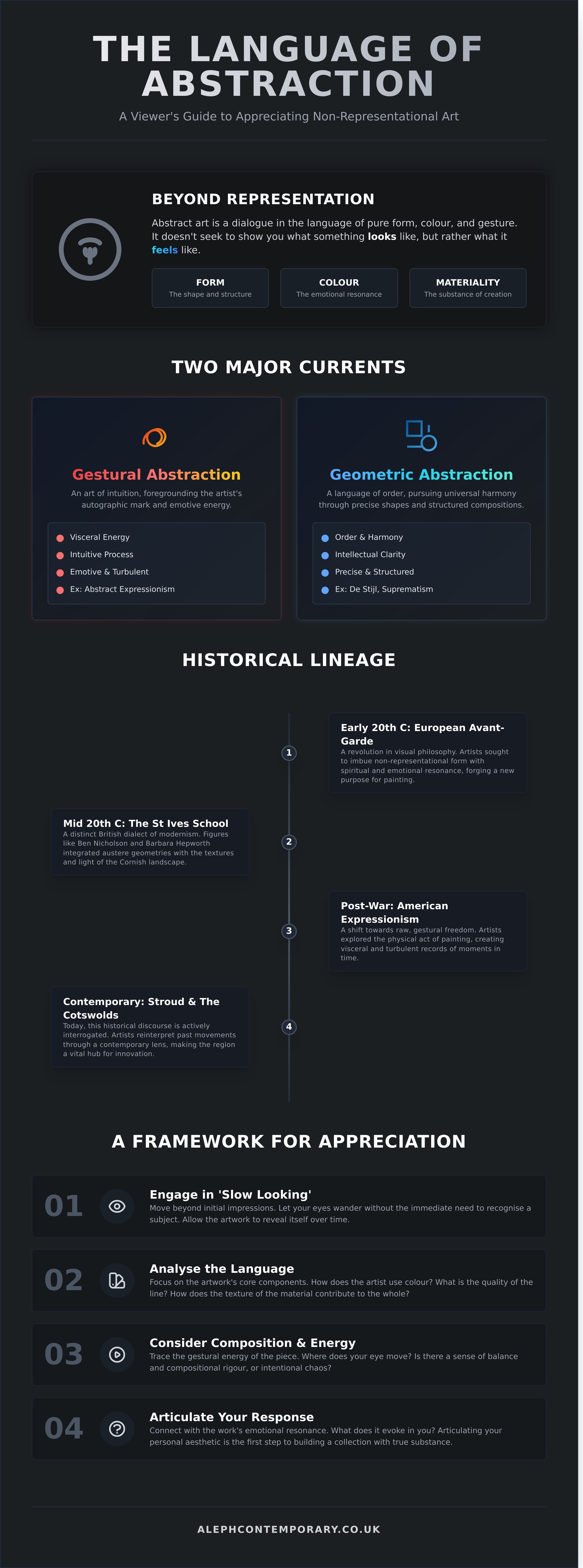
To approach the world of abstract art is to enter a dialogue conducted not in words, but in the elemental language of pure form, colour, and gesture. Liberated from the necessity of representing the objective, physical world, the abstract artist engages with a different kind of reality-one that is internal, emotional, and conceptual. This art does not seek to show you what something looks like, but rather what something feels like. The meaning resides within a liminal space, forged in the silent exchange between the materiality of the artwork and the unique perception of the viewer, distinguishing itself profoundly from art where recognisable forms are merely schematised or simplified.
The Core Tenets of Abstraction
At its heart, abstraction champions the principle of art for art’s sake, a profound freedom from mimetic duty. The focus shifts inward, towards the very substance and process of creation; the viscosity of paint, the tension of the canvas, and the artist's physical engagement with their materials become the subject. This emphasis on materiality is not merely technical but philosophical. By shedding recognisable imagery, artists from across the long and complex history of abstract art have sought to communicate universal truths and spiritual states, creating forms that resonate on a primal, pre-linguistic level.
Gestural vs. Geometric Abstraction
Within this expansive territory, two major currents have defined much of its discourse: the gestural and the geometric. Gestural abstraction, exemplified by the visceral energy of Abstract Expressionism, foregrounds the artist's autographic mark-an emotive, often turbulent record of a moment in time. It is an art of intuition. Conversely, geometric abstraction pursues a language of order, harmony, and intellectual clarity, employing precise shapes and structured compositions to evoke a sense of universal purity. The dynamic tension between these two poles-the impassioned gesture and the considered form-has fuelled a rich and varied artistic conversation that continues to evolve.
A Brief History: From Global Movements to the Cotswolds Scene
To comprehend the vibrant landscape of contemporary abstract art in Stroud is to trace a lineage of radical thought that stretches back over a century. The seeds of abstraction were sown in the late 19th century, as post-Impressionist painters began to dismantle the primacy of representation, yet it was in the early 20th century that the movement truly erupted. This departure from mimesis towards an internal, subjective reality-a complex question the Tate thoughtfully explores in its definition of what is abstract art?-initiated a profound and enduring dialogue about the very purpose of painting. This global conversation, from the spiritual fervour of the European avant-garde to the raw energy of American post-war expressionism, found a unique and resonant echo in the British Isles, a legacy that continues to inform the practices of artists drawn to the Cotswolds today.
The European Avant-Garde
At the vanguard of this revolution, Wassily Kandinsky sought to imbue non-representational form with a spiritual resonance, believing colour and line could directly access human emotion. In parallel, Piet Mondrian and the De Stijl movement pursued a universal harmony through a rigorously reduced geometric language, while Kazimir Malevich’s Suprematism proposed a radical simplification of form, seeking a "zero point" of painting that privileged pure feeling and perception above all else. These artists were not merely creating a new style; they were forging a new visual philosophy.
The St Ives School and British Abstraction
While Continental Europe and later America were epicentres of this new art, Britain developed its own distinct dialect. The St Ives School, with figures like Ben Nicholson and Barbara Hepworth, became a crucible for a form of modernism that maintained a profound dialogue with its environment. Nicholson’s lyrical abstractions, for instance, masterfully integrated the austere geometries of international modernism with the textures, light, and liminal forms of the Cornish landscape. This enduring tension between pure abstraction and a sense of place remains a powerful undercurrent in British art, a legacy clearly visible in the Cotswolds.
Contemporary Abstraction in Stroud
Today, Stroud stands as a significant hub where this historical discourse is not just remembered but actively interrogated. Artists working in the region reinterpret the gestural freedom of Abstract Expressionism and the formal rigour of Minimalism through a contemporary lens, exploring diverse materiality and conceptual frameworks. They continue the vital conversation between landscape and abstraction, proving that the revolutionary spirit of the early 20th century remains a potent and inexhaustible source of creative inquiry.
How to 'Read' an Abstract Painting: A Framework for Appreciation
To stand before a piece of abstract art is to be invited into a silent dialogue, one that moves beyond the immediate search for recognisable imagery. The initial question, "What is it supposed to be?", often misses the point entirely. The true engagement begins with the practice of 'slow looking'-a deliberate, unhurried absorption of the work that allows your initial, intuitive emotional response to surface. This visceral connection is not an endpoint but a crucial beginning, a personal anchor from which a deeper, more intellectual appreciation can be built.
Analysing Composition and Form
Every abstract work possesses an internal logic, an architecture of feeling constructed from formal elements. Consider the composition's balance: is it a harmonious equilibrium or a deliberate, dynamic tension? Follow the gestural lines to understand the rhythm and movement that guide your eye across the canvas. Observe the profound dialogue between the solid shapes and the charged emptiness of the negative space that surrounds them. The physical scale of the work is also paramount; a monumental canvas commands a different kind of bodily engagement from the viewer than an intimate, small-scale piece, altering the entire perceptual experience.
Decoding Colour and Texture
Colour in abstract art is rarely merely decorative; it is a primary carrier of psychological and emotional weight. A palette of muted, earthy tones might evoke a sense of grounding and temporality, while swathes of vibrant, dissonant colour can create a feeling of exhilarating rupture. Beyond hue, one must consider the work's materiality. The physical surface of the painting-the thick, sculptural impasto of oil paint, the delicate transparency of a watercolour wash, or the layered history of a collage-offers a tactile dimension. This texture contributes directly to the work’s sensory impact, inviting a connection that is as much felt as it is seen.
Understanding Intent and Context
While a personal response is vital, enriching it with context can unlock further layers of meaning. An artist's statement or a thoughtfully chosen title can act as a crucial entry point into their conceptual framework, offering a glimpse into the ideas that catalysed the work's creation. Furthermore, understanding where an artist is situated within the broader discourse of art history, a lineage well-documented in Tate's overview of abstract art, illuminates the traditions they are engaging with or rebelling against. With this framework in mind, the most rewarding step is to put theory into practice. View our curated collection to practice your analytical skills and discover the profound dialogues contained within each piece.
The Abstract Art Landscape in Stroud and the Cotswolds
The Cotswolds have long functioned as a muse, a pastoral idyll that has drawn artists for centuries. Yet, within this landscape of rolling hills and honey-coloured stone, Stroud has carved out a distinct identity as a fiercely independent and creative hub. It is a town defined by its dynamic friction-a place where the romanticism of the English countryside engages in a constant dialogue with a post-industrial, radical heritage. This unique confluence has cultivated a contemporary art scene of remarkable quality and originality, one that is less concerned with fleeting trends and more invested in a profound exploration of materiality and form.
Why Stroud Attracts Contemporary Artists
The appeal of Stroud for the contemporary artist lies in its liminal character. The town’s topography, marked by deep valleys and the architectural remnants of its woollen mills, offers a rich visual and conceptual vocabulary that resists simple categorisation. This environment fosters a supportive and critically engaged ecosystem of studios, foundries, and artist-led initiatives, creating a community that values rigorous practice. While maintaining a vital proximity to the major art centres of London and Bristol, Stroud retains a singular, uncompromised identity, allowing artists the space for deep, uninterrupted inquiry away from the pressures of a metropolitan market.
Discovering Abstract Art in the Region
For the discerning collector, navigating this landscape is an exercise in discovery, guided by thoughtfully curated exhibitions that serve as crucial platforms for new and established talent. The most compelling local abstract art often engages with the genius loci, or 'spirit of place', translating the region's unique tensions into gestural, non-representational language. It is this commitment to substance and integrity that institutions like Aleph Contemporary champion. By focusing on artists of exceptional quality and conceptual depth, we contribute to a cultural discourse that extends far beyond the Cotswolds, presenting work that possesses an enduring, international significance.
Beginning Your Collection: Acquiring Abstract Art with Confidence
The transition from observer to collector marks a profound shift in one’s engagement with art; it is the moment when appreciation evolves into a personal, intellectual, and aesthetic commitment. To begin collecting abstract art is to begin curating a narrative that reflects your own vision, a process that requires a delicate balance between the visceral, emotional response to a piece and a considered understanding of its long-term cultural significance. It is about more than decoration; it is about living with works that challenge, console, and perpetually unfold their meaning over time, transforming the very character of your living space.
Developing Your Collector's Eye
Cultivating a discerning eye is an immersive process, one rooted in active looking and thoughtful inquiry. We encourage you to frequent galleries and exhibitions, not only in Stroud but further afield, allowing your preferences to be shaped and refined by direct encounters with the work. Follow artists whose practice resonates on a deeper conceptual level, and crucially, initiate a dialogue with gallerists. Their role extends far beyond sales; they are conduits to the artist’s world, offering invaluable context on process, materiality, and the ideas that animate the canvas.
Practical Steps for Your First Acquisition
While establishing a budget is a pragmatic first step-perhaps starting from £1,000 to £5,000 for a significant work by an emerging artist-it should serve as a framework for exploration rather than a rigid constraint. When you find a work that truly captivates you, consider it an invitation to learn more. Key questions to pose include:
- What is the artist's exhibition history and what is the trajectory of their career?
- Can you elaborate on the conceptual underpinnings of this particular piece or series?
- How will the work’s scale, texture, and colour palette interact with the specific light and architecture of my home?
Why a Specialised Gallery Matters
Navigating the contemporary art landscape requires expertise and a trusted guide. A specialised gallery offers the benefit of a curator's rigorous selection process, providing assurance of provenance and a direct link to artists engaged in a significant global discourse. This curated environment grants you access to both established figures and the most promising emerging talents whose work demonstrates enduring intellectual and aesthetic value. For those ready to take this transformative step, we invite you to begin a conversation with us about your collection.
Embarking on Your Collecting Journey
Our exploration has traversed the complex language of abstraction, moving from its global history to the gestural marks that define its very materiality, revealing how the Cotswolds, and Stroud in particular, serves as a vital locus for this ongoing artistic discourse. Armed with a framework for appreciation, you are now equipped not merely to view, but to engage with and interpret these powerful works, transforming the act of looking into a profound personal dialogue.
The journey into collecting abstract art begins with a single, resonant piece that speaks to your own intellectual and aesthetic sensibilities. As a gallery deeply rooted in the vibrant artistic hub of Stroud, Aleph Contemporary is dedicated to fostering this very dialogue, championing a curated selection of both emerging and established contemporary artists whose practices are defined by their uncompromising quality and originality. This is your invitation to move from appreciation to acquisition with confidence.
Discover original abstract works from our curated artists and begin the conversation that will last a lifetime.
Frequently Asked Questions
How do I determine the value of an abstract painting?
Determining the value of an abstract painting involves a nuanced assessment of several critical factors. An artist’s exhibition history, their placement within significant public and private collections, and the critical discourse surrounding their work are paramount. Provenance, or the history of ownership, adds a crucial layer of authenticity and desirability. The work’s materiality, scale, condition, and its significance within the artist's broader oeuvre are also fundamental considerations that inform its current market valuation and future potential.
What is the difference between modern and contemporary abstract art?
The distinction lies primarily in historical context and philosophical underpinnings. Modern abstraction, rooted in the period from the early 20th century to the 1970s, was often driven by utopian ideals and a formalist interrogation of the medium itself. Contemporary abstraction, by contrast, emerged from a post-modern context and engages in a more pluralistic, self-aware dialogue with art history, global culture, and new material possibilities, reflecting the complex realities of our current temporal moment.
How can I be sure an abstract artwork is a sound investment?
While passion should always guide acquisition, a sound investment is typically anchored in diligent research and expert guidance. Focus on artists who demonstrate a consistent and critically engaged studio practice, a robust exhibition record with respected galleries, and institutional recognition. A gallery with a strong curatorial vision acts as a vital filter, championing artists whose work possesses not just immediate aesthetic power but the intellectual rigour and historical resonance that predicate enduring cultural and financial value.
Where can I see high-quality abstract art exhibitions in the Cotswolds?
The Cotswolds offers an increasingly sophisticated landscape for viewing significant art. Beyond our own curated programme at Aleph Contemporary in Stroud, discerning collectors should explore institutions such as Messums Wiltshire, which presents ambitious exhibitions in a unique setting. Additionally, New Brewery Arts in Cirencester and The Wilson Art Gallery and Museum in Cheltenham frequently feature compelling displays of modern and contemporary British art, providing a rich regional context for the serious enthusiast.
How do I care for an original abstract painting once I've purchased it?
Proper care is essential to preserving the integrity and value of an original work. It is imperative to display paintings away from direct ultraviolet light and sources of extreme heat or humidity. A stable environment is key. For handling, transportation, and installation, consider professional art handlers. Any cleaning or restoration should be entrusted exclusively to a qualified conservator, ensuring the long-term stability of the painting’s material surface and structural support for generations to come.
What defines the selection of artists at Aleph Contemporary in Stroud?
Our curatorial vision is defined by a commitment to artists engaged in a rigorous and poetic interrogation of painting. We champion individuals whose work demonstrates a profound dialogue with art history while forging a unique visual language. The selection prioritises intellectual depth, material innovation, and an authentic gestural voice. We seek to present abstract art that transcends decoration, offering instead a liminal space for contemplation on the enduring questions of form, perception, and human experience.

