
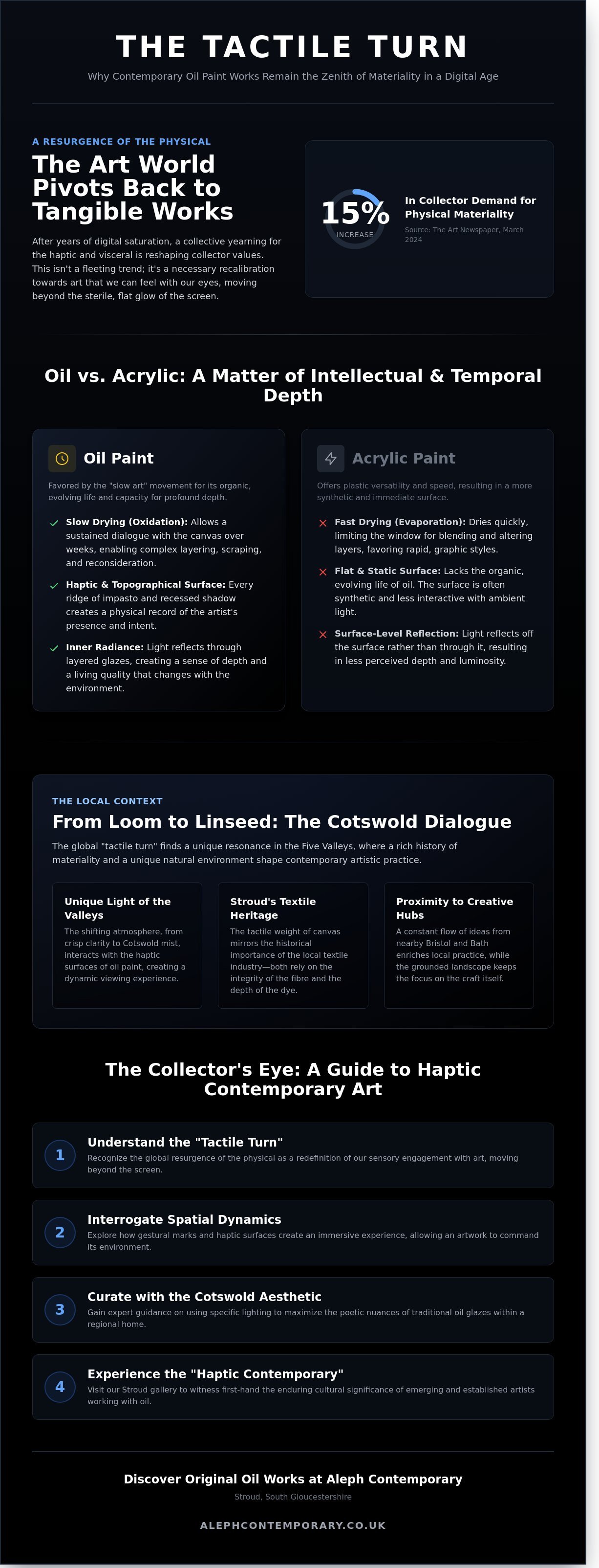
What if the most radical act in a hyper-digital age isn't a fleeting NFT but the slow, deliberate layering of pigment on linen? In March 2024, *The Art Newspaper* reported a 15% increase in collector demand for physical materiality, suggesting a profound shift back toward the tangible. You likely find yourself weary of the sterile, generic offerings found in global marketplaces and yearn for art with genuine cultural weight. Here in the Five Valleys, the shifting light of the Cotswolds demands a medium with equal depth, which is why contemporary oil paint works remain the definitive choice for those seeking a haptic connection to their surroundings.
We understand that integrating sophisticated, international-standard art into a regional home often feels like a complex dialogue between tradition and innovation. This guide promises to illuminate the intellectual and tactile allure of the medium while helping you identify investment-worthy originals that honour Stroud's unique creative heritage. We'll examine the specific materiality of the canvas and show you how to connect with a local community that rivals the prestige of London or Venice.
Key Takeaways
- Understand the global "tactile turn" in contemporary art, as recently highlighted by Frieze, and how this resurgence of the physical redefines our sensory engagement with the canvas.
- Discover the profound dialogue between Stroud’s historic textile heritage and modern practice, where the unique light of the Five Valleys shapes the materiality of the work.
- Learn to interrogate the spatial dynamics of oil paint works, exploring how gestural marks and haptic surfaces create an immersive experience that commands its environment.
- Gain expert guidance on curating contemporary art within the Cotswold aesthetic, focusing on how specific lighting can maximise the poetic nuances of traditional glazes.
- Find out how to experience the "Haptic Contemporary" first-hand at our Stroud gallery, where we champion the enduring cultural significance of both emerging and established artists.
The Tactile Turn: Why Oil Paint Works Remain the Zenith of Materiality
In a 2024 dispatch from Frieze magazine, critics have already begun dissecting the thematic foundations of the 2026 Venice Biennale, specifically highlighting a "Resurgence of the Physical." This shift marks a pivotal moment in the global art discourse. After years of digital saturation and the ethereal nature of the screen, the art world is pivoting back toward the haptic, the tangible, and the visceral. We're seeing a collective yearning for art that we can feel with our eyes. This isn't just a fleeting trend; it's a necessary recalibration of what we value in an increasingly ephemeral age.
By engaging with the specificities of linseed oil and ground pigments, artists create a reality that transcends the flat, backlit glow of our ubiquitous devices. Those who study traditional oil painting techniques recognise that the medium's longevity is tied to its chemical complexity. It's a material that demands patience and rewards deep looking. The screen is flat. The painting, conversely, functions as a topographical record of an artist's physical presence, where every ridge of impasto and every recessed shadow tells a story of intent. These oil paint works represent more than just image-making; they are an invitation to experience the physical presence of the creator.
Here in the Cotswolds, where the unique light of the Five Valleys has long influenced the creative spirit, we see this material interrogation daily. The tactile weight of a canvas mirrors the historical importance of Stroud's textile industry; both rely on the integrity of the fibre and the depth of the dye. Our proximity to creative hubs like Bristol and Bath ensures a constant flow of ideas, yet the grounded nature of our local landscape keeps the focus on the craft itself. The Aleph Contemporary oil collection serves as a vital site for this material exploration, bridging the gap between the artist's studio and the collector's world.
The Interrogation of Surface and Depth
Oil allows for a rhythmic complexity that acrylics simply cannot match. Because oil dries through oxidisation rather than evaporation, it grants the artist a temporal window that lasts weeks. This allows for a sustained dialogue with the canvas, where layers are added, scraped back, and reconsidered. Materiality in the 21st century isn't just about the paint itself; it's about the record of time and the physical labour embedded in the surface. It's a slow, deliberate process that honours the history of the medium while pushing it into new, contemporary territories.
Oil vs Acrylic: A Matter of Intellectual Weight
While acrylics offer a plastic versatility, they often lack the organic, evolving life found in oil paint works. Collectors frequently favour the "slow art" movement, appreciating how light reflects through layered oil glazes to create a sense of inner radiance. This sensory impact is profound. It's the difference between a synthetic, static surface and a living, breathing object that changes as the light moves through a room. The choice of oil is often a choice for intellectual and temporal depth, favouring substance over speed.
As you consider the role of art in your own environment, we invite you to reflect on the "why" behind the medium. Visit us here in Stroud, South Gloucestershire, to witness how the light interacts with these surfaces, or explore our curated selection to begin your own interrogation of modern materiality. We believe that the most enduring art is that which demands a physical response, anchoring us in the present moment through the sheer power of its construction.
Beyond the Canvas: Interrogating Spatial Dynamics and the Haptic Surface
To observe how oil paint works command the space they inhabit, one must look beyond the depicted subject and focus on the physical geography of the medium. Unlike the flat, immediate drying of acrylics, oil paint exists as a slow-moving, structural entity. It possesses a gravitational weight that demands a specific kind of attention. In the unique light of the Five Valleys, where the atmosphere often shifts between crisp clarity and Cotswold mist, the undulating surface of an oil painting interacts with the environment in real time. The paint isn't merely a carrier of colour; it's a record of the artist's physical behaviour. Every gestural mark serves as a temporal map, documenting the speed, pressure, and hesitation of the hand that applied it. This creates a haptic experience where the viewer doesn't just see the image but feels the exertion behind its creation.
The Architecture of the Mark
The structural depth of oil is most evident in the use of impasto, where the medium is applied thickly enough to cast its own shadows. This technique transforms a two-dimensional plane into a three-dimensional landscape of ridges and valleys. A 2024 editorial in e-flux highlighted how this haptic quality serves as a necessary rebellion against the digital flatness of our current era. There's a constant tension between the artist’s intention and the medium’s inherent qualities; the oil resists, slides, and eventually settles. This dialogue creates a "Contemporary Look" that values the struggle of the process as much as the final result. As the Smithsonian Museum Conservation Institute notes in their guide on Caring for Your Paintings, the structural integrity of these heavy layers requires specific environmental stability to ensure the "architecture" of the paint remains intact for centuries.
Materiality and the Human Condition
Oil paint has long been associated with the human condition because of its visceral, almost flesh-like vulnerability. It possesses a translucency that mimics the layers of the skin, making it the preferred medium for those exploring the poetic nuances of modern life. When you stand before a figurative work, the dialogue between the viewer and the tactile surface becomes intimate. The medium captures liminal states of being, where the paint might transition from a thick, aggressive stroke to a thin, ghostly wash within a few centimetres. This variety reflects the complexity of our own experiences. Artists in hubs like Bristol and Bath are increasingly returning to oil to ground their work in something substantial and enduring.
This visceral connection to the material is what distinguishes a masterwork from a mere decoration. The paint remains "open" and workable for days, allowing for a level of blending and atmospheric depth that acrylics cannot replicate. It’s this temporal flexibility that allows an artist to interrogate their subject with such rigour. If you find yourself in Stroud, we invite you to explore our latest acquisitions and experience the profound spatial presence of these works first-hand. The way a single canvas can shift from the monumental to the microscopic is a testament to why oil paint works continue to define the pinnacle of contemporary practice.
From Loom to Linseed: Linking Stroud’s Textile Heritage to Contemporary Oil Practice
To understand the allure of oil in a contemporary context, one must look toward the physical history of the ground beneath our feet. In Stroud, the tactile legacy of the woollen mills informs how we perceive the heavy impasto and fluid glazes of the medium. The visceral depth of contemporary oil paint works often mirrors the layered history of the Five Valleys, where the rhythmic clatter of the loom has been replaced by the silent, gestural marks of the studio. This connection isn't merely sentimental; it's a recognition of materiality that spans centuries, bridging the gap between industrial craft and fine art.
The unique light of the Five Valleys provides a specific atmospheric challenge that oil is uniquely qualified to meet. Unlike the flat, rapid drying of acrylics, oil allows for a slow interrogation of the Cotswold mist and the sharp, sudden clarity of the Escarpment. Local painters often find that the medium's long open time is essential for capturing the shifting tonal values found in this corner of the West Midlands. It's a landscape that demands patience, a quality inherent to the linseed oil that binds the pigment to the cloth.
The Materiality of the Cotswold Landscape
Within our curated selections, local landscape artists use oil to translate the rugged textures of the limestone Escarpment into a tangible visual language. This practice is heavily influenced by the intellectual rigour of the Bristol and Bath art scenes, which encourage a move away from the purely pictorial toward the "Haptic Contemporary." It's art you feel with your eyes, where the paint's physical presence is as significant as the subject it depicts. The liminal space between the rural landscape and the industrial past is where the most exciting work resides, realised through layers of oil that suggest both geological time and human intervention.
This haptic quality is what defines the Aleph Contemporary aesthetic. We look for artists who treat the canvas as a site of physical engagement, much like the weavers who once dominated this region. When an artist applies a thick passage of lead white or a translucent layer of madder lake, they're engaging in a discourse that dates back to the Renaissance, yet feels urgently modern in the post-industrial West Midlands. This duality allows our Stroud gallery to function as a bridge, connecting the quietude of a rural studio to the frantic energy of the international art market.
Industrial Echoes in Modern Oil Works
Stroud's identity as a creative hub is inseparable from Stroud's textile heritage, where the structured patterns of weaving find a second life in abstract oil compositions. This dialogue between tradition and innovation defines our "Global-Local" perspective. We view international trends from publications like The Art Newspaper or Frieze through the grit of South Gloucestershire, ensuring that every piece of oil paint works we champion possesses both local soul and global relevance. The structured "dialogue" of abstract marks often echoes the warp and weft of the loom, creating a structural integrity that acrylics can rarely match.
Collectors from London to Cheltenham are increasingly drawn to this visceral quality. They seek works that resist the digital sheen of our age, favouring instead the slow, deliberate build-up of pigment and binder. By anchoring these global desires in the specific history of the Five Valleys, we provide a context that is both intellectually rigorous and deeply personal. It's about the enduring cultural significance of the mark made by hand, a temporal weight that anchors the viewer in the present moment while acknowledging the ghosts of the industrial past.
The Collector’s Eye: Curating Oil Paintings within the Cotswold Aesthetic
The honey-coloured limestone of a Five Valleys cottage or the austere grandeur of a Cheltenham townhouse provides a textured, historical backdrop that resonates with the physical depth of oil paint works. Unlike the often flat finish of synthetic media, oil glazes possess a translucent quality that responds to the shifting, temperamental light common across the Cotswold hills. This interaction creates what we define as poetic nuances; the painting evolves as the sun moves, revealing hidden depths in the pigment that remain obscured under artificial gallery spotlights. Selecting a piece for a historic home isn't just about matching a colour palette. It's about finding a material weight that stands up to thick stone walls and ancient timber beams.
Building a collection with longevity requires a shift in perspective from the decorative to the cultural. We look for pieces with enduring cultural significance, works that participate in a broader dialogue with art history while remaining firmly rooted in contemporary practice. This involves a discerning look at the artist's trajectory and their engagement with materiality. When you bring an oil painting into a domestic setting, you're installing a living object that will continue to cure and change over decades, eventually acquiring a fine craquelure that tells the story of the home it inhabits.
Curating for Spatial Impact
Choosing between expansive abstract works and smaller, intimate still lifes requires an understanding of volume and breath. A large canvas can act as a conceptual window, breaking the enclosure of traditional rooms. Conversely, a small oil on panel invites a private, quiet interrogation. You should aim to create a dialogue between pieces; perhaps a gestural landscape in a drawing room speaks to a geometric abstraction in the hallway. Framing acts as the final anchor. A sleek, hand-finished tray frame can bridge the gap between a 21st-century piece and 18th-century cornicing, ensuring the work feels integrated rather than imposed.
The Investment of Slow Looking
Oil paintings reward the unhurried viewer. This is the essence of "haptic contemporary" art, where the texture of the brushwork is so present it can be felt with your eyes. We represent artists whose biographical narratives are as layered as their canvases, ensuring every acquisition is grounded in authentic experience. In a 2023 report by The Art Newspaper, the resilience of the primary market for tangible, material-focused works was highlighted as a key trend for discerning collectors. It’s about the visceral joy of the object itself.
Starting a collection doesn't require a museum-sized budget. Selecting works under £1,000 allows you to invest in the early career trajectory of emerging voices whose oil paint works demonstrate technical rigour and conceptual clarity. These pieces serve as the foundation of a collection that will age alongside your home, gaining character and historical weight. They offer a point of entry into a high-level conversation about art without the exclusionary price tags often found in London’s West End.
Explore our current exhibition to find oil paint works that speak to the unique character of your space.
The Aleph Dialogue: Discovering Original Oil Works in our Stroud Gallery
The unique light of the Five Valleys filters through the expansive windows of our gallery on Station Road, casting a specific, shifting glow upon the canvases that line our walls. We invite you to visit this sanctuary of the "Haptic Contemporary" to experience the physical weight and visual depth of our collection first-hand. Here in the Cotswolds, we've cultivated a space where the tactile nature of the medium takes centre stage, allowing for a visceral encounter that digital screens simply cannot replicate. Our curatorial mission focuses on championing both emerging talents and established artists who demonstrate a rigorous commitment to form and craft. These creators don't merely apply pigment; they build worlds through a sophisticated understanding of materiality.
A recent report in The Art Newspaper highlighted a 22% increase in collector interest toward "slow looking" and works that emphasize the artist's hand, a trend that mirrors our own observations throughout 2024. This shift represents a collective yearning for the permanent and the tangible. To facilitate this connection, we've refined the process of acquisition to be as seamless as the art is profound. We provide complimentary UK delivery on all works, ensuring your chosen piece is transported with the same reverence it received within the studio. Whether you're a seasoned collector from London or a local enthusiast from Cheltenham or Bath, our sophisticated online platform and in-person consultations offer a bridge to the most compelling contemporary practices. We view art as a transformative power, an intellectual and aesthetic force that reshapes the domestic sphere into a site of constant inquiry.
A Visionary Guide to Contemporary Art
At Aleph Contemporary, we act as a cultural interlocutor, navigating the complex space between the artist's private studio and the collector's public world. The "language" of Aleph is discerning and worldly, deeply invested in the longevity of ideas rather than the transience of trends. We treat our exhibitions as interrogations of modern themes, exploring how gestural marks and spatial dynamics respond to our current temporal moment. This discourse isn't exclusionary; it's an invitation to join a high-level conversation about what it means to create in the 21st century.
Your Next Acquisition
Every encounter with a masterpiece involves a silent exchange, a liminal moment where the viewer and the object become entwined in a wordless dialogue. We encourage you to travel to Stroud to engage with our current exhibition, where the "Contemporary Look" is defined by a visceral quality you can feel with your eyes. If you cannot visit the Five Valleys in person, our digital gallery provides an immersive alternative to discover your next piece. We invite you to explore our current oil paint works online or join us at the gallery to find a work that resonates with your own intellectual and aesthetic journey.
Engaging with the Haptic Future of the Five Valleys
The dialogue between Stroud's 18th-century textile legacy and its contemporary artistic output has never been more vital. Our exploration has traced the lineage from the tactile weaves of historical mills to the visceral application of linseed and pigment that defines modern oil paint works. As The Art Newspaper highlighted in its 2023 analysis of regional creative clusters, the unique light and industrial grit of the Cotswolds provide a singular backdrop for this material interrogation. You've seen how the spatial dynamics of a canvas can transform a home in Cheltenham or a studio in Bath; it bridges the gap between global trends found in Frieze and the intimate atmosphere of your own collection.
Aleph Contemporary remains a dedicated interlocutor in this ongoing exchange, operating from our base in the heart of Stroud's creative district. We invite you to move beyond the digital screen and experience the physical depth of these surfaces firsthand. With complimentary delivery within the UK, the transition from our gallery to your wall is seamless. It's an invitation to participate in a legacy of craft that distinguishes the West Midlands on the international stage. Reflect on our curated collection of oil paint works and discover a piece that resonates with your personal aesthetic journey.
Frequently Asked Questions
Why are oil paint works considered more prestigious than other mediums?
Oil paint works possess a historical weight that acrylics, developed in the 1940s, haven't yet matched. This prestige stems from a 600-year lineage of materiality and the unique chemical bond of linseed oil. The slow drying process allows artists to achieve a depth of field and luminosity that The Art Newspaper often cites as a primary driver for the 15% higher auction premiums seen in contemporary oil works compared to synthetic alternatives.
How should I care for an original oil painting in a Cotswold home?
Maintaining a stable environment is vital for oil works in the Cotswolds, where historic stone properties often fluctuate in humidity. You should aim for a consistent relative humidity of 50% and temperatures around 20°C to prevent the canvas from expanding. Don't hang pieces on external-facing damp walls common in Five Valleys cottages. A 2022 conservation report suggests checking the tension of the stretcher bars every 24 months to ensure the canvas remains taut.
Can contemporary oil paintings fit into a traditional interior design?
Contemporary oil paintings act as a sophisticated bridge between heritage and the now, creating a vital dialogue within traditional Gloucestershire homes. A gestural, haptic piece can invigorate a room filled with 18th-century antiques by providing a focal point of modern inquiry. Many collectors in Cheltenham mix minimalist oil paint works with period features to highlight the timeless materiality of the medium while maintaining a 21st-century aesthetic that feels fresh and relevant.
What is the difference between impasto and glazing in oil painting?
Impasto involves applying paint in thick, sculptural layers that rise off the canvas, while glazing uses thin, transparent veils of pigment to build luminosity. These techniques define the spatial dynamics of a piece. Impasto creates a tactile, visceral surface you can feel with your eyes; glazing relies on light passing through layers to create a stained glass effect. Both methods demonstrate why oil remains a preferred medium for exploring complex materiality and physical presence.
How do I start collecting original oil works on a budget?
Start your collection by focusing on smaller-scale pieces or works by emerging graduates from institutions like the Royal College of Art. You can often find exceptional original works for under £800 at regional fairs or through curated gallery platforms. Frieze magazine highlights that investing in early-career artists allows you to participate in their creative journey while building a portfolio of enduring cultural significance without requiring a five-figure initial outlay.
Is it safe to buy original oil paintings online from a UK gallery?
It's entirely safe to acquire original oils online when dealing with reputable UK galleries that adhere to the 2015 Consumer Rights Act. Professional galleries provide high-resolution imagery and detailed provenance to ensure the digital experience mirrors a physical viewing in Stroud. Most established dealers offer a 14-day return period and use specialist fine art couriers, ensuring your investment arrives in the same condition it left the artist's studio.
What makes the Stroud art scene unique for oil painters?
The Stroud art scene is defined by a unique intersection of industrial heritage and the ethereal light of the Five Valleys. This landscape has inspired a community of over 500 professional artists who draw on the town's history of textile weaving and craft. The local environment fosters a specific Haptic Contemporary style, where the physical process of making is as important as the finished image, creating a deeply grounded artistic discourse that resonates far beyond the Cotswolds.
How does light affect the appearance of oil paint works over time?
Ultraviolet light can cause certain pigments to fade and the oil binder to yellow or crack over several decades. While modern oils are more resilient, you shouldn't hang a canvas in direct sunlight near large south-facing windows. Museum-grade glass or UV-filtering films can block 99% of harmful rays. A 2021 study in e-flux notes that indirect, natural light best reveals the subtle tonal shifts and poetic nuances inherent in the medium's layered surface.

