
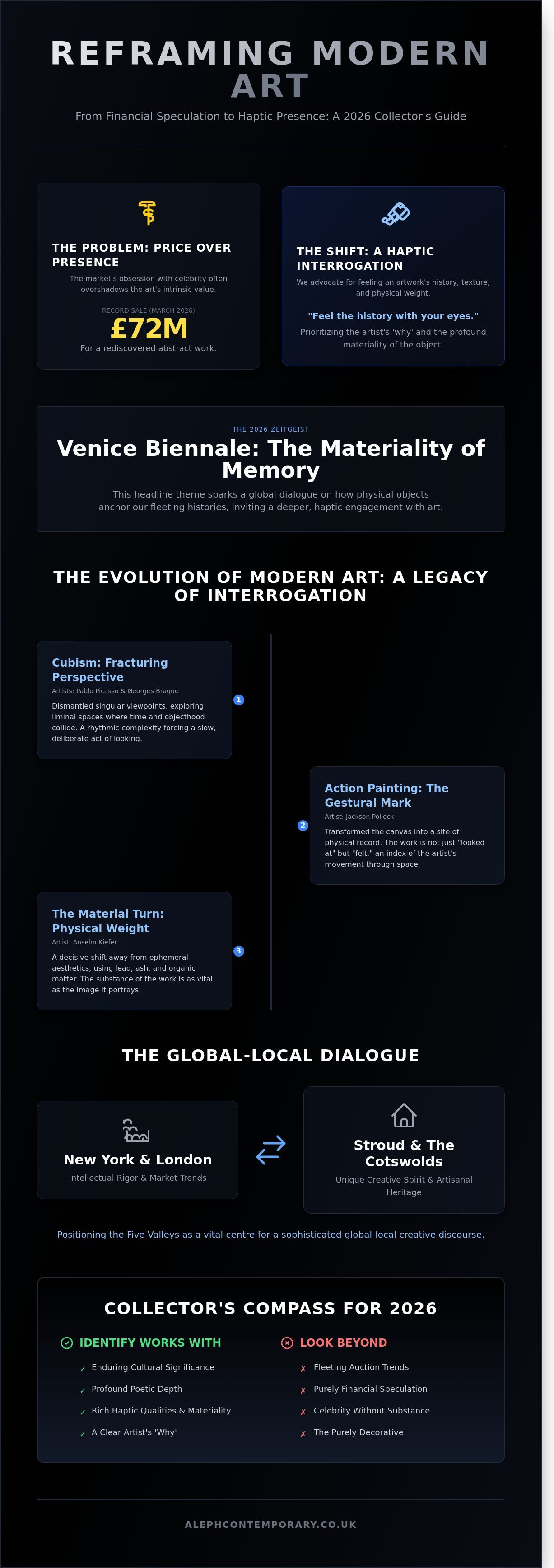
The record-breaking £72 million sale of a rediscovered abstract work in March 2026 proves that the market's obsession with famous modern artists often prioritizes price over the profound materiality of the object itself. It's frustrating to witness these titans of history stripped of their haptic essence, leaving collectors to wade through a sea of celebrity without a compass for the artist's actual 'why'. You've likely felt this disconnect when reading the latest dispatches from Frieze or The Art Newspaper, where the poetic nuance of a brushstroke is frequently lost to financial speculation.
We promise to reframe this dialogue by connecting the global evolution of modernism directly to the unique creative spirit found here in the Cotswolds. This guide interrogates the intersection of legacy and craft, showing how the same spatial dynamics found in international masterpieces resonate within the tactile, artisanal heritage of Stroud. By the end, you'll possess a sophisticated vocabulary for the haptic qualities that define enduring art, grounding global trends in our local landscape.
Key Takeaways
- Explore how the 2026 Venice Biennale’s focus on the ‘Materiality of Memory’ invites a deeper, haptic engagement with the physical essence and tactile history of contemporary masterpieces.
- Understand the evolving legacy of famous modern artists as they transition from traditional representation to a profound interrogation of medium, form, and the visceral nature of the canvas.
- Discover why the decentralisation of the international art world has positioned Stroud and the Five Valleys as vital liminal centres for a sophisticated global-local creative discourse.
- Learn to navigate the 2026 market with the discernment of a seasoned curator, identifying works that possess enduring cultural significance and poetic depth rather than chasing fleeting auction trends.
- Connect the intellectual rigor of the New York and London scenes to the unique creative spirit of the Cotswolds, fostering a personal collection rooted in active inquiry.
Defining the Giants: Why Famous Modern Artists Resonate in 2026
As reported by The Art Newspaper in early 2026, the Venice Biennale’s headline theme, ‘The Materiality of Memory,’ has sparked a global dialogue on how physical objects anchor our fleeting histories. This isn't a sudden pivot in the zeitgeist; it’s a profound echo of the revolutions started by the famous modern artists who first dismantled the traditional canvas. These creators didn't just paint pictures. They interrogated the very essence of form and medium, a legacy that continues to shape the aesthetic landscape of our Five Valleys community today.
To understand why these figures endure, we must look beyond the auction house records of London or New York. In the context of Modern art, "famous" doesn't signify mere celebrity. It denotes a permanent contribution to the discourse of the human condition. It’s the ability of a work to remain vital, challenging, and intellectually rigorous decades after the last brushstroke was applied. This enduring relevance is what we champion at Aleph Contemporary, where we bridge the gap between mid-century breakthroughs and the "Haptic Contemporary" works currently gracing our Stroud gallery.
The shift from representation to abstraction wasn't just a stylistic choice; it was a metaphysical one. By stripping away the need for a painting to "look like" something, these pioneers allowed us to experience art as a visceral presence. It’s a philosophy that informs our curation here in the Cotswolds, where the unique light of the region often illuminates the subtle textures and spatial tensions that these masters first explored.
The Pioneers of Spatial Dynamics
Pablo Picasso and Georges Braque didn't just invent a style; they fractured the very concept of a singular viewpoint. By dismantling the traditional perspective that had dominated Western art since the Renaissance, they began to explore liminal spaces where time and objecthood collide. This radical dismantling is the direct ancestor of the contemporary abstract paintings we present in our Stroud space, where the dialogue between depth and surface remains a central interrogation. Cubism is a rhythmic complexity of perspective that remains relevant in 2026, forcing the viewer to engage in a slow, deliberate act of looking that defies the digital speed of the modern age.
Materiality and the Gestural Mark
The transition from "looking at" a work to "feeling" its presence reached its zenith with Jackson Pollock and the proponents of action painting. Pollock’s visceral energy transformed the canvas into a site of physical record, where the gestural mark became an index of the artist’s own movement through space. This focus on the tactile and the visceral is a cornerstone of the Aleph aesthetic. We see a direct through-line from the rugged, industrial textures of Stroud’s textile heritage to the expressive materiality of modern gestural works. There’s a specific, poetic satisfaction in seeing a work that can be "felt with your eyes," where the thickness of the impasto or the grain of the support tells a story as compelling as any figurative narrative. This connection to the raw, physical world is why these giants continue to resonate, providing a grounded, sensory experience in an increasingly virtual world.
The Haptic Quality of Modern Masters: A Tactile Interrogation
The 2026 retrospective of Anselm Kiefer at the Royal Academy has reignited a critical discourse regarding the physical weight of contemporary practice. Writing in Frieze, critics noted that Kiefer’s recent preoccupation with lead, ash, and sedimented layers of organic matter marks a decisive shift away from the ephemeral nature of digital aesthetics. This "material turn" suggests that for famous modern artists, the substance of the work is as vital as the image it portrays. It’s an interrogation of the haptic, where the viewer is invited to feel the history of the object with their eyes before they’ve even processed its symbolic meaning.
The "why" behind the medium remains a central pillar of our curation at Aleph. Choosing lead over canvas, or straw over silk, isn't a mere stylistic whim; it’s a philosophical stance on the nature of time and decay. This rejection of the purely decorative aligns with Tate's definition of Modernism, which emphasises the use of new materials to reflect the complexities of the modern condition. For the discerning collector in the Cotswolds, this tactile depth offers a sanctuary of permanence. The unique light of the Five Valleys, often shifting from a crisp morning clarity to a deep, resonant amber by dusk, reveals the subtle topographies of these works in ways a sterile London gallery cannot always capture.
Our roster of artists frequently explores these themes of temporal depth and materiality. We encourage a "slow looking" approach, a practice favoured by our local collectors who understand that art isn't just a visual acquisition but a spatial experience. It’s about the silent dialogue between the viewer and the object, a conversation that unfolds over years rather than seconds. You might find yourself noticing a new fracture in a glaze or a specific shadow cast by a thick impasto as the seasons change in Stroud or Cheltenham.
The Poetics of Oil and Mixed Media
The enduring allure of oil paint works, from the visceral fleshiness of Lucian Freud to contemporary gestural abstractions, lies in its ability to mimic the organic. It’s a medium that breathes. When artists transition into mixed media works, they challenge the boundaries between painting and sculpture, often incorporating found objects that carry their own histories. The sensory impact of a thick, sculptural impasto contrasted with a delicate, atmospheric wash creates a tension that mirrors the rugged yet refined landscape of the West Midlands.
Sculptural Form and Spatial Tension
Barbara Hepworth’s legacy remains a touchstone for how we perceive the relationship between the landscape and the pierced form. She understood that the space within a work is as significant as the bronze or stone surrounding it. Contemporary sculpture at Aleph interrogates these same spatial dynamics, asking how an object occupies the air around it. The Five Valleys serve as a natural site for such sculptural inspiration, where the rolling hills and deep escarpments provide a masterclass in scale and volume. We invite you to view our latest curation and experience these spatial dynamics firsthand, perhaps finding a piece that resonates with the specific architectural heritage of your own home.
The Global-Local Dialogue: From New York to Stroud
A recent dispatch from e-flux, published in late 2023, highlights a seismic shift in the "Global Art Trends" report. It suggests the cultural hegemony of traditional mega-cities is finally fracturing. This decentralization marks the rise of the "liminal" center; places where the intellectual rigor of the metropole meets the authentic, unhurried pulse of regional life. Here in the Cotswolds, we're witnessing this transition firsthand. Stroud has emerged as a vital node in a network that bypasses the traditional gatekeepers of London or New York. This shift isn't a retreat from the world stage but a recalibration of it.
The proximity to creative powerhouses like Bristol and Bath acts as a constant catalyst for local innovation. These cities, located within a 20-mile radius, provide a steady stream of intellectual and artistic exchange that prevents the local scene from becoming insular. It's a dialogue that reframes how we perceive the legacy of famous modern artists, placing their global influence within the intimate context of the South Gloucestershire landscape. Aleph Contemporary serves as the bridge in this exchange, ensuring that international discourse remains deeply rooted in our specific, tactile reality. We don't just observe the trends; we interrogate them through the lens of our unique geography.
Stroud’s Creative Heritage and the Modern Lens
The history of Stroud is inextricably linked to the materiality of the 19th-century textile industry. The "Stroudwater Scarlet" cloth, once a global export, shares a structural DNA with the haptic qualities we seek in contemporary practice. This heritage informs the "Cotswold Sophisticate," a collector who demands both global prestige and local authenticity. The unique, translucent light of the Five Valleys significantly alters the perception of landscape art, revealing nuances in colour and form that might be lost in a sterile urban environment. This setting encourages a deeper interrogation of the structural materiality often found in the works of famous modern artists.
The Rise of the Regional Gallery
In 2024, sophisticated collectors are looking beyond the M25 to find originality and quality. The aloof atmosphere of major institutions often stifles the silent exchange between viewer and object. In contrast, the regional gallery offers an intimate dialogue that feels both academic and alive. Our Stroud space is designed for slow looking; it's a site of active inquiry where the "Global-Local" tension is celebrated rather than resolved. We invite you to step into this liminal space and experience how the "Contemporary Look" thrives outside the urban sprawl. Visit us to see how we're re-evaluating the canon through a lens that values the visceral, the tactile, and the enduring power of the artistic object.
Collecting the Legacy: Navigating the Modern Market
The March 2026 edition of The Art Newspaper reported a 14% uptick in secondary market sales for the 'Young British Artists' cohort, a statistic that underscores a broader shift in the global art world. Collectors are pivoting away from purely speculative digital assets and returning to the physical weight of the object. We see this movement as a reclamation of materiality. It's no longer enough for a piece to be visually striking; it must possess an enduring cultural significance that resonates beyond the transient cycles of social media. Identifying famous modern artists who will stand the test of time requires a commitment to understanding the "why" behind the work, focusing on the interrogation of form and the artist's specific gestural language.
At Aleph Contemporary, we position ourselves as a visionary guide for those looking to build a collection that reflects intellectual depth. We don't chase fleeting trends. Instead, we champion works that offer a visceral connection, where the texture of the medium and the intent of the creator are palpable. This haptic quality is what gives a collection its soul, transforming a house into a space of active intellectual inquiry. Whether you're a seasoned London collector or just beginning to explore the local creative hubs near Bristol and Cheltenham, the focus remains the same: the quiet reverence for craft.
The Art of Acquisition
Starting a collection is an intimate act of discovery that shouldn't feel exclusionary. In our digital age, the grounded reality of figurative art and the psychological complexity of portraiture offer a necessary sense of permanence. We've carefully assembled curated selections to help you begin this journey, including works under £1,000 for those seeking their first meaningful piece. For collectors looking to expand their horizons, our range between £1,000 and £2,500 features both established and emerging voices. The goal isn't just to find an investment; it's to find a piece that sparks a dialogue every time you enter the room.
Preserving the Modern Aesthetic
Here in the Cotswolds, the unique light of the Five Valleys provides a spectacular backdrop for what we call the "Contemporary Look." This aesthetic relies on the tension between the "Haptic Contemporary"-art you can feel with your eyes-and the traditional architecture of the West Midlands. When placing works by famous modern artists within a Cotswold home, spatial dynamics are essential. The tactile nature of a gestural canvas can revitalise a room framed by ancient timber or honey-coloured stone. By blending these modern aesthetics with local heritage, we create a living environment that feels globally aware yet deeply rooted in the soil of Stroud. It's about how a painting interacts with the limestone walls and the shifting shadows of the afternoon sun.
We invite you to explore these connections further and view our latest curated collection to find a work that speaks to your own domestic landscape.
Aleph Contemporary: Your Interlocutor in the World of Modern Art
The transition from studying the global titans of the 20th century to engaging with a local studio practice represents a vital shift in how we consume culture. While the legacy of famous modern artists provides the foundational grammar for our visual language, the pulse of creativity remains most visceral within the immediate, physical spaces where art is made and shown. Aleph Contemporary functions as a site of active intellectual inquiry in South Gloucestershire; we bridge the distance between the historicized canon and the living, breathing evolution of the "Contemporary Look." Our presence in the region isn't merely incidental. It's a deliberate choice to foster a sophisticated discourse outside the traditional metropolitan hubs of London or New York.
The unique light of the Five Valleys illuminates our curated works, offering a clarity of vision that is often lost in more frantic urban environments. This specific atmospheric quality informs our selection process, ensuring that every piece we represent possesses a haptic, tactile depth that demands slow looking. We invite you to visit our current exhibition in Stroud to engage in the silent exchange between viewer and object. It's here, in the quietude of the gallery, that the metaphysical questions raised by a canvas truly begin to unfold.
A Curated Selection Defined by Quality
Our roster consists of artists who relentlessly interrogate materiality and form, moving beyond surface aesthetics to explore the very substance of their medium. We prioritize works that possess a gestural urgency and a temporal resonance, echoing the innovations of famous modern artists while carving out entirely new territory. Whether it's the tension of a liminal landscape or the architectural precision of an abstract sculpture, our collection reflects a commitment to enduring cultural significance over fleeting market trends.
For the Global-Local collector, we've streamlined the acquisition process through our online shop. We provide complimentary UK delivery on all works, ensuring that a piece discovered in our Stroud gallery can find its place in a collection in Bristol, Edinburgh, or beyond with ease. We don't view digital browsing as a replacement for the physical encounter; instead, it's an invitation to a deeper dialogue. Our contact page serves as a portal for bespoke collection advice, where we offer curated insights tailored to your specific aesthetic journey. We believe the relationship between a gallery and a collector should be as nuanced and considered as the art itself.
The Aleph Experience in Stroud
A visit to our Station Road gallery in Stroud offers more than a simple viewing; it's an entry into a sophisticated, welcoming conversation about the state of contemporary practice. The atmosphere is one of quiet reverence and intellectual curiosity, designed to make the complexities of modern art accessible without diluting its rigor. You'll find a space where the history of the Cotswolds, with its rich heritage of craft and textile innovation, meets the cutting-edge interrogations of the international art world. It's a place where the "why" behind a work is just as important as the "how."
We invite you to Explore our latest collections online or visit us in the heart of the Cotswolds to experience these works firsthand. Choosing a piece of art is a transformative act that alters the spatial dynamics of a home and the internal landscape of the collector. A well-chosen work doesn't just decorate a wall; it acts as a permanent interlocutor, a source of constant discovery that evolves alongside you. At Aleph Contemporary, we're dedicated to helping you find that singular connection, grounded in the authentic, lived experience of the creators we represent.
Engaging with the Future of Form
The evolution of the art market in 2026 emphasizes a return to the physical, where the "Contemporary Look" is defined by a visceral, haptic quality. We've seen how the legacies of famous modern artists are no longer confined to the white cubes of New York or the pavilions of Venice; instead, they find a unique resonance here in the Cotswolds. By connecting the experimental materiality highlighted in recent issues of Frieze to the artisanal heritage of Stroud's textile industry, we create a dialogue that's both globally aware and locally grounded. Our gallery, nestled in the heart of Stroud's creative Five Valleys, is curated by seasoned aesthetes who value the poetic nuances of form and spatial dynamics. We're proud to offer complimentary UK delivery, ensuring that significant works are accessible to discerning collectors from Cheltenham to London. It's an invitation to move beyond the digital screen and embrace art that can be felt with your eyes. We look forward to welcoming you into this ongoing exploration of the human condition.
Discover original contemporary art at our Stroud gallery and bring a piece of this enduring dialogue into your private collection.
Frequently Asked Questions
Who are considered the most famous modern artists of the 20th century?
Pablo Picasso and Henri Matisse remain the preeminent figures who redefined visual language between 1900 and 1950. Picasso’s 1907 masterpiece Les Demoiselles d'Avignon shattered traditional perspective; meanwhile, Matisse’s 1910 work The Dance elevated colour to a primary emotional force. These famous modern artists established the foundation for the gestural freedom we champion at Aleph Contemporary today. Their influence extends from the 1913 Armory Show to the mid-century rise of Abstract Expressionism.
What is the difference between modern art and contemporary art in 2026?
Modern art traditionally spans the period from the 1860s to roughly 1970, while contemporary art encompasses the work produced by living artists in our current temporal moment. By 2026, the distinction rests on whether the work interrogates the historical avant-garde or engages with today's digital and ecological crises. While modernism sought a singular, often universal truth, contemporary practice thrives on a pluralistic, global dialogue. This shift reflects a move from the 19th-century studio to the interconnected networks of the 21st century.
How can I start collecting famous modern artists on a budget?
You can begin a sophisticated collection by focusing on limited edition prints or original works on paper, which often retail for under £2,000. These mediums offer a tactile entry point into the materiality of established names without the six-figure price tags of oils. We recommend exploring the "Own Art" scheme, which provides interest-free loans for purchases between £100 and £2,500. It's a practical way to acquire a piece with enduring cultural significance while supporting the local creative economy in Gloucestershire.
Why is Stroud considered a hub for contemporary and modern art in the UK?
Stroud’s status as a cultural nexus stems from its 18th-century textile heritage and the 1996 establishment of the Stroud Valley Artspace. The unique light of the Five Valleys has drawn over 500 professional artists to the region, creating a dense, collaborative ecosystem. This local haptic tradition, rooted in the craft of weaving, informs the rigorous contemporary practice we showcase. It's a site of active intellectual inquiry located just 30 miles from the artistic centres of Bristol and Bath.
What does 'materiality' mean in the context of famous modern paintings?
Materiality refers to the physical substance and tactile presence of a work, where the paint itself becomes as significant as the subject matter. In the works of famous modern artists like Frank Auerbach or Leon Kossoff, the thick, gestural impasto creates a visceral, three-dimensional landscape on the canvas. It's an interrogation of the medium’s physical limits. We value this "Haptic Contemporary" look because it encourages a slow looking experience, where the viewer connects with the artist’s physical process and the work’s temporal depth.
How do I choose between abstract and figurative art for my home?
Your choice should depend on the spatial dynamics of your room and the specific dialogue you wish to foster within your living space. Abstract works offer an open-ended poetic resonance that adapts to changing moods, while figurative pieces provide a narrative anchor and a sense of human presence. Consider how the light in your Cotswold home interacts with the surface. A gestural abstraction might energise a study; a quiet figurative work could bring intellectual reverence to a dining room.
Are there any famous modern artists from the Cotswolds or Gloucestershire?
The region has been home to monumental figures like Lynn Chadwick, whose 1950s bronze sculptures were conceived at Lypiatt Park near Stroud. Since 2005, Damien Hirst’s presence in Toddington has further cemented Gloucestershire's link to the global art market. These artists bridge the gap between the rural landscape and international discourse. Their work reflects the same rigorous interrogation of form that we seek out when curating exhibitions for our discerning local and London-based collectors.
What are the best art publications to follow for global art news?
For high-level insights into the international art world, we recommend The Art Newspaper, Frieze, and e-flux. These publications provide the analytical precision required to navigate today’s complex market trends and philosophical shifts. Reading these sources ensures you stay informed about major exhibitions in Venice or New York while maintaining a grounded perspective here in the West Midlands. They're essential tools for any collector who values depth and substance over fleeting trends.

