
Can a work born from a digital matrix ever truly inhabit the same hallowed space as a unique canvas, or is the distinction between a mass-produced poster and a gallery-grade masterpiece becoming increasingly liminal? For many collectors in the United Kingdom, the hesitation is palpable. You've likely stood before a work, captivated by its gestural depth, only to wonder if the vibrancy of these glicée prints will survive the next decade or if they're destined to become ghosts of their former selves. It’s a valid concern in an era where the market is often saturated with ephemeral reproductions that lack the physical gravitas required for serious curation.
We recognise that your investment is as much about the preservation of a creative legacy as it is about aesthetic pleasure. This guide will illuminate the technical sophistication and archival permanence that define the modern glicée process, providing you with the analytical tools to distinguish true curatorial value from mere decorative ephemera. By examining the precise dialogue between light-fast pigments and acid-free substrates, you'll gain the confidence to acquire limited editions that command respect within the contemporary art discourse. We'll navigate the essential protocols for conserving works on paper, ensuring your collection remains a vibrant testament to the human condition well beyond 2026.
Key Takeaways
- Understand the etymological evolution and gestural depth that distinguish gallery-grade reproductions from the flat quality of traditional offset lithography.
- Master the technical benchmarks of archival permanence, from the necessity of acid-free cotton rag substrates to the exacting 300 DPI standards required for authentic glicée prints.
- Discover how limited edition prints by established British contemporary artists serve as a sophisticated entry point for interrogation and investment within a diverse portfolio.
- Learn the precise conservation methods, such as the use of UV-protective glass, required to protect the temporal nature of paper from environmental degradation.
- Explore the curated synergy between subject and medium in our selection of still life and landscape prints, selected with the same rigour as our primary canvases.
Defining the Glicée Print: Beyond the Surface of Reproduction
The term "Glicée" emerged in 1991 when printmaker Jack Duganne sought a name to distinguish high-quality artistic outputs from the utilitarian associations of industrial inkjet technology. Derived from the French verb gicler, meaning to spray or squirt, the word reflects the technical precision of the IRIS printer used during that era. Today, the evolution of Defining the Glicée Print has transformed it from a niche experiment into a cornerstone of the international art market. It represents a sophisticated intersection where the artist’s digital or physical original meets a medium capable of translating every nuanced brushstroke into a lasting physical form.
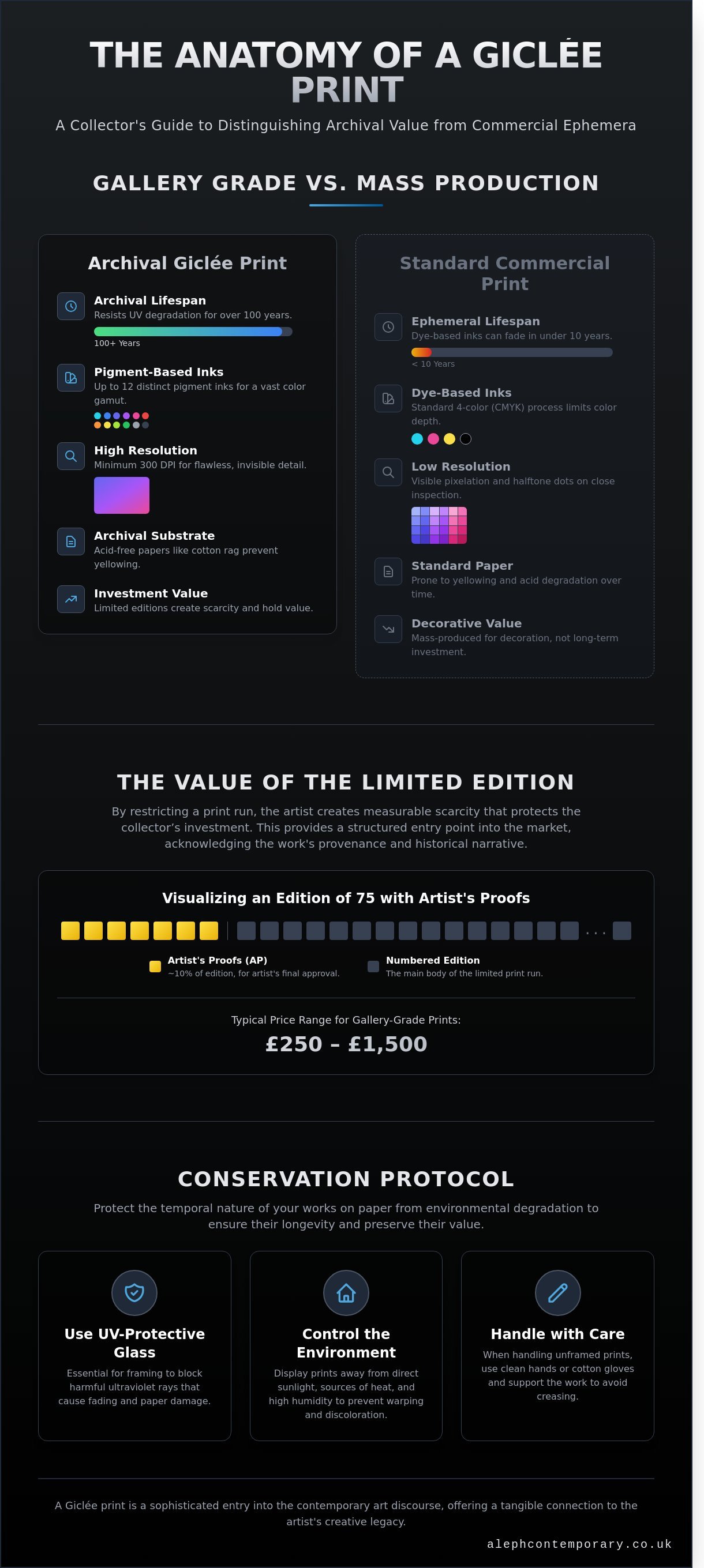
Unlike the flat, mechanical quality of offset lithography, which often relies on a four-colour CMYK process and visible halftone dots, glicée prints offer a gestural depth that mirrors the texture of the original work. Modern systems utilise up to 12 distinct pigment colours, allowing for a chromatic range that captures subtle shifts in light and shadow. This technological fidelity ensures that the print isn't a mere copy; it's a continuation of the artist’s discourse. Contemporary creators frequently choose this medium to engage with a wider audience, ensuring their work exists beyond the walls of a single private collection while maintaining the intellectual rigour of their practice.
The concept of the limited edition functions as a vital vehicle for exclusivity and sustained value. By restricting a run to a specific number, such as an edition of 50 or 75, the artist creates a measurable scarcity that protects the collector’s investment. Prices for these works often range from £250 to £1,500, providing a structured entry point into the market that acknowledges the work’s provenance and its place within the artist’s wider historical narrative.
The Distinction Between Fine Art Prints and Commercial Reproductions
Materiality defines the boundary between a lasting investment and a fleeting image. Glicée prints rely on archival pigment-based inks that resist UV degradation for over 100 years, whereas commercial reproductions often use dye-based inks that fade within a decade. The inclusion of the "artist proof," typically comprising 10 per cent of the total edition, establishes a direct link to the creator’s hand and final approval. A Glicée is a high-resolution digital print using archival pigments on fine art substrate.
A New Language for Art Acquisition
Collecting prints allows for a unique form of cultural participation that democratises the acquisition process without compromising on substance. It offers an emotional resonance, allowing the viewer to own a tangible segment of a larger creative exploration. We view the print as a liminal object, existing in the space between the singular original canvas and the viewer’s personal environment. This accessibility fosters a silent exchange between the artist and the public, where the work becomes a site of active intellectual inquiry. For many collectors in the UK, these prints represent the first step in a lifelong journey of curation, providing a sophisticated way to engage with the transformative power of modern art.
The Alchemy of the Process: Pigment, Substrate, and Permanence
The creation of glicée prints isn't merely a mechanical act of reproduction; it's a sophisticated technical discipline that demands rigorous adherence to specific archival standards. At the heart of this process lies the resolution threshold. While standard commercial printing often falters at lower densities, a true fine art edition requires a minimum of 300 dots per inch (DPI). This density ensures that the digital grid becomes invisible to the human eye, allowing the fluid strokes of a brush or the sharp edge of a charcoal line to retain their ontological integrity. When an image is captured at this high resolution, the resulting print avoids the aliasing and "pixelation" that plague lesser formats, preserving the artist's original intent with startling clarity.
The depth of a print is dictated by its ink system. Traditional printers rely on a four-colour CMYK process, which often fails to replicate the wide gamut of a painter's palette. Professional studios utilise a 12-colour pigment-based ink system. These expanded sets include multiple variations of black, grey, and vibrant chromatic additions that capture the "gestural" nuances of a work. These pigments don't sit on the surface like dye; they bond with the fibres, creating a richness of colour that mirrors the light-absorbing qualities of a physical canvas. It's this specific interaction between light and pigment that grants the work its soul, ensuring that the subtle shifts in tone are felt rather than just seen.
The Significance of Archival Substrates
The choice of paper is a foundational decision in the life of a print. For a work to be classified under the Glicée standard, it must be printed on acid-free, 100% cotton rag or alpha-cellulose paper. This "temporal" consideration is vital; standard wood-pulp papers contain lignin, which eventually breaks down and yellows the work. By contrast, archival substrates are chemically stable. You can learn more about the alchemy of pigment and substrate through research from the Image Permanence Institute, which confirms that these materials are rated to last over 100 years in gallery conditions without perceptible fading.
The "tooth" or texture of the paper influences the viewer’s perception of depth and materiality. A heavy, 310gsm textured paper can mimic the ruggedness of an impasto technique, while a smooth matte finish might suit a delicate watercolour. Collectors often choose between these finishes based on how they want the light to interact with the surface. A satin finish provides a gentle lustre that enhances contrast, whereas a deep matte finish eliminates glare, inviting a more contemplative, "slow looking" experience. These choices aren't merely aesthetic; they're an extension of the artwork's physical presence.
Colour Fidelity and the Artist’s Vision
Achieving true colour fidelity requires a constant "dialogue" between the artist and the master printer. This isn't a "set and forget" process. It involves multiple proofs and adjustments to ensure the digital file translates perfectly to the physical medium. This precision is especially critical when capturing the ethereal layers found in abstract paintings, where the vibration between two similar hues might be the very essence of the piece. The printer must balance the saturation and luminance to ensure the "materiality" of the original work isn't lost in the transition from studio to paper.
The goal is to produce an object that possesses its own gravitas. When the 12-colour system and the archival substrate meet, the result is a piece of art that stands as a definitive statement of the artist's vision. If you're interested in how these technical elements coalesce into a finished work, you might explore our latest curated editions to see these principles in practice. Every print becomes a bridge between the ephemeral moment of creation and the lasting legacy of the collector's archive.
The Role of Glicée Prints in Contemporary Art Discourse
Within the rarefied atmosphere of the contemporary gallery, glicée prints function as a critical bridge between the artist’s most intimate sketches and their monumental canvases. These works allow for a rigorous interrogation of an artist’s visual vocabulary, offering a temporal record of their evolving materiality and conceptual shifts. By examining the nuances of a print, the collector gains a deeper understanding of the gestural precision that defines a practitioner’s style. For the emerging collector, these editions serve as a sophisticated entry point to buy original paintings online in the UK, establishing a foundation of connoisseurship before moving into unique primary works. The investment potential of limited edition prints by established British contemporary artists remains robust; data from the last decade suggests that well-managed editions by mid-career artists can see secondary market appreciation of 15% to 25% within five years of the run closing.
The secondary market, often viewed as a barometer for an artist’s enduring relevance, places a premium on the confluence of rarity and physical integrity. Collectors don't merely look for the image; they seek the assurance of the Certificate of Authenticity (COA) and a pristine provenance. A missing COA can reduce the market value of a print by as much as 40%, as it serves as the definitive proof of the artist’s sanction. The condition of the paper, the vibrancy of the pigment, and the absence of foxing are paramount. To ensure the longevity of these assets, collectors must adhere to rigorous standards regarding the Conservation of works on paper, protecting the materiality of the object from the degradative effects of UV light and fluctuating humidity. This commitment to preservation reflects a reverence for the work that transcends simple acquisition.
Collecting with Intent: Building a Diverse Portfolio
A sophisticated portfolio thrives on the dialogue between different media. Integrating glicée prints from various genres—such as figurative art, sculptures, or even the striking aerial photography of international artists like Eamon Wyss—creates a layered narrative within a private collection. By acquiring editions from those identified as artists to watch in 2026, a year many curators anticipate will see a resurgence in tactile expressionism, the collector secures a stake in the future of British contemporary discourse. This strategic approach ensures a cohesive aesthetic, where the print serves as a rhythmic counterpoint to the impasto of a canvas or the bronze of a bust.
The Ethics of the Edition
The prestige of a print run is inextricably linked to its scarcity. Smaller runs, typically between 25 and 50, command higher prices because they maintain an air of exclusivity. The artist’s signature and the pencilled numbering are not merely marks; they are the artist’s personal guarantee of the work's legitimacy. In a digital age where reproduction is effortless, the transparency of the edition size is vital. Galleries that provide clear, documented histories of their print runs foster a culture of trust, ensuring that the integrity of the artist's vision remains uncompromised by over-saturation.
Conservation and the Temporal Nature of Works on Paper
The physicality of a work on paper is a delicate negotiation with time. When we acquire glicée prints, we aren't merely purchasing a visual representation; we're accepting stewardship of a physical artifact whose materiality remains in constant dialogue with its surroundings. This temporal nature requires a sophisticated approach to preservation. The archival inks and acid-free substrates used in high-end editions are designed for longevity, yet they aren't immune to the slow erosion of environmental neglect. Protecting the "materiality" of the print means acknowledging that paper is a living, breathing medium that reacts to every shift in its microclimate.
Preservation begins with the invisible. Exposure to ultraviolet radiation is the primary catalyst for photochemical degradation, which can lead to the irreversible fading of pigments. Museum-grade glass, providing 99% UV protection, is a non-negotiable standard for the serious collector. Beyond the glass, the internal architecture of the frame must be entirely acid-free. Using pH-neutral mounting boards prevents "acid burn," a yellowing effect that occurs when lignins in cheaper materials migrate into the art paper. When handling unframed works, white cotton gloves are essential to prevent the transfer of skin oils; these oils can cause permanent staining or alter the paper's chemical balance over a 25-year period.
Lighting schemes should be designed with quiet reverence for the medium. Direct sunlight is an aggressive force that no amount of protective coating can fully withstand. The "centre" of a room’s illumination should rely on indirect, diffused light or LED fixtures that emit zero UV heat. Professionals often recommend maintaining light levels below 50 LUX for sensitive works on paper to ensure the chromatic intensity of your glicée prints remains as vivid as the day they left the press.
The Art of Framing: Enhancing the Object
Framing is an act of curation that extends the artist's intent into the physical realm. A contemporary frame shouldn't merely contain the work; it should provide a structural "dialogue" that respects the piece's modern origins. The mount serves as a liminal space, a silent perimeter that allows the image to breathe and prevents the paper from touching the glass. This gap is vital for air circulation. Consulting with a specialist, such as the team at First4Frames Gallery, ensures that the aesthetic choices, such as a deep box frame or a floating mount, reflect the intellectual weight of the artwork while providing a secure, archival sanctuary.
Environmental Considerations for Longevity
Paper is hygroscopic, meaning it absorbs and releases moisture based on its environment. In architectural settings with fluctuating temperatures, this leads to "cockling" or warping. To maintain the flat, pristine surface of a print, collectors should aim for a stable temperature between 18 and 22 degrees Celsius and a relative humidity of 40% to 60%. These figures, established by the Fine Art Trade Guild (founded 1910), are the benchmarks for preventing mould growth and structural tension. Periodic inspections of the frame’s rear seal are necessary to ensure no dust or pollutants have breached the enclosure over time.
Discover how materiality and vision converge by exploring our latest acquisitions. Explore our curated collection of editions
Acquiring Glicée Prints from Aleph Contemporary
At Aleph Contemporary, we apply the same curatorial rigour to our print editions as we do to our primary market canvases. We don't see the medium as a secondary tier of acquisition; instead, it serves as a vital bridge between the artist’s private studio practice and the collector’s living space. Each work is selected for its ability to maintain the integrity of the original’s gestural mark-making and chromatic depth. Our collection of still life and landscape prints reflects a deep commitment to the longevity of artistic ideas. These aren't just images, they're objects of contemplation designed to foster a silent exchange between the viewer and the object.
The gallery functions as a site of active intellectual inquiry where every edition is an interrogation of the artist's original intent. We don't chase fleeting trends. We champion works with enduring cultural significance, ensuring that the glicée prints you acquire today will remain relevant in the decades to come. This steady, contemplative approach encourages you to linger on the work, discovering new poetic nuances within the materiality of the paper and the precision of the ink.
A Curated Selection for the Discerning Collector
Our roster includes artists who treat the digital medium as a sophisticated extension of their creative discourse. By exploring our online shop, you can discover a wide range of works under £1, 000, making high-level contemporary art accessible without compromising on intellectual depth. We ensure every piece meets exacting standards of archival permanence, using lightfast pigments that preserve the artist's specific palette. This commitment to quality means the temporal nature of light captured in a landscape or the delicate textures of a still life remain as vivid as the day they were pulled from the press.
We believe the dialogue between tradition and innovation is central to modern practice. Our artists often blend classical techniques with contemporary technology to create glicée prints that possess a unique, tactile presence. This focus on the "language" of the international art world ensures that every piece in our collection, regardless of its price point, carries the weight of serious artistic interrogation. We provide a platform where the specificities of an artist’s process are celebrated and shared with a global audience of aesthetes.
Your Journey with Aleph Contemporary
The transition from digital discovery to the physical presence of art in your home requires a sophisticated, personalised touch. We provide a bespoke advisory service to help you find a piece that resonates with your existing collection or helps you begin a new one. Whether you're an emerging collector or an established patron, our team offers tailored support to guide your selection. We offer complimentary UK delivery on all orders, ensuring your acquisition arrives with the care its provenance deserves. Our logistics partners are specialists in handling delicate works, providing peace of mind from the moment of purchase to the final installation.
Our role is to act as a visionary guide and a sophisticated cultural interlocutor. We invite you into a high-level conversation about your next acquisition, moving beyond simple aesthetics to explore how a piece functions intellectually within your space. It's more than a transaction; it's a transformative experience that connects the artist’s studio directly to your world. We remain deeply invested in the longevity of the ideas we represent, fostering a community of collectors who value substance and depth.
Embracing the Future of the Archival Object
Collecting art in 2026 demands an appreciation for the delicate synthesis of technological precision and archival permanence. The modern understanding of glicée prints transcends the mere act of reproduction; it fosters a sophisticated dialogue between the artist’s gestural intent and the enduring materiality of cotton rag substrates. These works, when produced to ISO 9706 standards, guarantee a lifespan exceeding 100 years, securing their place within the temporal landscape of fine art. As a premier gallery based in Stroud, Aleph Contemporary remains dedicated to championing established artists whose practices interrogate the very boundaries of the medium. We offer complimentary UK delivery on all orders to facilitate your next acquisition with the same level of care we bring to our curatorial process. It's an invitation to participate in a legacy of artistic excellence and intellectual inquiry. Explore our curated collection of Glicée prints and original artworks. We look forward to helping you discover a piece that resonates with your personal vision.
Frequently Asked Questions
How long do Glicée prints typically last before fading?
Glicée prints typically endure for 100 to 200 years without visible fading when displayed under archival conditions. This longevity stems from the use of pigment-based inks and acid-free substrates, which resist the photochemical degradation common in lesser reproductions. Testing by the Wilhelm Imaging Research institute confirms that these prints maintain their chromatic integrity far longer than standard dye-based alternatives. Such temporal endurance ensures the artwork remains a lasting legacy within a private collection.
Is a Glicée print considered an original piece of art?
A glicée print is a high-fidelity reproduction rather than an original work of art. While the artist oversees the production, the final object is a digital translation of a pre-existing painting or drawing. It functions as a democratic bridge, allowing collectors to engage with an artist’s vision at a different price point. It doesn't possess the unique physical materiality of an original canvas but retains the aesthetic essence of the creator's intent.
What is the difference between a Glicée print and a standard inkjet print?
The primary distinction lies in the archival quality of the materials used. Unlike standard inkjet prints that use four dye-based inks, glicée prints utilise a minimum of 12 pigment-based inks on 300gsm acid-free paper. This technical rigour results in a wider colour gamut and superior lightfastness. Standard prints often degrade within 5 to 10 years, whereas the glicée process prioritises the preservation of the artist’s nuanced tonal range for centuries.
Do Glicée prints hold their value over time?
Limited edition prints often appreciate or maintain their value, particularly when the edition size is restricted to 50 or 100 copies. Secondary market data shows that prints from established contemporary artists can see a 15% to 20% increase in value over a decade. Value's inextricably linked to the artist’s rising profile and the scarcity of the specific run. Collecting these works represents a sophisticated entry into the art market with tangible historical weight.
What should I look for on a Certificate of Authenticity?
A valid Certificate of Authenticity must include the artist's handwritten signature, the specific edition number, and the exact date of production. It should also detail the technical specifications, such as the 310gsm Hahnemühle paper or the Epson UltraChrome HDR inks employed. This document serves as a vital provenance record. Without these 5 key identifiers, the print’s standing within the art historical discourse and its future resale value remain precarious.
Can Glicée prints be produced on canvas as well as paper?
Glicée prints are frequently produced on archival-grade cotton canvas as well as heavy-weight rag paper. Canvas prints offer a tactile materiality that echoes the presence of an original oil painting, especially when finished with a protective UV varnish. Most UK galleries offer canvas options in 400gsm weights to ensure structural integrity over time. This versatility allows the work to exist in various spatial contexts, from traditional frames to contemporary gallery wraps.
How should I clean the glass on a framed Glicée print?
You should clean the glass by applying a small amount of ammonia-free pH-neutral cleaner to a lint-free microfibre cloth. Never spray liquid directly onto the frame, as moisture can seep behind the mount and damage the 100% cotton substrate. A gentle circular motion is sufficient to remove dust or fingerprints. Maintaining the clarity of the 2mm anti-reflective glass ensures the viewer's dialogue with the artwork remains uninterrupted by environmental debris.
Why are limited edition prints more expensive than open editions?
Limited edition prints command higher prices because their scarcity is strictly controlled and verified by the artist. When an edition's capped at 25 or 50 prints, the rarity creates a competitive market environment that open editions lack. Each print is often hand-signed and numbered, representing a direct connection to the artist’s studio. This exclusivity, combined with the 25% higher production costs for bespoke archival runs, justifies the premium price in the professional art world.

